
Farah Zahir
Oniket Research Group
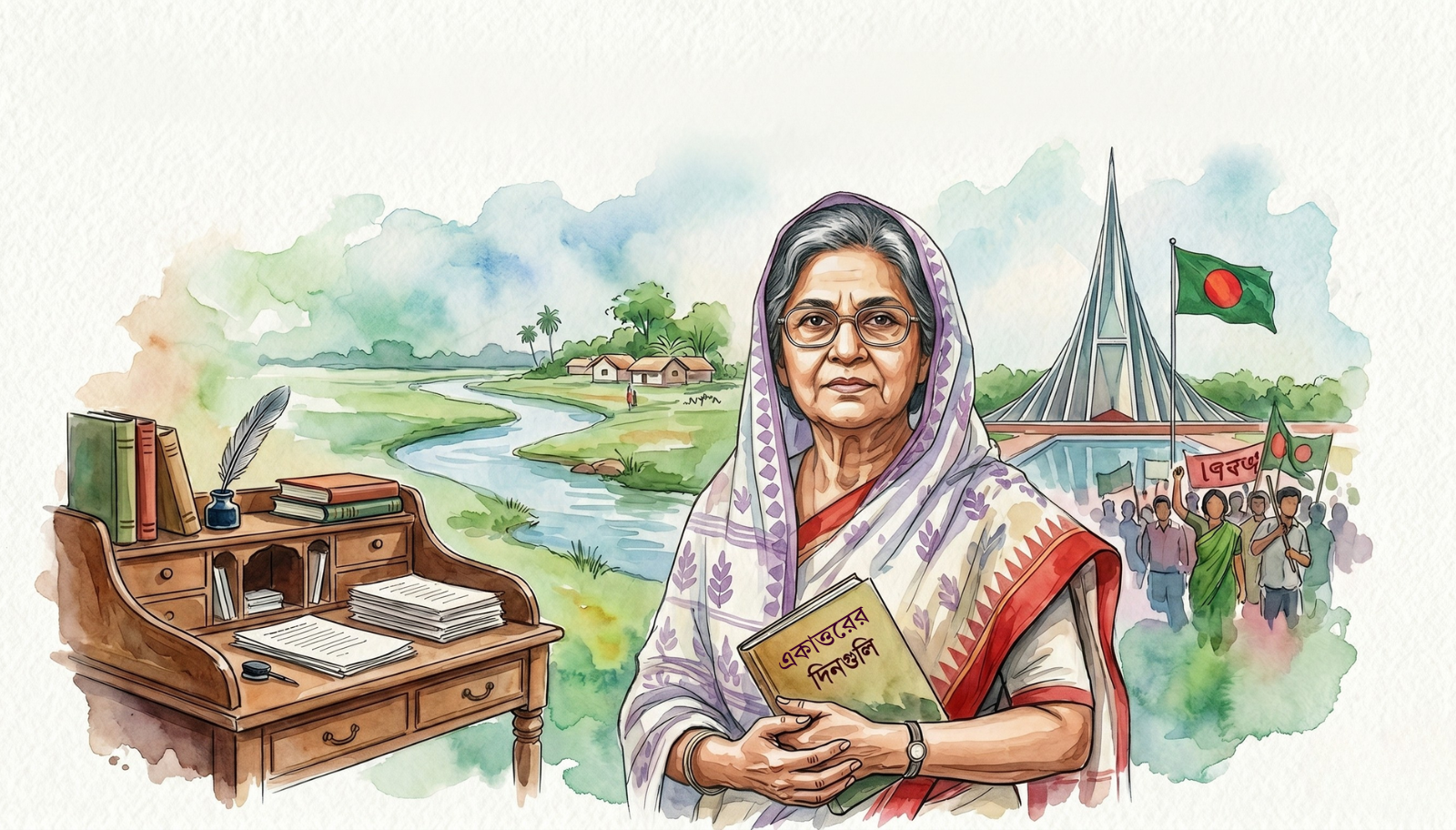
In the annals of Bangladesh’s Liberation War, a select few names have been enshrined in history for their remarkable contributions. Among these illustrious figures, the name Jahanara Imam stands out as a beacon of excellence and distinction. She was not merely a writer or the mother of a martyr; she was the conscience of a nation, an inspiration to a generation, and an indefatigable guardian of the spirit of the Liberation War.
The nation takes pride in her birthday, for she was, like the rest of us, a great Bangladeshi who cherished the spirit of the Liberation War.
Jahanara Imam was born on 3rd May 1929 in the fertile land of Bangladesh. From a very early age, she displayed an exceptional aptitude for learning and developed herself in the realms of education, literature, and social thought. Despite embarking on her professional journey as an educator, her aptitude transcended a singular identity, encompassing a multifaceted range of competencies. She functioned as an author, an organiser, and a courageous voice for national consciousness. During the 1971 Liberation War, her only son, Shafi Imam Rumi, was martyred for his country. From that moment onward, the personal grief and national sorrow of the subject became intricately intertwined in her life. This noble woman, honoured with the title “Shahid Janani” (Mother of the Martyrs), passed away on 26 June 1994. Nevertheless, her ideals and legacy persist.
Days and Nights of ’71: A Living Document of History
Jahanara Imam’s most significant accomplishment is indisputably ‘Days and Nights of ’71’. This diary, which was written in 1971, is an exceptional human document concerning the Bangladesh Liberation War. The book is not a tedious history text; it is the most harrowing chapter in the nation’s history, as seen from the perspective of a mother. The narrative of her son Rumi’s participation in the war of independence, his subsequent imprisonment, and eventual martyrdom is presented by the author with such detachment and courage that the reader is moved to tears and fortified at the same time. Patriotism is expressed not only as an emotion but also as an active duty on every page. It is widely regarded as one of the most distinguished examples of war literature in the Bangla language.
Living with Cancer: A Portrait of Human Courage
In her work ‘Living with Cancer’, Jahanara Imam employs a remarkable combination of honesty and fearlessness in her depiction of a protracted illness. This is indicative of a resolute spirit that remained steadfast in its convictions and its sense of duty to its nation, even in circumstances where personal sacrifice was imminent.
Notwithstanding the physical discomfort, she persisted in her writing and continued to move. The book instructs the reader on how to maintain human dignity and courage in life’s most arduous trials. This text is not merely a description of an illness; it is a story of philosophical defiance, where a person does not waver from their principles, even in the face of death.
Another Life:
The present volume constitutes an autobiography, in which the author, Jahanara Imam, recounts the events and experiences that have shaped her life, including both the challenges she has faced and the personal growth she has undergone. The narrative in question chronicles the arduous journey of a female protagonist in the process of forging her own identity, overcoming the considerable societal barriers that stand in her way. The author has opted for a straightforward and unadorned style, eschewing verbosity and prolixity in favour of a lucid and unembellished narrative voice.
A close reading of the book in question reveals that her patriotism was not a sudden reaction. This was the culmination of a protracted period of introspection and the establishment of a robust foundation in humanistic values.
Jahanara Imam’s patriotism was not merely a matter of rhetoric; rather, it was a philosophy of life that was manifest in her actions. The subject did not confine her grief over the loss of her son to a personal sphere; instead, she transformed that sorrow into a force for the national movement. In 1992, she established a People’s Court to demand the trial of war criminals, and even on her deathbed, she fought with a sedition case hanging over her. Her literary works and personal history convey the notion that patriotism signifies more than mere participation in parades; it embodies the willingness to make the ultimate sacrifice in the pursuit of truth and justice. He posited that a nation’s true strength does not lie in its armaments, but rather in the courage of its conscientious citizens.