
Desk Report
Oniket Desk
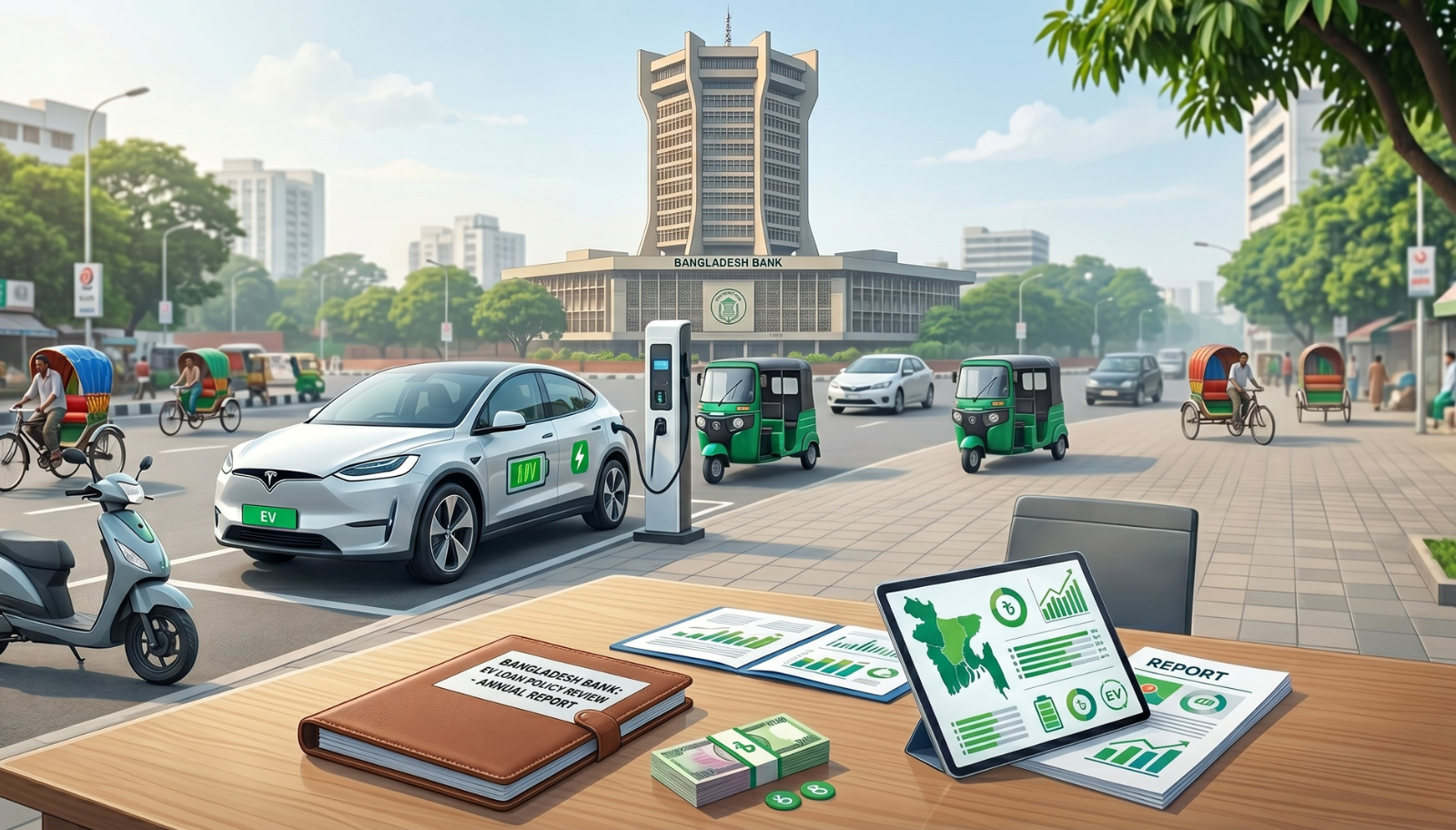
On 5 May 2026, Bangladesh Bank(BB) issued a revised circular under the Bank Company Act, 1991, raising the auto loan ceiling for electric and hybrid vehicles to Tk 80 lakh per individual. This is a significant Tk 20 lakh premium over the Tk 60 lakh cap applicable to conventional vehicles. The directive also introduced a more lenient debt-equity ratio of 80:20 for EV and hybrid purchases, compared to the 60:40 requirement for standard automobiles, and doubled the unsecured personal loan ceiling from Tk 5 lakh to Tk 10 lakh.
Positioned as part of a broader ‘green transport push,’ the policy merits rigorous scrutiny, particularly given that Bangladesh’s EV sector remains entirely import-dependent, operating without any meaningful domestic manufacturing base.
Policy Context and Stated Rationale
The BB circular arrives in the context of a coordinated government effort to accelerate the energy transition. Days prior to the circular, the cabinet approved sweeping duty exemptions on electric buses and trucks, with all customs duty, regulatory duty, supplementary duty, advance tax, and advance income tax waived for new electric buses with a minimum of 17 seats, leaving only a 15 percent VAT. The BB itself justified the revised loan limits by citing rising automobile prices, growing consumer demand, and the imperatives of shifting towards energy-efficient transport.
The urgency appears amplified by Bangladesh’s current fuel crisis: supply disruptions linked to the US-Israeli conflict in Iran have caused severe petrol shortages, exposing the acute vulnerability of an economy almost entirely dependent on imported fossil fuels. Against this backdrop, the energy diversification logic is understandable. However, a coherent rationale does not automatically translate into sound policy design.
An Import-Dependent Sector: The Core Structural Problem
The most fundamental weakness of the policy lies in its failure to distinguish between incentivising a green transition and subsidising import demand. Bangladesh’s EV sector has no significant domestic production. Data from the National Board of Revenue show that only 178 EVs were imported in FY2024–25 and a mere 82 units in the first half of FY2025–26, reflecting negligible market penetration ( Bangladesh Lags in EV Adoption despite Global Surge, 2026 ).
While Bangladesh Auto Industries Ltd has constructed a factory spanning 100 acres in Chattogram’s National Special Economic Zone with an investment of Tk 1,440 crore, production has not yet commenced due to delays in gas connections. Runner Automobiles’ recently signed agreement with China’s BYD to explore local assembly is still at the exploratory stage. In this context, the BB’s enhanced loan facility essentially channels credit into the demand side of a market where the entire supply chain is sourced abroad, ranging from battery packs to assembled vehicles. Every Tk 80 lakh loan drawn down to purchase an EV represents an equivalent outflow of foreign exchange, directly worsening the current account balance.
The country’s vehicle market already contracted to a 10-year low in 2024, with vehicle registrations falling to approximately 3.08 lakh units, largely due to the very foreign exchange constraints that expansive import-linked consumer lending will further aggravate.
Economic Implications: Trade Deficit and Foreign Exchange Stress
Bangladesh imported USD 387 million worth of cars in 2024, underlining the existing pressure of automobile imports on foreign exchange reserves ( Cars in Bangladesh Trade | The Observatory of Economic Complexity, 2026 ). Liberalising credit access for EV purchases, without a corresponding push to localise EV manufacturing, risks channelling foreign exchange into imports of high-end consumer goods, directly contradicting the objectives of reserve stabilisation that have preoccupied the Bangladesh Bank in recent years.
Industry voices have explicitly warned that tax incentives should favour local production and assembly over imports. The president of the Bangladesh Automobile Assemblers and Manufacturers Association noted that policy stability protecting domestic investment in EV assembly could generate employment and build backward linkage industries. This outcome diametrically opposed to the import-stimulating logic of the current credit incentive. Furthermore, high duties on imported components, currently around 61 percent, continue to disadvantage local assemblers, suggesting that the regulatory environment is pulling in contradictory directions simultaneously.
Banking Sector Risks: Leverage, Liquidity, and Concentration
The revised debt-equity ratio of 80:20 for EV loans is a structurally risky provision. By requiring borrowers to contribute only 20 percent of the vehicle’s cost as equity, it materially increases bank exposure to collateral that is both depreciating and, in Bangladesh’s nascent EV ecosystem, highly illiquid. Should EV resale markets fail to mature, a likely outcome given the country’s underdeveloped charging infrastructure and the thin volume of registered EVs, estimated at just over 400 units as of April 2024 ( EV Adoption in Bangladesh: Market Dynamics & Energy Readiness, 2025 ). Banks holding these loans could face significant non-performing asset accumulation. This concern is compounded by the simultaneous doubling of unsecured personal loan limits. While the BB has directed banks to ensure that consumer loan growth does not exceed overall loan growth, this safeguard is permissive rather than restrictive, leaving substantial discretionary space for aggressive retail lending. Bangladesh’s banking sector already contends with elevated non-performing loan ratios; further relaxation of consumer credit standards introduces incremental systemic risk.
Social Equity and Cost of Living
The distributional profile of this policy is deeply regressive. A Tk 80 lakh loan ceiling, even at a favourable debt-equity ratio, implies vehicle costs well above Tk 1 crore, placing EV ownership firmly in the domain of upper-middle-class and wealthy Bangladeshis.
The country’s vehicle market collapse in 2024 was driven precisely by the inability of the middle class to absorb high vehicle prices amid stagnating incomes, soaring import costs, and double-digit lending rates. The BB circular offers no concessions to lower-income segments seeking affordable green mobility, such as electric three-wheelers or electric two-wheelers, vehicles with far greater social reach and economic relevance.
The doubling of unsecured personal loan limits from Tk 5 lakh to Tk 10 lakh, while nominally broadening access to credit, risks stoking consumer price inflation in an economy already under inflationary pressure. Increased household borrowing without commensurate income growth typically reduces net disposable income once debt servicing obligations are factored in, effectively raising the real cost of living for borrowing households.
Policy Alternatives and Recommendations
A more structurally coherent green transport policy would condition credit incentives on the degree of domestic value addition, offering preferential loan terms only for EVs assembled or manufactured within Bangladesh, thereby linking credit expansion to productive investment rather than pure import demand. Simultaneously, reducing duties on EV components (currently at around 61 percent) would make local assembly economically viable and stimulate the backward linkage industries that can generate employment at scale.
For the broader public, channelling green finance towards electric three-wheelers and public transit electrification would deliver greater environmental and social returns per taka disbursed, consistent with the World Bank’s finding that developing countries gain the most from e-mobility through electric buses and two- and three-wheeled vehicles.
Bangladesh Bank’s Tk 80 lakh EV loan ceiling, while well-intentioned in its green ambitions, is a policy instrument poorly matched to Bangladesh’s structural realities. By incentivising demand for a product that the country cannot yet produce domestically, the circular risks worsening the trade deficit, increasing foreign exchange outflows, raising banking sector exposure through elevated leverage ratios, and concentrating its benefits among the affluent, while leaving the cost-of-living burden on ordinary borrowers unchanged or worse.
The fuel crisis that lends this policy to its urgency demands precisely the kind of structural transformation, that includes domestic EV manufacturing, charging infrastructure development, and public transport electrification. Easier consumer credit for imported luxury vehicles cannot deliver these. A more deliberate sequencing of supply-side industrial policy before demand-side credit liberalisation would have been considerably sounder.
References
Bangladesh lags in EV adoption despite global surge. (2026). http://economicexpress.net/news/16707?ln=en
Cars in Bangladesh Trade | The Observatory of Economic Complexity. (2026). https://oec.world/en/profile/bilateral-product/cars/reporter/bgd

