
Desk Report
Oniket Desk
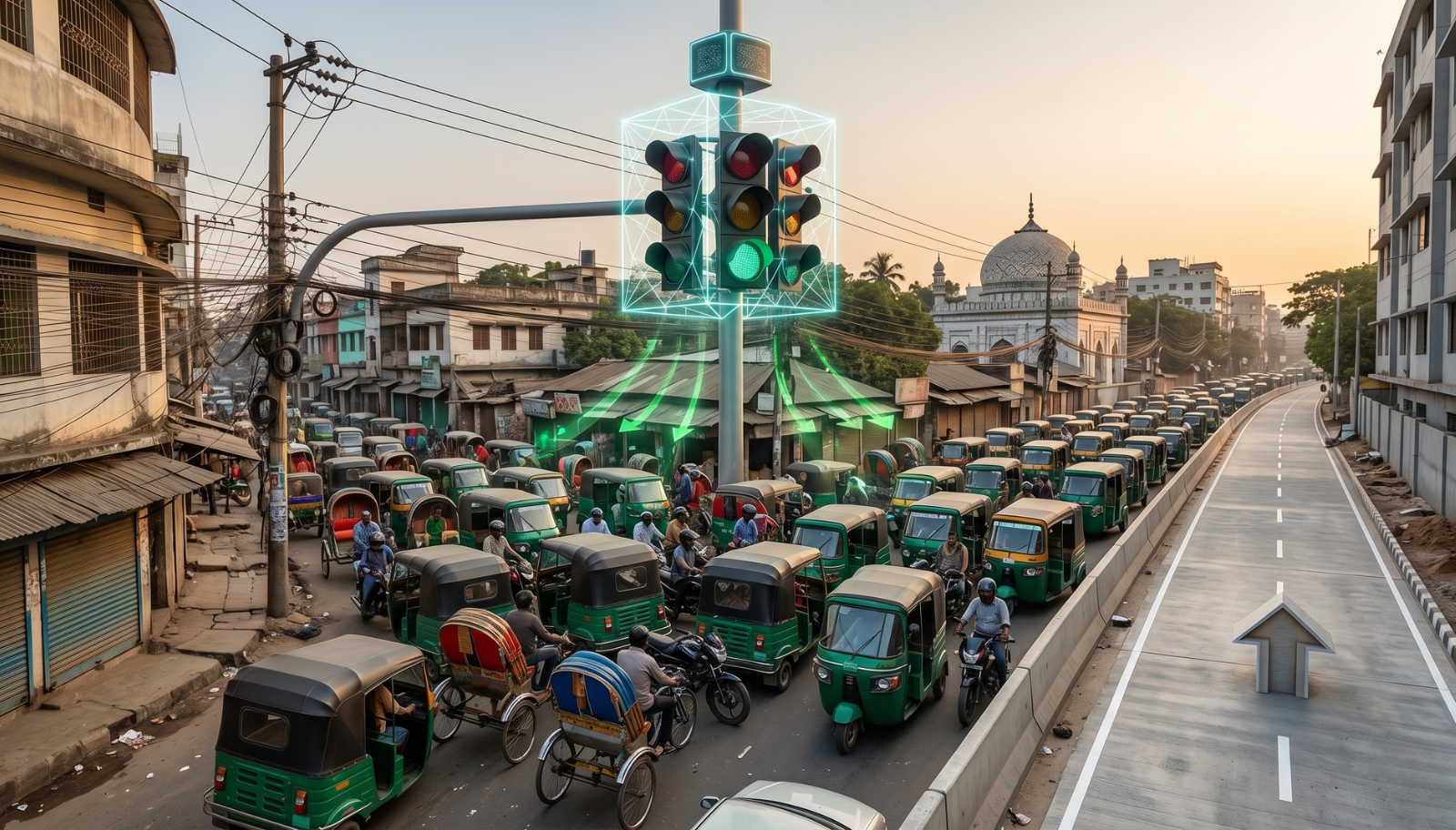
Bangladesh has taken a significant step toward modernising its chronically dysfunctional urban traffic management system. In March 2026, Prime Minister Tarique Rahman presided over a high-level cabinet meeting on reducing traffic congestion in Dhaka, from which a package of landmark decisions emerged. Among the most consequential: 120 traffic signals in the capital are to be progressively automated using locally developed technology, city buses are to be placed under GPS tracking, and railway crossings within the city are to receive automated signal lighting systems alongside manual controls.
Reinforcing this direction, the Dhaka Metropolitan Police (DMP) in early May 2026 activated an AI-based automated traffic enforcement and case-generation system, deploying AI-integrated CCTV cameras at approximately 500 key junctions across the city to detect violations including red light jumping, speeding, and the improper use of mobile phones while driving. The system, operating under the DMP’s Traffic Division, recorded over 200 violations within its first day of operation. For a city consistently ranked among the world’s worst for traffic management, these initiatives represent a genuine and overdue shift in ambition.
Why Optimism Must Be Tempered
Bangladesh’s history with traffic technology investments, however, counsels caution. Dhaka-South City Corporation spent Tk 119 crore over fifteen years on successive generations of traffic signal systems, including digital lights, countdowns, solar powered panels, remote controlled signals. All of these became non-functional within months of installation, primarily due to poor maintenance, lack of road discipline, and the absence of enforcement. Experts from the Bangladesh University of Engineering and Technology (BUET) have stated plainly that no digital initiative will succeed unless the fundamental conditions for a functioning traffic system are first established. These include (but not limited to) lane discipline, segregated motorised and non-motorised vehicle lanes, and adequate road capacity.
The structural challenges are formidable. Dhaka’s roads account for less than 10 percent of the city’s total area that is far below the internationally recommended 20 to 25 percent minimum. And even that limited network is perpetually encumbered by uncontrolled parking, hawker encroachments, and the absence of coordination among the multiple agencies sharing jurisdiction. For the two city corporations, DMP, BRTA, BRTC, the Roads and Highways Department, and the Dhaka Transport Coordination Authority, AI-powered cameras could potentially excel at detecting violations. But they cannot, by themselves, compel motorists to follow lanes that do not effectively exist, or enforce signal compliance on roads where the physical infrastructure of signalling remains inconsistent.
Cybersecurity and data governance represent additional vulnerabilities that the current initiative has not yet addressed publicly. A city-wide network of AI surveillance cameras generates enormous volumes of sensitive data. Without a robust data protection framework, clear protocols on data retention, access, and misuse prevention, and resilient cybersecurity architecture, the system carries risks of privacy violation and systemic exploitation.
Reforms That Must Accompany Technology
For the AI traffic initiative to succeed where its predecessors have failed, it must be embedded within a comprehensive and simultaneous reform agenda. Four priorities are critical.
First, institutional coordination must be resolved before technology is scaled. A single apex authority, potentially a strengthened Dhaka Transport Authority, must be empowered with a clear mandate, adequate resources, and jurisdictional authority over all stakeholders to eliminate the fragmentation that has historically paralysed implementation.
Second, physical road infrastructure must be upgraded in parallel. AI signalling systems are calibrated on assumptions of lane discipline and defined vehicle classifications. Until Dhaka’s roads are physically redesigned to separate vehicle types, impose parking controls, and clear illegal occupations, the AI system will be processing chaotic inputs and producing unreliable outputs.
Third, maintenance and technical sustainability must be institutionalised. A dedicated technical unit within each city corporation (staffed by trained engineers and adequately funded through a ring-fenced maintenance budget) must be established as a precondition for any deployment, not an afterthought.
Fourth, public awareness and behavioural change campaigns must run concurrently with enforcement. AI-based prosecution is a deterrent tool, not a behavioural transformation tool. Sustained public education on traffic law, paired with consistent and visible enforcement, is necessary to shift the deeply entrenched norms that make Dhaka’s traffic uniquely resistant to technological intervention.
Bangladesh’s AI traffic initiative is the right idea. Ensuring it does not become yet another costly cautionary tale requires the political will to reform the system around the technology, not merely install the technology within an unreformed system.