
Naima Onamika
Oniket Research Group
The article titled “Rethinking healthcare for children in the CHT” by Sumit Banik, recently published in The Daily Star, has once again brought attention to the issue of child healthcare in the Chittagong Hill Tracts. It is time to rethink how far healthcare services are truly reaching the countless children living in these remote hill communities and what should actually be done to address the situation.
If we look at the reality on the ground, a child’s illness in the vast hilly regions of Bangladesh is not merely a family hardship; it becomes a severe test of time, distance, poverty, and the limitations of the healthcare system. Particularly in the remote areas of Bandarban, a child falling ill often marks the beginning of uncertainty, anxiety, and struggle for an entire family. The recent child deaths in Alikadam and fears surrounding a measles-like outbreak have once again exposed this harsh reality.
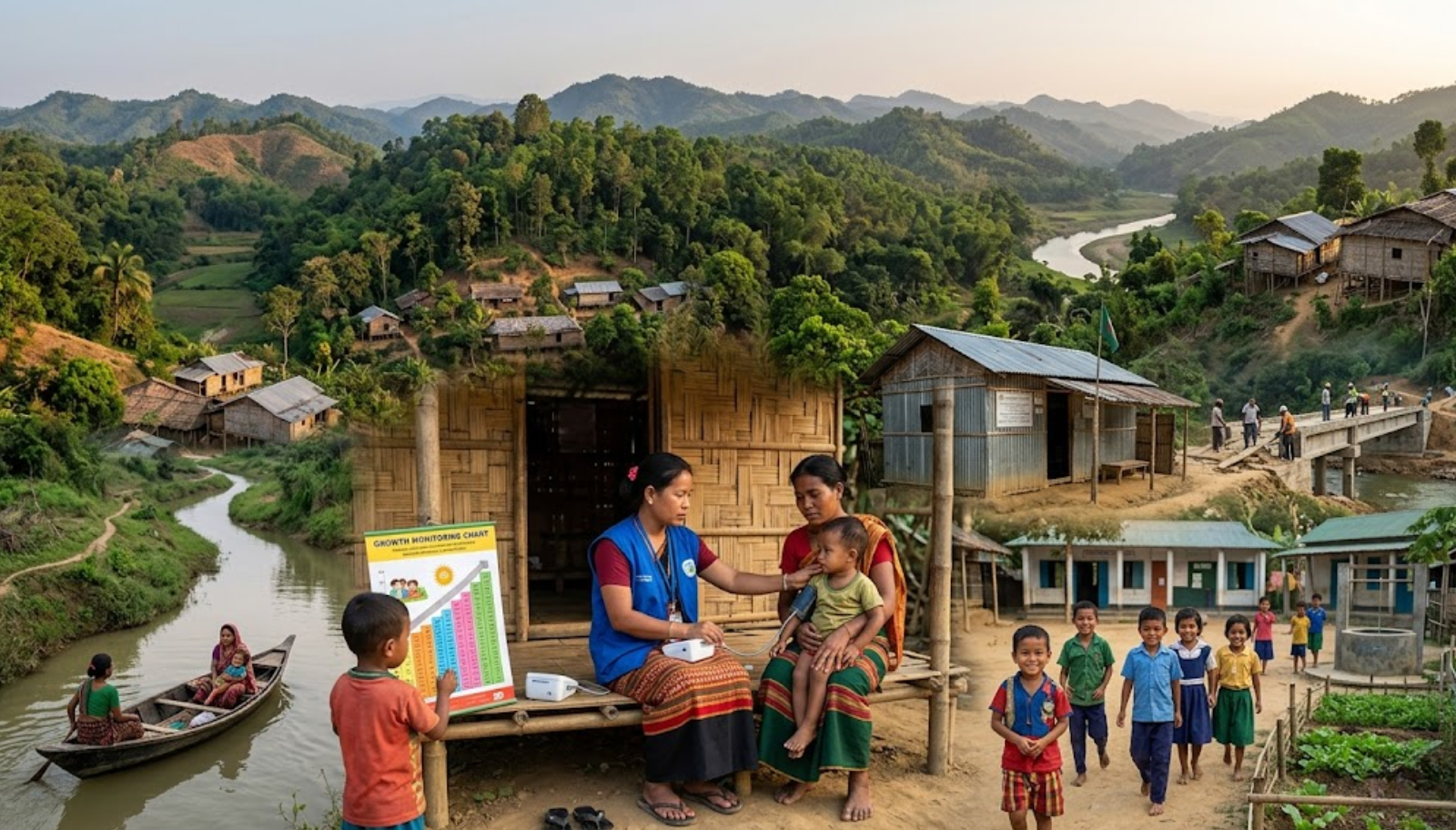
For the Mro, Marma, and other indigenous communities living in the Chittagong Hill Tracts, access to healthcare remains a major challenge. Many families must walk for hours across difficult mountain terrain just to reach the nearest health facility. In some places, travel requires boats; elsewhere, motorcycles; and in many cases, only walking is possible. This long journey is not only time-consuming but also financially overwhelming for many families. As a result, many are compelled to rely on local and traditional healing practices, which, in most cases, are not sufficient.
Conventionally, the solution to this problem may appear simple, building more hospitals, appointing more doctors, or expanding infrastructure. However, the geographical reality of the hill tracts is so distinct that these traditional approaches are not always effective. A separate strategy is required, one that takes into account the lifestyle, communication barriers, and practical realities of life in the hills.
One of the most effective ways to address this crisis could be bringing healthcare services directly to the people. Through regular mobile health units, vaccination services, maternal and child healthcare, and primary treatment facilities can be delivered directly to remote unions. If healthcare workers visit these areas according to a fixed schedule, it will gradually build trust among local communities and encourage them to seek medical care when needed.
At the same time, it is extremely important to develop healthcare workers from within the local communities themselves. By training local young people as community health workers, they can more easily identify the early signs of illness and quickly refer patients when necessary. Since they are familiar with the local language and culture, people are also more likely to trust them.
However, one of the greatest challenges remains the lack of emergency transportation. When a child’s condition suddenly worsens, there is often no quick way to transport them to a medical facility. Travel through hilly terrain is both difficult and expensive. In this context, motorbike ambulances, community-based emergency funds, and rapid communication systems are urgently needed.
Traditional healthcare practices should not be dismissed entirely; rather, they should be viewed with importance. The trust of local communities has long been rooted in these systems. Therefore, instead of excluding them, integrating traditional practices with modern healthcare could produce positive outcomes. If traditional healers are trained to identify dangerous symptoms, they can help refer patients to health centres more quickly.
Different approaches are also necessary to improve health awareness. Language itself is a major factor here. Urban language or conventional awareness campaigns are often ineffective among hill communities. Health messages are more likely to be accepted if they are communicated through local languages, storytelling methods, and community-based communication systems.
Finally, I would say that the Chittagong Hill Tracts require a specialized healthcare policy. A single healthcare strategy for the entire country is neither sufficient nor fully applicable to the realities of this region. Without a special budget, long-term planning, and effective coordinated initiatives between the government and private sectors, a lasting solution to this crisis will not be possible.
A child in Alikadam should not face life-threatening risks simply because of where they were born. Healthcare is not a luxury; it is a fundamental right. Therefore, the children of the hill tracts deserve a healthcare system that does not merely provide treatment but truly stands beside them when they need it most.
Keep reading… Public Health Programmes: Present and Future
Alarming spread of measles: why is transmission not stopping despite ongoing vaccination?