
Siddique Bappee
Oniket Research Group
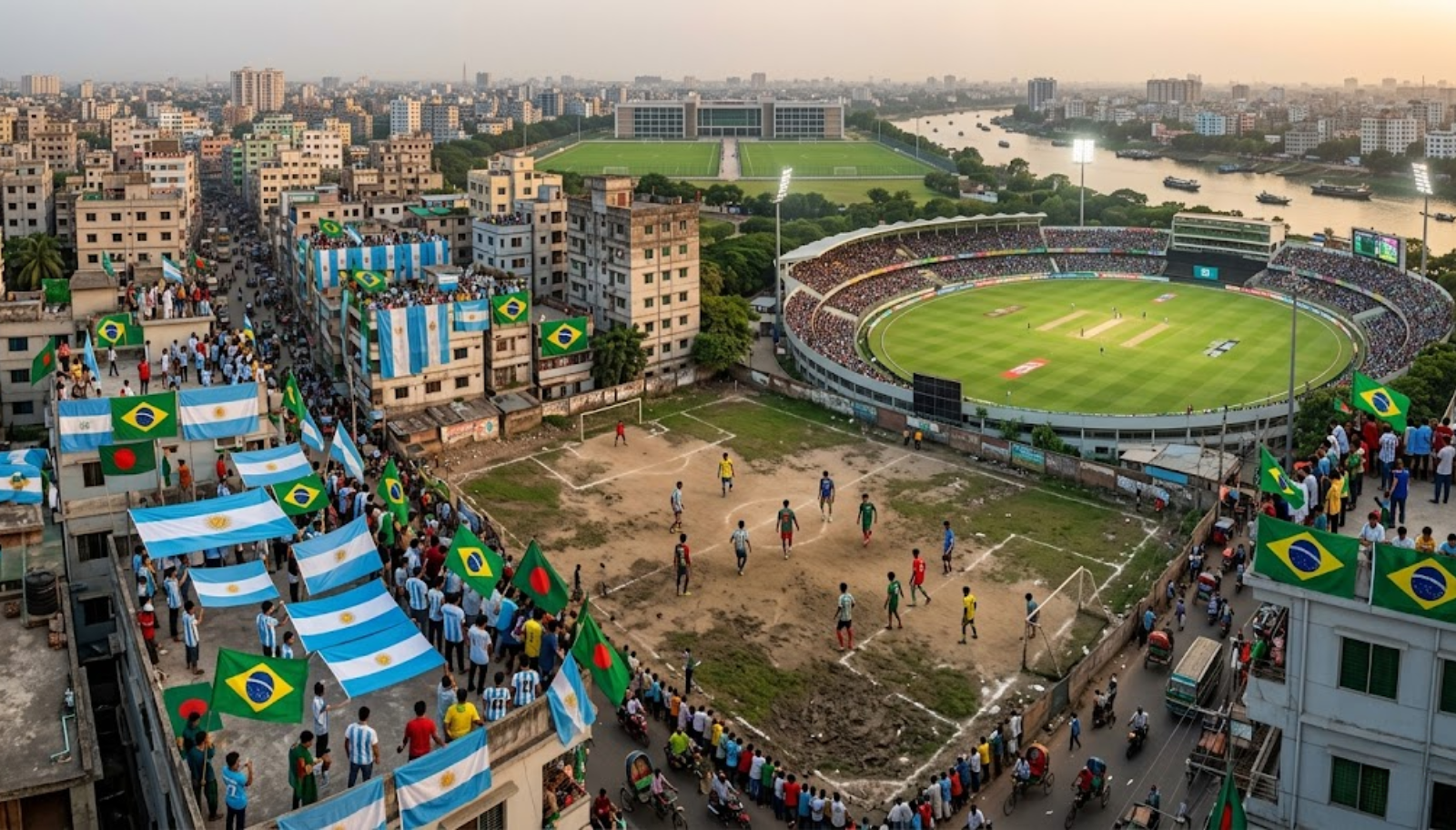
Every four years, Bangladesh erupts in football fever. Neighbourhoods are painted in Argentine blue and white or Brazilian yellow and green. Rooftop flags outnumber those of the national colours. Millions stay awake through the night to watch matches played on other continents between teams they will never see in person.
The intensity of this passion is genuine and remarkable. Its tragic dimension is equally genuine: a nation of 170 million people, mad for football, watches the sport entirely as spectators of others’ glory… because Bangladesh itself, ranked persistently among the lowest FIFA-rated nations in the world, has never come close to qualifying for a World Cup and rarely advances meaningfully even within the regional SAFF Championship.
The Weight of the Rankings
Bangladesh’s FIFA ranking has hovered in the 180s for most of the past decade. This is a position that places the national team below nations with populations smaller than a single Bangladeshi district and with a fraction of the economic resources.
Neighbours with comparable development histories have pulled decisively ahead. India, once an equally modest football nation, has climbed into the top 100, driven by sustained investment in the Indian Super League, a professional domestic ecosystem, and structured youth development. Nepal, with a fraction of Bangladesh’s population and resources, has regularly outperformed Bangladesh in recent SAFF tournaments. The gap is not explained by geography, genetics, or football culture. It is explained by decisions involving institutions, finance, and politics that Bangladesh has consistently made poorly.
Why Bangladesh Fails
The Bangladesh Football Federation is the proximate cause of much of the national team’s sustained underperformance. The BFF has for years been governed through a committee structure that rewards political loyalty and personal connection over football competence. Selection of coaches, allocation of development budgets, management of domestic league affairs, and engagement with FIFA and AFC programmes have all been shaped by the internal politics of an organisation that has never fully functioned as a professional sports administration body. Coaching appointments were inconsistent, where foreign coaches brought in at expense and then removed before their development programmes could bear results, replaced by interim arrangements that provide continuity of mediocrity.
The domestic league (the Bangladesh Premier League in football) suffers from quality, credibility, and financial fragility problems that undermine its function as a talent development pipeline. The traditional giants of Bangladeshi club football, Abahani and Mohammedan, carry enormous historical prestige and passionate supporter bases but have not been able to sustain the professional infrastructure, youth academies, and scouting networks that comparable clubs in India, Thailand, or Vietnam now maintain as standard. Talented young players in Bangladesh develop in an environment that does not push them hard enough, expose them broadly enough, or compensate them reliably enough to make football a rational career choice over more stable alternatives.
Cricket’s dominance in the national sporting imagination compounds every other structural problem. Sponsorship, media coverage, government attention, and parental aspiration all flow overwhelmingly toward cricket, leaving football to compete for a secondary share of resources in a country where resources for elite sport development are limited to begin with. A talented fourteen-year-old athlete in Bangladesh today receives a clear and consistent signal from every social institution around them: cricket is where the investment is, where the contracts are, and where the national pride concentrates. Football development cannot simply wish this reality away. It must compete with it structurally.
What the Government Must Do
The government must enforce genuine governance reform at the Bangladesh Football Federation as a condition of continued public support and national affiliation. This means separating BFF leadership from political patronage networks, instituting transparent financial reporting, and requiring professional football administration credentials for executive positions. FIFA’s own governance standards, which the BFF is technically obligated to meet, provide a ready-made reform framework that has simply not been enforced.
A National Football Academy must be established with a residential, professionally staffed institution that identifies talented players between the ages of twelve and sixteen from across all eight divisions of the country and develops them under full-time professional coaching. Bangladesh produces athletes. The pipeline from raw talent to international standard performance does not exist in any functional form. India’s AIFF Elite Academy and Japan’s youth system models both demonstrate that this infrastructure can be built within a decade and produce measurable national team improvement. The government has built physical infrastructure for far less strategically consequential purposes.
In addition, school-level football must be formalised as a national sports curriculum component, with district competitions, standardised coaching certification for physical education teachers, and a structured pathway from school tournaments to divisional and national youth teams. The talent pool in a nation of 170 million is vast. The mechanisms to identify and develop it are virtually absent. Building those mechanisms at the school level is the highest-return investment available in Bangladeshi football, and it costs a fraction of what a single stadium renovation or foreign coaching contract demands.
Bangladesh’s football fever is real. What it has lacked, for generation after generation, is not passion; it is the institutional seriousness to match passion with investment, governance with accountability, and ambition with the patient, unglamorous infrastructure of development. Until that changes, Bangladeshis will continue painting their rooftops for Argentina and Brazil, watching from the outside a game they love too deeply to have neglected for this long.