
Ruksana Akhter
Freelance Architect
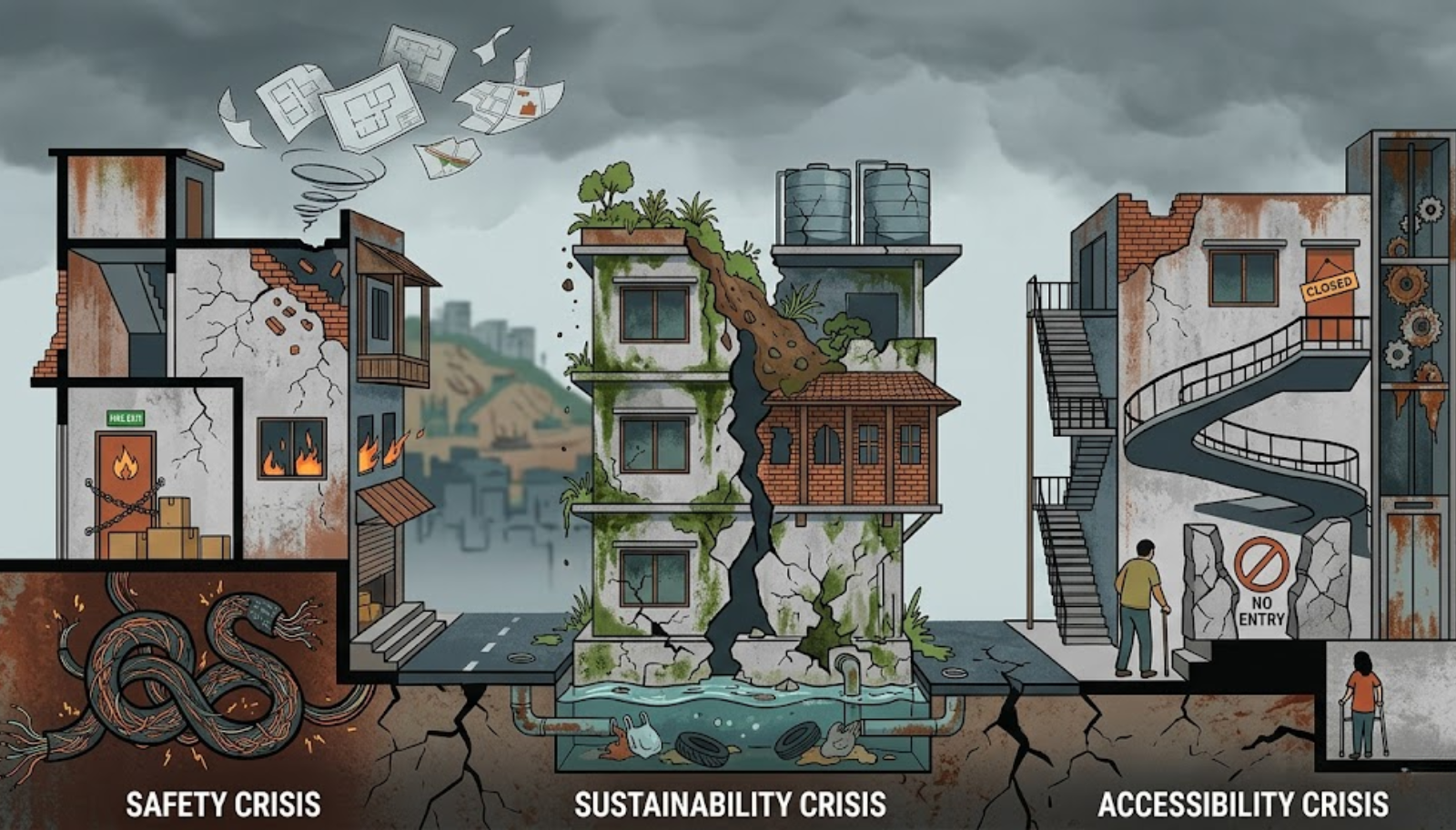
Chattogram is Bangladesh’s commercial engine. As the country’s principal port city and second largest urban centre, it drives a disproportionate share of national trade, industry, and economic activity. Yet the commercial buildings that house this economic energy are, by any credible measure, dangerously unfit for purpose. A convergence of fire hazards, structural inadequacy, environmental unsustainability, and near total exclusion of persons with disabilities defines an environment in which the risks to life and economic vitality are both severe and worsening.
A City on Fire
The fire safety crisis in Chattogram’s commercial buildings is not a latent risk. It is an active emergency. A 2024 assessment found that 97 percent of high-rise buildings in Chattogram are at severe risk of fire, with 93 percent lacking fire safety clearance altogether. Research conducted across the Chattogram City Corporation area recorded 2,514 fire incidents over a five-year period, of which 27 percent occurred in commercial areas. The frequency of fire incidents rose from approximately 200 per year to 675, with electrical faults accounting for 66 percent of all causes. The 2022 explosion and fire at the BM Container Depot killed at least 33 people and injured over 200, including firefighters and police officers, and exposed in catastrophic detail the consequences of storing hazardous materials in facilities without adequate safety provisions.
The firefighting response capacity is wholly inadequate to the scale of risk. Nine fire stations serve a city corporation area of approximately 155 square kilometres and a population of around six million people. The ratio of population to trained firefighting staff in Chattogram stands at approximately 21,277 persons per firefighter, which is 33 times larger than the ratio in Oklahoma City and six times larger than that of Bangkok. In only around 50 percent of incidents firefighting teams arrive within the eight-minute international standard, with traffic congestion cited as the primary obstacle to timely response.
Structural and Sustainability Failures
Most commercial structures in Chattogram are owner built, non-engineered constructions designed to maximise lettable floor space within the shortest possible time and at the lowest possible cost. Building code compliance is treated as optional by developers who face minimal inspection risk and even less enforcement consequence. The Bangladesh National Building Code 2014 exists on paper but its conversion into binding law with active enforcement has proceeded with negligible urgency. Buildings constructed two centuries ago during the colonial era, without any fire safety provisions whatsoever, continue to function as active commercial premises.
From a sustainability perspective, Chattogram’s commercial stock is equally deficient. The city faces significant climate vulnerability including coastal flooding, cyclones, and the compounding effects of sea level rise. Commercial buildings are rarely designed with flood resilience or energy efficiency as considerations. Green building standards remain largely aspirational in a development environment governed by short term profit calculations and absent regulatory consequences.
Exclusion by Design
People with disabilities are effectively excluded from the majority of Chattogram’s commercial buildings. Accessible entrances, ramps, lifts, tactile paving, and accessible bathroom facilities are exceptional rather than standard features. This is not an oversight. It is a systematic design culture that treats accessibility as a luxury addition rather than a fundamental legal and ethical obligation. In a city with a large and growing population, this exclusion represents both human rights failure and economic inefficiency.
Essential Reforms
Mandatory fire safety certification. No commercial building should be permitted to operate without a valid fire safety clearance from the Bangladesh Fire Service and Civil Defence. Existing buildings should face a defined compliance deadline with occupancy suspension as the penalty for non-compliance.
Enforce the building code without exception. The Chattogram Development Authority must conduct systematic, unannounced structural inspections of commercial buildings. Developers found in violation should face prosecution, not administrative notices.
Expand firefighting capacity. Chattogram requires a minimum of double its current number of fire stations, a substantial increase in trained personnel, and the installation of fire hydrants at regular intervals across commercial zones.
Mandate accessibility compliance. New commercial building approvals should require certified accessibility audits as a condition of occupancy. Existing buildings should be required to retrofit basic accessibility features within a fixed period.
Integrate climate resilience into planning. The Chattogram Development Authority should require flood resilience assessments and green building standards as baseline conditions for commercial construction approval, particularly in low lying and coastal zones.
Chattogram’s commercial buildings do not merely fall short of international standards. Many of them are active threats to the people who work in them, trade from them, and pass by them. Reform is not a long-term aspiration. It is an immediate obligation.