
Sheikh Selim
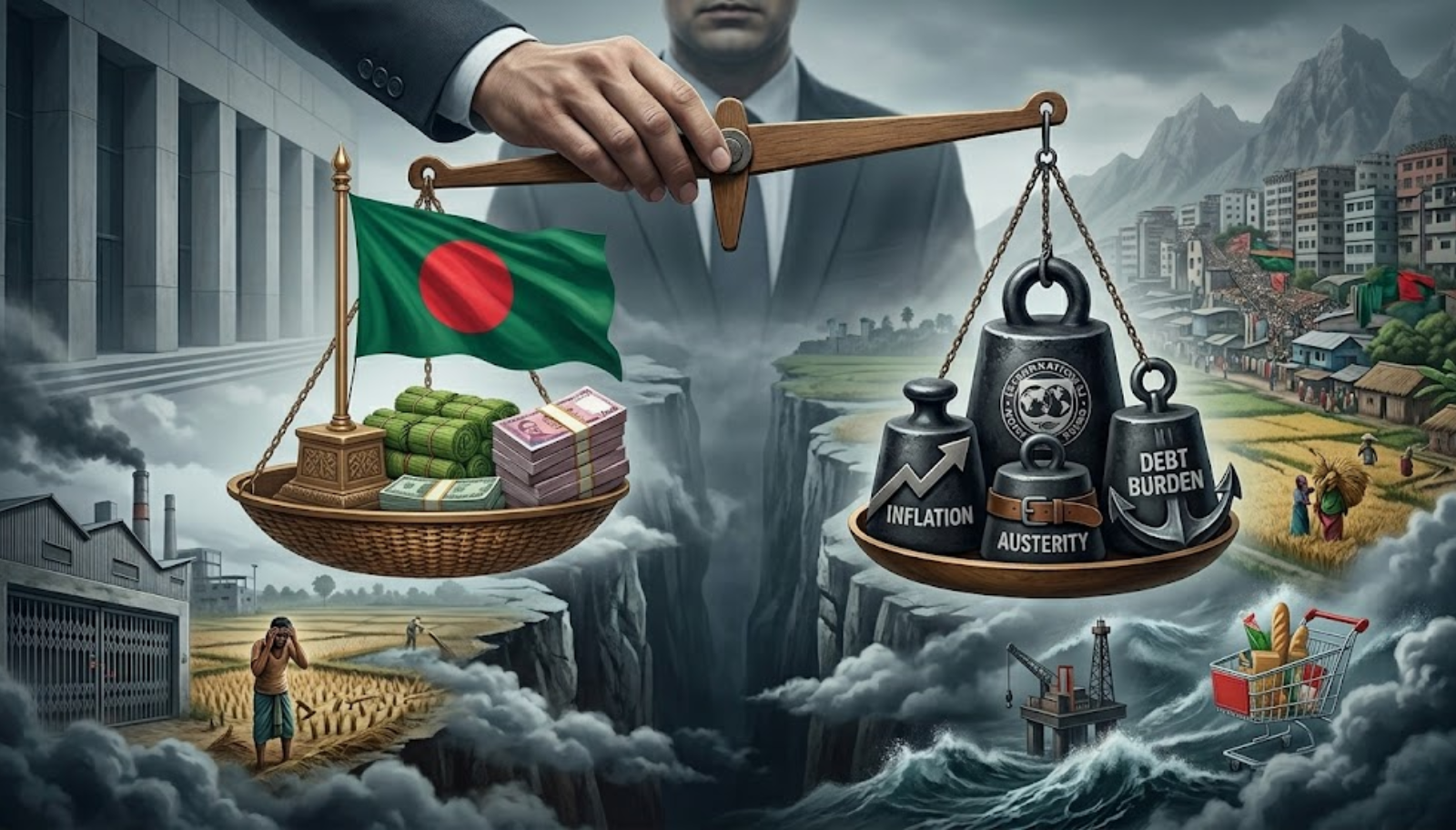
The formal request made by Bangladesh to the International Monetary Fund (IMF) in early June for a new financial arrangement (accepted by the IMF on June 4) is a pivotal and consequential moment in the country’s recent economic history. Government officials have characterized the move as a proactive step toward macroeconomic stability and structural reform. However, a critical examination of the circumstances surrounding this request reveals deep underlying tensions in the country’s monetary framework, its growth trajectory, and its management of an expanding national debt.
The decision to pursue a successor program, rather than to complete the existing one, gives rise to significant inquiries concerning fiscal discipline, policy credibility, and the long-term financial implications of external reliance. The same holds true for the IMF’s acceptance.
The Context: A Programme Left Incomplete
Bangladesh entered its current IMF-supported programme in January 2023 under the Extended Credit Facility, the Extended Fund Facility, and the Resilience and Sustainability Facility, securing what was initially a $4.7 billion package subsequently expanded to $5.5 billion. Of this amount, only $3.64 billion has been disbursed across five tranches, leaving $1.86 billion unreleased.
The inability to access the remaining funds is not an incidental matter. The International Monetary Fund (IMF) withheld the sixth tranche of the loan, contingent on demonstrable progress in meeting the stipulated conditions, namely revenue collection reform and institutional restructuring. However, the implementation of these conditions was found to be significantly deficient. Instead of fulfilling the obligations established by the prior program, the incumbent government has opted to request a wholly new arrangement, attributing this decision to altered political and economic conditions.
This approach, while pragmatic in the short term, raises legitimate concerns about the government’s willingness to absorb the structural reforms that genuine economic stabilization demands. A more intriguing and disconcerting inquiry pertains to the rationale behind the IMF’s acceptance of this proposal.
Monetary Policy Under Pressure
The implications for monetary policy are among the most immediate and consequential dimensions of this development. Bangladesh’s monetary environment is already severely strained. Inflation reached 9.04 percent in April 2026, driven by non-food price pressures, geopolitical disruptions linked to the Iran war, and surging energy costs. Bangladesh imports 95 percent of its oil and liquefied natural gas requirements, and following the outbreak of the US-Israel war on Iran in February 2026, oil prices climbed to approximately $100 per barrel, more than 50 percent above their pre-war level. In April, the government raised fuel prices by 10 to 15 percent, a move that further stoked inflationary pressure on households and producers alike.
It is highly probable that any new IMF program will necessitate a more stringent monetary policy, encompassing interest rate discipline and exchange rate flexibility as conditions of engagement. While these measures are appropriate long-term correctives, their short-term impact on an economy with private sector credit growth of only 4.7 percent and weak investment momentum could be contractionary.
The Bangladesh Bank is confronted with the formidable challenge of curbing inflation without further constricting the credit environment that businesses require to invest and expand. A new IMF programme structured around orthodox monetary tightening risks deepening this contradiction rather than resolving it.
Economic Growth: A Fragile Recovery at Risk
GDP growth in FY2024-25 fell to 3.49 percent, one of the lowest rates in decades, and the IMF projects only a modest rebound to 4.7 percent in FY2026, well below the government’s own target of 6.5 percent under the incoming FY2027 budget. The gap between official ambition and independent projections themselves revealing the scale of the challenge. Private investment accounted for just 22 percent of GDP, constrained by high borrowing costs, energy shortages, and policy uncertainty. The garment industry, which generates more than 80 percent of Bangladesh’s export earnings, has been further disrupted by supply chain dislocations tied to the Iran war, with raw material costs for key inputs rising sharply and work orders projected to fall by 20 to 25 percent in coming seasons.
In light of these circumstances, the conditions that accompany a new IMF program could have unintended consequences. The imposition of fiscal consolidation requirements at an accelerated pace could result in the compression of public investment at a time when the government declared an expansionary FY2027 budget.
The finance minister has acknowledged that certain conditions set forth by the IMF are not conducive to the current state of the Bangladeshi economy. This acknowledgment is indicative of the prevailing political and economic pressures in the country. However, it also signals the potential risks associated with a program that is negotiated but not fully owned or implemented by the government. The historical record indicates that International Monetary Fund (IMF) programs that are not accompanied by robust domestic political commitment are prone to stagnation during implementation. This phenomenon results in the failure to disburse the intended funds and implement the anticipated reforms.
National Debt: Growing Burden, Narrowing Margin
Perhaps the most structurally significant concern raised by this development is Bangladesh’s expanding debt profile. External debt reached $113.5 billion in late 2025, up from $112.2 billion the previous quarter. Although the World Bank and IMF classified Bangladesh as being at low risk of external debt distress as recently as 2024, with debt representing approximately 22 percent of gross national income, the ongoing Iran war, rising global interest rates, and increased external borrowing to fund energy and infrastructure needs are steadily eroding that margin of safety.
The IMF itself has warned that the conflict risks are triggering a global rise in debt levels, with global gross government debt already approaching 94 percent of world GDP and projected to reach 100 percent by 2029. Quite naturally, one can question why the IMF accepted this proposal.
This new IMF arrangement will add to Bangladesh’s external obligations, even if the terms are concessional. The critical question is whether the fiscal reforms attached to the programme will improve revenue mobilisation enough to reduce the debt-to-revenue ratio over time. Low revenue mobilisation has been a persistent structural weakness, and the IMF has flagged it explicitly as a precondition for any new arrangement. Without meaningful reform of the tax base, customs administration, and public expenditure efficiency, additional borrowing risks reinforcing a cycle in which debt service crowds out productive investment.
A Critical Juncture That Demands Genuine Reform
Bangladesh’s request for a new IMF arrangement is not inherently a sign of failure. In a global environment disrupted by geopolitical conflict, energy shocks, and post-pandemic fiscal stress, seeking multilateral support is a rational policy response. The concern, however, lies in the manner and motivation of the request, and the acceptance of it.
Walking away from an incomplete programme to negotiate a more accommodating one, while publicly questioning the suitability of reform conditions, risks undermining the policy credibility that investors, trading partners, and future creditors depend upon. The IMF’s own statement that any new arrangement must be grounded in strong policy commitments anchored by a credible reform agenda signal that the space for negotiating away difficult structural changes is limited. Bangladesh’s new programme, if it is to succeed, must be built not on flexibility alone, but on a genuine national commitment to the institutional reforms that sustainable growth and sound debt management ultimately require.