

Sheikh Selim
Bangladesh has made significant progress in economic development over the past two decades. However, the country’s universities continue to perform poorly in global academic rankings. The discrepancy between the nation’s developmental aspirations and the state of its university research indicates a systemic challenge that necessitates thorough examination and a strategic shift toward applied research.
The issue to be addressed hereafter is not the underlying reasons why Bangladesh’s universities are at the bottom of the ranking in terms of research. We must ascertain whether the appropriate competition and metrics are being examined and whether the objective being pursued is misguided. It is beyond doubt that there is a necessity for enhancement in the domains of university and institutional research capacity, output, achievement, and impact. Nevertheless, there are certain concerns regarding the evaluation metrics employed to assess underperformance. To ascertain how to improve, it is first necessary to identify the appropriate competition to engage in and the correct metrics for assessing research performance. The subject of this article is an examination of these very questions.
The Global Standing Problem
In the 2022 Quacquarelli Symonds (QS) World University Rankings, both Dhaka University (DU) and the Bangladesh University of Engineering and Technology (BUET) were placed in the 801–1,000 bracket, a position DU has held since sliding from the 601-plus bracket in 2012. Eight Indian universities and three Pakistani institutions had already reached the global top 500 by the same year.
The QS framework evaluates institutions across six weighted metrics: academic reputation, employer reputation, faculty-to-student ratio, citations per faculty, international faculty ratio, and international student ratio. Bangladeshi universities demonstrate substandard performance in virtually all areas. The question is not why; it is rather, what are we good at, and are those included in the criteria?
As per the global metrics, our citations-per-faculty metric is particularly damaging. As noted by senior academics at Dhaka University, local publications frequently lack international acceptability and are rarely cited in global scholarly discourse. Institutions in Singapore, China, and India have accelerated their citation profiles through coordinated institutional investment, something Bangladeshi universities have consistently failed to replicate. BUET, though recognized as the country’s premier engineering institution, publishes a low volume of research in high-impact, peer-reviewed international journals. Private universities, including NSU (North South University), BRAC University, and Daffodil International University, have made some progress in publication counts, but quality measured by impact factor and citation depth remains limited.
Why Academic Research Fails to Thrive
The failure is systemic rather than individual. The education budget in Bangladesh has historically accounted for approximately 2 percent of GDP, significantly below the recommended 6 percent threshold set by UNESCO. Insufficient funding can hinder the acquisition of essential equipment, prevent access to journal subscriptions, and limit researchers’ ability to attend and present at major international conferences. It also does not allow strategically flexible workload for faculty, that could otherwise enable the best researchers to allocate more time to research.
Faculty recruitment in public universities, including Dhaka University and BUET, has long been influenced by political considerations rather than purely academic and/or research merit, reducing the talent pipeline at the faculty level. A compounding issue is the near absence of a motivated graduate student culture. As a former Dean of Engineering at BUET observed, graduate students in Bangladesh overwhelmingly enroll for credential-based career advantages rather than genuine research interest. Without capable graduate students, faculty research capacity collapses at its foundation.
The institutional incentive structure also deters sustained scholarly output. The primary motivation for faculty publication in most public universities is to satisfy the minimum threshold for promotion, after which research productivity often declines sharply. A culture of post-tenure research accountability is lacking in comparison to leading Asian and Western institutions.
Figure 1: Bangladesh University Research Performance and Potential, 2024.
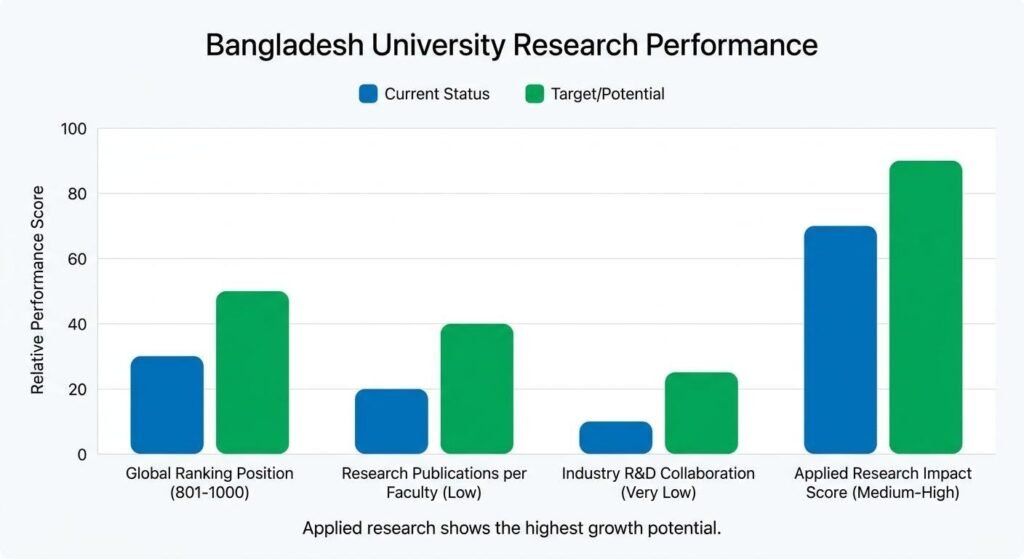
Figure 1 is based on data collected from Scopus, which illustrates the relative position of Bangladeshi universities (in blue bar) across key research performance dimensions (against their potential in green bar), highlighting that applied research offers the strongest near-term growth potential. Industry collaboration is alarmingly low and so is its potential (the green bar), while publication potential and current state is also weak.
Applied Research: A More Effective Path
Applied research addresses specific, real-world problems with findings that can be directly implemented. For a developing nation with urgent needs in food security, agriculture, public health, disaster resilience, climate adaptation, and industrial productivity, applied research delivers measurable societal returns that abstract theoretical inquiry cannot. It is evident that Bangladesh falls into this category, where the primary focus of university research should be on natural, behavioral and applied sciences and social sciences. This prompts us to consider the following important question: Are we using incorrect metrics to gauge Bangladesh’s research potential, such as citations and quartile publications?
Bangladesh Agricultural University (BAU) in Mymensingh is a prime example of the impact of targeted applied research. BAU and its affiliated government institutions, including BRRI (Bangladesh Rice Research Institute) and BARI (Bangladesh Agricultural Research Institute), have been instrumental in developing high-yielding, flood-tolerant, and salinity-resistant crop varieties. These varieties have directly contributed to Bangladesh achieving self-sufficiency in rice by the early 2000s. This body of work, with local relevance and systematic application, has arguably saved millions of lives and transformed the rural economy. No other theoretical research program in the country can make a comparable claim.
BUET has also demonstrated applied research effectiveness in structural engineering, specifically in the development of cost-effective building designs suited to Bangladesh’s flood-prone geography and seismic conditions. When these findings are connected to policy and construction practice, they create national-level impact. Private universities with robust industry connections, such as NSU and BRAC University, have initiated the production of applied research in public health, development economics, and information technology. This research has attracted international development funding and collaborations.
While these projects may not have resulted in publications indexed by Scopus or high citation scores, they have contributed to the development of the nation and the resolution of its practical problems. However, when evaluating the research strength of universities, we rely on established indicators of performance. This issue is particularly pronounced among academics who are preoccupied with their promotion pursuits. They often neglect to consider the potential economic and national impact of their research, focusing instead on meeting the requirements of the promotion PDR form. It is plausible that their mentors are also misguided, and as a result, they are inadvertently imparting misguided counsel to their students.
I have spent many years in the global top echelon of academia, and my research has spanned all facets of research performance around the world, creating impact in each area. I have a proven track record of publishing in prominent journals, securing funding, and contributing to government policy research. I have also disseminated my work to a global audience through various channels, including publications, short communications, conferences, seminars, interviews, and other dialogues and discussions.
My professional understanding is that the publication race in which Bangladesh-based academics are often involved (or which they find appealing) is often very different from the actual application and usefulness of the research they are investing time on and are aiming to publish. This is why we often see a published paper for Bangladesh-based academics that has 9 coauthors, most of whom have no contribution or connection with the research and may even fail to answer simple questions related to the paper. Their participation in the race in such means is driven primarily by academic promotion requirements rather than a genuine commitment to publish work that will benefit the nation, the field, or the specific topic. This is the main moral hazard of focusing on wrong metrics of research.
Benefits of Applied Research for Bangladesh
The benefits of prioritizing applied research are both immediate and long-term. In the agricultural sector, the implementation of scientific principles has already yielded significant gains in food security, amounting to billions of dollars annually. In the health sector, the application of epidemiological research has enabled Bangladesh to achieve child mortality reductions that are among the fastest in South Asia. In the field of engineering and technology, applied research at BUET has yielded guidelines for cyclone-resilient infrastructure, contributing to national disaster preparedness policy. The research has also led to the development of sustainable irrigation technology and indigenous approaches to local power generation.
Applied research also creates stronger university-industry linkages. When private universities collaborate with the garment, pharmaceutical, and ICT sectors to solve real operational problems, the resulting knowledge transfer benefits both the economy and the institution. This model, common in Germany’s Fraunhofer Institutes and South Korea’s government-university-industry consortia, is replicable in Bangladesh at a fraction of the cost. In Bangladesh, certain private universities have contributed to local skill and workflow design research for hospitality, entertainment and advertisement industry.
Moreover, applied research that is locally relevant is more likely to attract international development partners, NGOs, and multilateral organizations such as the World Bank and the Asian Development Bank, which specifically fund problem-driven, outcome-oriented studies. We must shift our focus to prioritize research that is directly aligned with the needs of the economy, business, industry, and the nation. Rather than engaging in research that might contribute to our academic promotion, our researchers and academics should concentrate on research that is directly beneficial to these sectors.
The Correct Path to Enhance R&D
To move forward, there is a need for coordinated action across government, academia, and the private sector. This is easier in theory than in practice. However, we can always convey the modality and engage in meaningful dialogues with the stakeholders to research and foster its growth. First, the national R&D budget must be raised to at least 1 percent of GDP, with dedicated allocations to priority sectors: agriculture, health, climate resilience, and digital technology. This is not an insurmountable challenge. However, the ongoing monitoring of its utilization and effectiveness remains a significant concern. Second, prominent universities such as Dhaka University, BUET, and BAU must each establish formal technology transfer units and industry vis-à-vis government liaison units that actively market university research capacity to the private sector.
Third, university promotion and tenure criteria must be reformed to reward applied impact alongside publication count. It is possible to coordinate these. Applied research narratives with simulated, calibrated, or pilot output can serve as a solid foundation for high-impact publications, multimodal dissemination, and practical industry or government impact. Collectively, these elements can result in meaningful publications. A researcher at BAU who develops a new crop variety adopted by 200,000 farmers should receive the same institutional recognition as one who publishes a theory, analytical, or general field academic paper in a high-impact journal.
Fourth, private universities, which currently have greater financial flexibility, must be incentivized through tax credits and research matching grants to invest in applied R&D departments and to partner with public institutions. In the absence of these incentives, private universities are unable to achieve the appropriate balance between their business or feasibility interests in student recruitment and their research impact, considering the workload models of private university faculty.
The University Grants Commission should therefore prioritize the development of a standardized workload model and a diverse range of faculty career path contracts to be implemented in faculty recruitment processes at public and private universities. One of these contracts may be focused on teaching, scholarship, and academic leadership for the faculty who prefer to engage and specialize in pedagogic research, academic leadership (e.g., heads, deans), and excellence in teaching. The second type of contract is for teaching, research, and research leadership. With the latter, more work hours are allocated to applied, impactful research, dissemination, publication, and research mentoring.
Finally, and most critically, graduate programs must be restructured around research apprenticeship models where students work on funded, industry-relevant projects from their first semester. This approach, combined with guaranteed research-track employment pathways and our fourth proposal, would transform the graduate student culture from credential-seeking to genuinely inquiry-driven.
Bangladesh is not in competition with MIT or Cambridge in terms of theoretical physics or Bayesian econometrics. This is an ill-advised race. Bangladesh has its own unique challenges to overcome. Here, universities must address their own challenges with unwavering rigor, creativity, impact, and urgency. Applied research, when scaled and sustained, is the most credible and productive route to that goal.

