
Dr. Umaima Imran
University of Birmingham, UK
More than five decades after 1971, Pakistan and Bangladesh continue to share one of South Asia’s most complex relationships. Historical grievances, political sensitivities and shifting geopolitical priorities have often shaped how the two countries engage with one another. Yet, in focusing almost exclusively on the past, both countries may be overlooking an important question: are they missing an economic opportunity that could benefit not only themselves but the wider region?
Recent developments suggest a cautious move towards greater pragmatism. Bilateral exchanges have gained momentum, supported by improved connectivity, eased visa arrangements and renewed diplomatic engagement. Trade between the two countries reportedly reached approximately USD 865 million during fiscal year 2024–25, reflecting a notable increase from the previous year. Although modest relative to the size of the two economies, these developments suggest that economic cooperation is once again becoming part of policy conversation.
When Competition Shapes the Narrative
To understand why this relationship matters, it is useful to examine how the economic trajectories of the two countries have evolved over time.
Pakistan was once among the region’s leading textile exporters, benefiting from its abundant cotton production and well-established manufacturing base. Today, Bangladesh has emerged as one of the world’s largest apparel exporters, second only to China in ready-made garments. Garment exports account for more than four-fifths of Bangladesh’s merchandise exports and have enabled the country to establish a strong presence in Western markets.
In many respects, the export destinations that once represented Pakistan’s comparative advantage have increasingly become Bangladesh’s success story. It would, however, be simplistic to suggest that economic competition alone explains the political distance that has characterized relations between the two countries. Politics and economics rarely operate independently. Changes in comparative advantage often reshape incentives, influence domestic interest groups and alter public narratives. Bangladesh’s rise as a manufacturing powerhouse occurred during a period when Pakistan struggled to diversify exports and strengthen its position within global value chains. Against the backdrop of unresolved historical sensitivities, perceptions of economic rivalry may have further complicated efforts towards deeper engagement.
However, viewing the relationship solely through the lens of competition risks obscuring the opportunities that coexist alongside it.
Turning Shared Interests into Shared Prosperity
The present structure of commerce suggests that the two economies may be more complementary than commonly assumed. Pakistan’s exports to Bangladesh continue to be dominated by cotton, textile yarn and fabrics, inputs that support Bangladesh’s highly competitive garment industry. Bangladesh, meanwhile, has developed expertise in transforming these inputs into higher value-added products destined for international markets. Rather than occupying identical positions within global trade, the two countries increasingly perform different functions within a broader production chain.
This distinction matters because competition and collaboration are not mutually exclusive.
Looking at successful regions around the world, economic collaboration often coexists with competition. According to the World Bank, trade among South Asian neighbours accounts for barely 5 per cent of the region’s total trade, compared with approximately 25 per cent within ASEAN. This comparison highlights the extent to which South Asia continues to underutilize its economic potential. Greater cooperation between Pakistan and Bangladesh could therefore contribute not only to bilateral prosperity but also to a more integrated and resilient regional economy.
Closer economic engagement could generate benefits, extending well beyond increased trade flows. Improved logistics, more efficient customs procedures and stronger commercial linkages could lower costs for businesses, strengthen supply chain resilience and support employment creation. As global markets become increasingly uncertain and vulnerable to disruption, regional partnerships can provide an additional source of stability.
This does not imply that history should be forgotten. The events of 1971 continue to hold profound significance, particularly within Bangladesh, and any effort to strengthen engagement must recognize the emotions and sensitivities attached to that period. Economic cooperation cannot erase the past, but neither should the past permanently limit future possibilities.
Choosing the Path Ahead
A gradual and carefully managed approach may offer the most realistic path forward. Rather than reviving the politically contentious idea of a comprehensive Free Trade Agreement, both governments could begin with a narrowly focused Preferential Trade Agreement covering sectors where mutual gains are most visible. Bangladesh could secure improved access for ready-made garments, pharmaceuticals and selected processed foods, while Pakistan could strengthen its role as a supplier of cotton, textile yarn and fabrics to Bangladesh’s export-oriented manufacturing sector. At the same time, accelerating direct shipping links, reducing customs delays and addressing non-tariff barriers would lower transaction costs that continue to discourage commercial exchange.
Bangladesh’s search for new markets as it prepares to graduate from Least Developed Country (LDC) status, together with Pakistan’s efforts to revitalize export competitiveness and diversify its export base, presents an opportunity that deserves serious consideration.
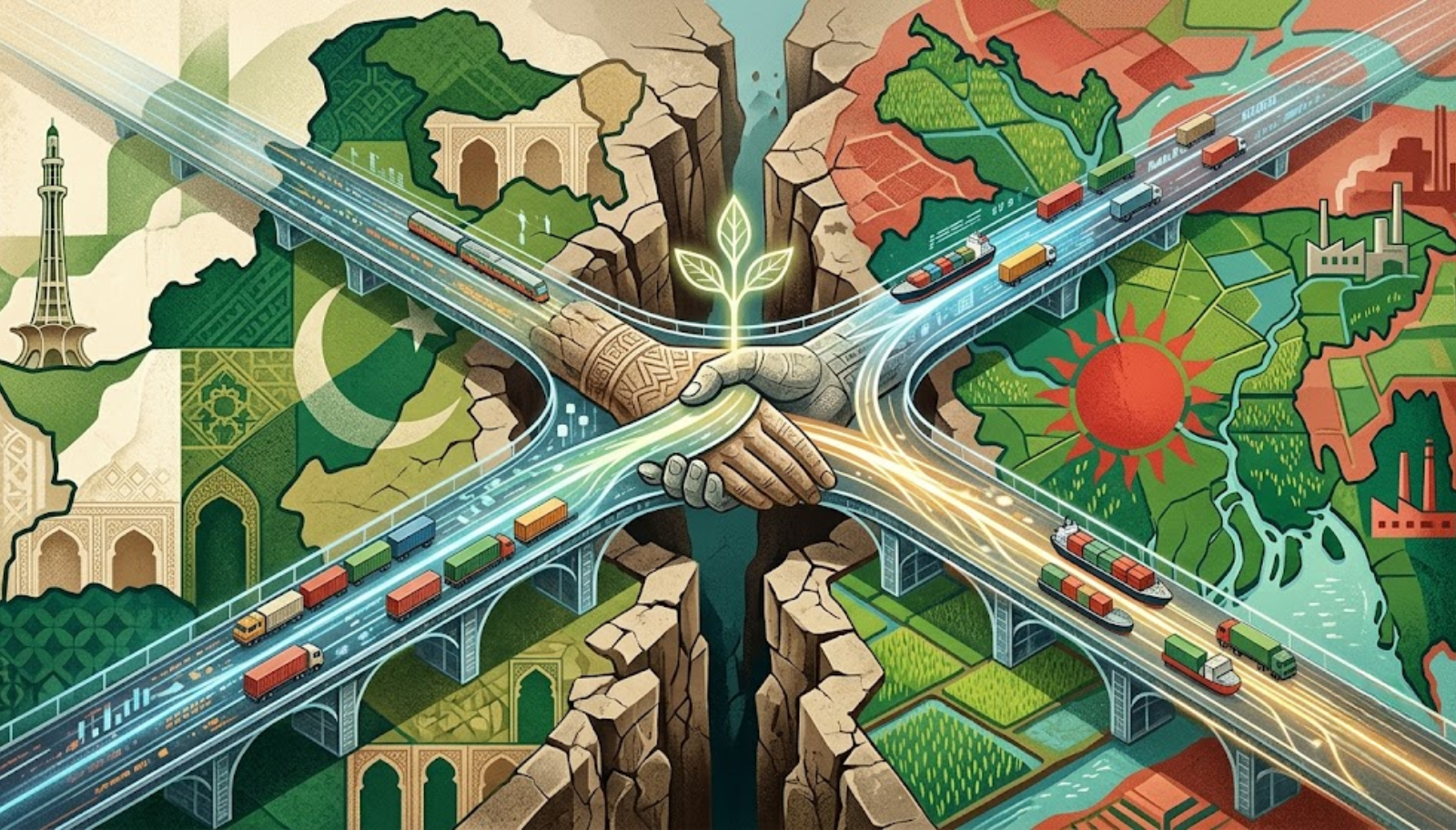
To conclude, Pakistan and Bangladesh stand at an economic crossroads. One path continues to treat economic engagement as a casualty of history. The other recognizes that, in an increasingly interconnected world, shared prosperity need not come at the expense of national interests. Transforming old wounds into new opportunities will require pragmatism, political will and a willingness to look beyond inherited divisions. It may not resolve every difference between the two countries, but it could lay the foundations for a more prosperous and resilient future for Pakistan, Bangladesh and South Asia as a whole.
Sources
- The Political Economy of Pakistan–Bangladesh Bilateral Ties (Desk Report).
- World Bank, South Asia Regional Integration: Trade.
- World Trade Organization (WTO) Trade Profiles.
- World Integrated Trade Solution (WITS).
- UN Comtrade Database.




Comments on “Old Wounds, New Opportunities: Pakistan and Bangladesh at an Economic Crossroads”