
Naima Onamika
Commissioning Editor, The Oniket Bulletin
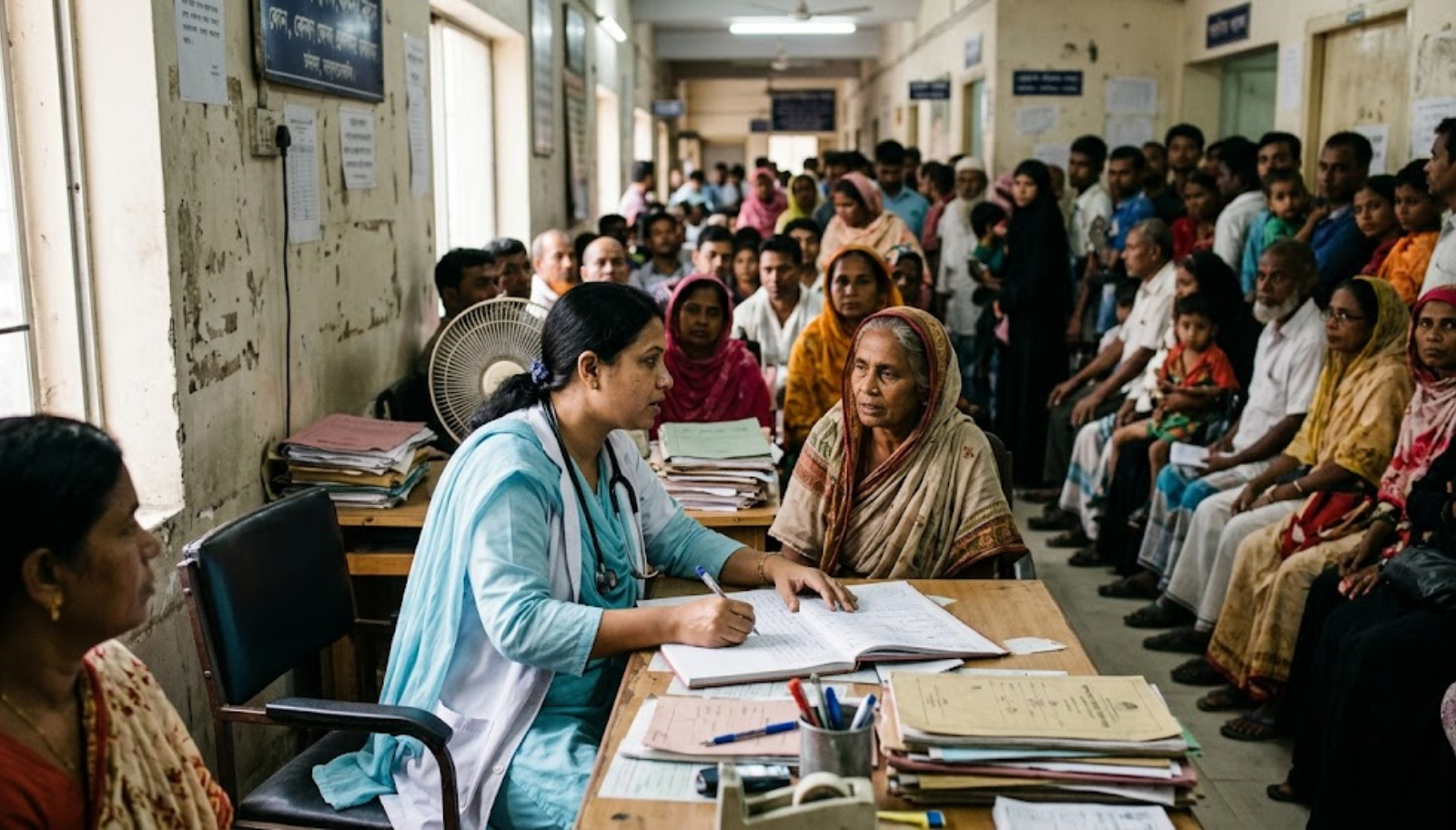
The effectiveness of Bangladesh’s public healthcare system depends largely on the competence, availability, and working conditions of government doctors. Most of the country’s population, particularly low- and middle-income communities, relies on public hospitals and health centres for medical care. However, the workload carried by government doctors has reached a level where personal dedication and professional competence alone cannot overcome the challenges. This is not simply a question of individual performance. It reflects deeper structural weaknesses in the country’s healthcare administration, human resource management, and service delivery system.
According to health policy experts, an effective healthcare system requires a balance between doctors’ workload, the nature of their responsibilities, and the resources available to them. In Bangladesh, however, doctors’ responsibilities have long been shaped more by administrative routines, workforce shortages, and immediate operational demands than by evidence-based workforce planning. As a result, many government doctors work in conditions that fall well below internationally recognised standards for a safe and effective working environment.
This article examines the broader management challenges behind this situation and discusses several practical policy measures that could improve both doctors’ working conditions and the overall quality of public healthcare.
Crisis in Human Resource Management
The shortage of doctors in Bangladesh’s public health sector has been a long-standing concern. The problem extends far beyond the number of physicians available. It also involves unequal distribution of medical personnel, prolonged vacancies, poor planning in transfers and postings, and weak human resource management.
Many positions in rural hospitals and Upazila Health Complexes remain vacant for extended periods, while large urban hospitals struggle under overwhelming patient loads. This imbalance weakens institutional capacity across the healthcare system and places excessive pressure on doctors. As a result, the balance between different levels of public healthcare delivery continues to deteriorate.
When Doctors Become Administrators
One of the biggest challenges facing government doctors in Bangladesh is the need to manage extensive administrative responsibilities alongside clinical duties. Doctors spend a significant amount of time maintaining patient records, preparing government reports, collecting programme data, attending meetings, coordinating administrative activities, and implementing official directives.
This raises an important question. Is a specialist doctor’s greatest value found in medical expertise or in completing paperwork?
In many advanced healthcare systems, administrative and information management tasks are handled by dedicated support staff. In Bangladesh, however, the same individual is expected to provide clinical care, manage administration, and oversee operational responsibilities simultaneously. Consequently, less time is available for patient care, and the quality of healthcare inevitably suffers.
Weak Referral System
Another fundamental weakness of Bangladesh’s healthcare system is the absence of an effective referral mechanism. Many patients bypass primary healthcare facilities and seek treatment directly at district hospitals or medical college hospitals.
As a result, tertiary hospitals are burdened with large numbers of patients whose conditions could have been managed at local healthcare facilities. This unnecessary patient flow not only increases the workload of doctors but also leads to inefficient use of limited healthcare resources. Without establishing a well-functioning referral system, balancing the workload across public hospitals will remain difficult.
Poor Working Conditions Reduce the Quality of Care
Professional performance depends not only on individual capability but also on a supportive working environment. Many public hospitals across Bangladesh continue to face shortages of essential medical equipment, modern diagnostic facilities, medicines, skilled nursing support, and digital management systems.
Doctors often spend valuable time coordinating limited resources, arranging alternative diagnostic options, and handling administrative issues instead of focusing on clinical decision making. These challenges delay patient care, increase professional frustration, and significantly reduce the quality of treatment.
Heavy Workload and the Growing Mental Health Burden
Long working hours, continuous emergency duties, frequent night shifts, and inadequate opportunities for rest gradually lead to professional burnout among government doctors. International research has consistently shown that prolonged burnout affects clinical judgement, communication with patients, empathy, and the overall quality of healthcare delivery.
In Bangladesh, there has been limited policy discussion and institutional action regarding doctors’ mental wellbeing, working conditions, and professional satisfaction. Improving the quality of healthcare cannot be achieved without ensuring the wellbeing of those who deliver it.
A New Approach to Performance Evaluation
The current system for evaluating government doctors’ places considerable emphasis on attendance, administrative compliance, and official performance indicators. A more meaningful assessment should prioritise the quality of clinical care, patient satisfaction, sound clinical judgement, professional ethics, teamwork, leadership, and continuous professional development.
Across modern healthcare systems, outcome-based performance evaluation is increasingly recognised as the most effective approach. Bangladesh should gradually move towards adopting this model.
Five Policy Priorities for Reform
Reducing the workload of government doctors and improving professional performance require several important policy reforms.
First, vacant positions should be filled without delay through evidence-based workforce planning that reflects population needs and disease patterns. Effective incentives should also be introduced to retain doctors in rural areas.
Second, Bangladesh should establish an integrated national digital health system that includes electronic health records, online reporting, electronic prescriptions, and hospital management software. These measures would significantly reduce administrative workloads and allow doctors to devote more time to patient care.
Third, primary healthcare services should be strengthened through a mandatory and efficient referral system, ensuring that tertiary hospitals receive only those patients who genuinely require specialised treatment.
Fourth, doctors should be provided with safe working environments, mental health support, reasonable working hours, regular professional training, research opportunities, and transparent career development pathways.
Finally, Bangladesh should move beyond a doctor centred healthcare model by developing multidisciplinary teams that include nurses, pharmacists, medical technologists, community health workers, and hospital administrators working together to deliver integrated healthcare services.
Conclusion
The workload crisis facing government doctors in Bangladesh is not an isolated administrative issue. It reflects broader structural weaknesses within the country’s healthcare system. Reducing excessive workload is not simply a matter of protecting doctors’ professional interests. It is essential for improving patient safety, raising the quality of healthcare, strengthening public confidence in government hospitals, and achieving Universal Health Coverage.
The future of Bangladesh’s healthcare system will depend not on asking doctors to work harder, but on building a healthcare system that allows them to spend most of their time treating patients rather than managing administrative burdens. Scientific workforce planning, effective use of technology, stronger human resource management, and improved governance can significantly enhance doctors’ performance while creating a more efficient, accountable, and sustainable public healthcare system.