
Nishita Shukla
BRAC University
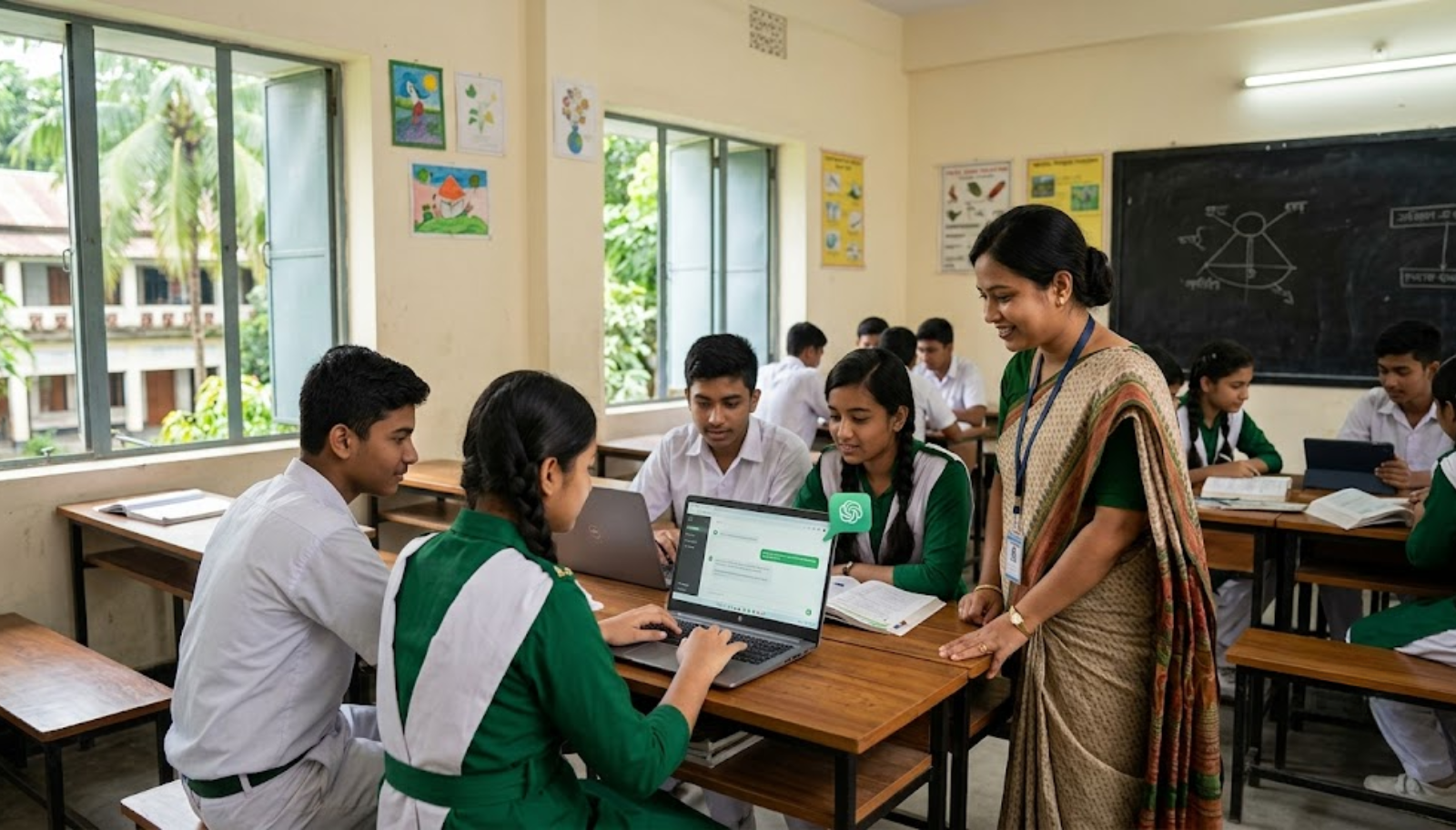
The rapid diffusion of generative artificial intelligence tools into everyday academic life has confronted Bangladesh’s education system with a challenge it is poorly equipped to meet. From primary schools anchored in rote memorization to university departments where theory still outpaces practice, the gap between technological reality and curriculum preparedness has grown unmistakably wide. Recognizing this gap is the first step; closing it will require coordinated reform across every tier of the education apparatus.
The Challenges
At the school level, the problem begins with how learning itself is conceived. The national curriculum remains heavily oriented toward rote learning, conditioning students to treat writing tasks as finished products to be submitted rather than processes to be developed through reflection and critical thinking. This habit of mind makes students particularly susceptible to misusing AI: when the goal is a polished output rather than an engaged intellectual struggle, generative tools offer an irresistible shortcut. Instead of synthesizing information from multiple sources and evaluating its reliability (skills that build analytical capacity), students outsource the entire cognitive exercise to algorithms.
Teachers, meanwhile, are caught in a structural bind. Most have received no training in how to incorporate AI into pedagogy, and the abysmal salary structure in much of the school system provides little incentive for professional development. Teachers forced to sustain themselves through private tuition have neither the time nor the motivation to learn new tools or redesign their instructional methods. The result is a teaching workforce that cannot guide students toward responsible AI use because it has not been guided there itself.
Even privileged schooling environments are not immune. Institutions following international curricula like the Cambridge syllabus, which emphasize personal engagement and contextual analysis, report that students working independently at home routinely turn to AI for assignment preparation. The synthesizing skills that earlier generations of students developed through laborious research and evaluation are now being delegated to machines, eroding the very critical thinking that progressive curricula aim to cultivate.
The unreliability of generative AI compounds the damage. Well-documented incidents of AI tools fabricating information mean that students who rely on them uncritically may internalize falsehoods alongside polished prose. A curriculum that does not equip students to verify, interrogate, and contextualize AI-generated content leaves them intellectually defenseless.
At the university level, the absence of a unified policy framework looms large. Academics reports a persistent tension between wanting to trust students and the unmistakable quality gaps between classwork and submitted assignments. Without institutional guidelines, faculty are left to penalize students ad hoc or look the other way; neither of which serves learning.
The problem cuts across disciplines. Even in computer science and engineering (disciplines one might expect to be ahead of the curve), curricula remain theory-heavy, with limited hands-on application aligned to real industry needs such as Bangladesh’s emerging semiconductor and chip design sector.
Perhaps most fundamentally, senior academia’s prevailing attitude toward AI remains one of fear rather than engagement. The preconceived notion that AI is merely a cheating tool (rather than a pedagogical instrument whose ethical use can enhance educational efficiency) continues to shape institutional responses in reactive, prohibitive directions.
Policy Outlook
Addressing these challenges demands a multi-pronged policy agenda. The University Grants Commission of Bangladesh must take the lead in formulating a national framework for AI use in education. This must be one that distinguishes between permissible assistance and academic dishonesty, provides clear benchmarks for faculty, and replaces ad hoc penalization with consistent, transparent standards. This framework should be discipline-specific: what constitutes appropriate AI use in a programming course differs from what is acceptable in a history essay.
Curriculum reform must rebalance the emphasis from product to process. Assessment structures should reward the demonstrable development of ideas through drafts, reflective commentary, and oral defense, rather than solely the final submitted text. Redesigning evaluation around processes inherently reduces the utility of AI shortcuts while strengthening genuine learning.
Targeted investment in teacher training is indispensable. Programs that equip educators with both technical literacy in AI tools and pedagogical strategies for integrating them meaningfully into instruction must be funded and incentivized, including through salary reform that reduces dependence on supplementary private tuition income.
University curricula, particularly in science and engineering, must be updated to bridge the gap between theoretical foundations and industry-relevant practical applications. Partnerships with industry can inform curriculum design, ensuring graduates possess the capabilities that an AI-driven economy demands.
Finally, a cultural shift within academic leadership is necessary. Senior academics and administrators must move from prohibition to stewardship, engaging with AI themselves, understanding its capacities and limitations, and modeling the ethical, critical use they expect from students. The future of education in Bangladesh will be AI-shaped; the question is whether policy can make it AI-guided rather than AI-determined.