
Soumili Chatterjee
University of Birmingham, Dubai
Clean air is the prime example of a shared public good. Yet, in two of South Asia’s most polluted cities, it is being treated as a waste dump for negative externalities. Dhaka and New Delhi are both capital cities defined by the deteriorating quality of their most life-sustaining asset: air. While the World Health Organization sets a benchmark air quality index of 5 micrograms per cubic meter (μg/m³), Dhaka recorded a PM2.5 concentration of 68 μg/m³ in 2025, more than 13 times the advised WHO guideline.
New Delhi, on the other hand, is facing a more dire situation, averaging around 88 μg/m³ every year. For these cities, this problem goes far beyond environmental failure; this is evident as we observe lifespans reducing, hospital wards slowly reaching their maximum capacity and children growing up with respiratory illnesses. This article compares the environmental realities of the two capitals and the policy reforms necessary to secure a breathable atmosphere for future generations to come.
The Institutional Architecture of Regulatory Failure
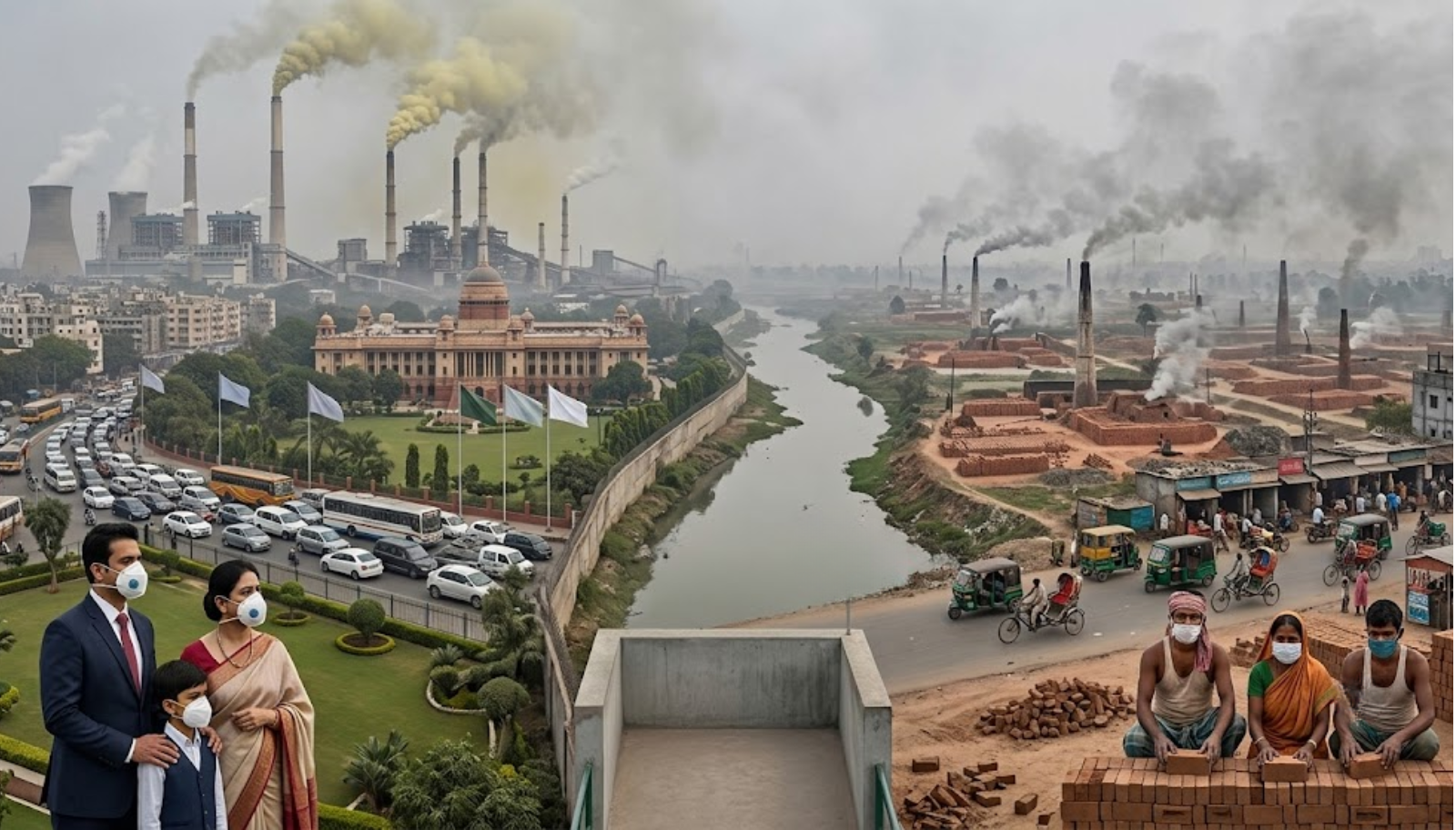
New Delhi’s hazardous air quality is fueled by a culmination of vehicular and industrial emissions and construction dust, all of which are trapped in the city’s atmosphere during the winter months. This is due to its unique regional geography in the Indo-Gangetic plains (Taukir, 2025). Despite India’s National Clean Air Programme (NCAP) driving substantial local declines in PM2.5 indices over the years, Delhi is finding it difficult to solve its winter spikes because the primary cause- agricultural crop burning- occurs in neighboring Indian states. This is a classic economic problem, where Delhi faces horizontal negative externalities.
On the other hand, Dhaka’s toxic air is a result of heavy reliance on brick kilns, frequent open municipal waste burning, highly polluting transport such as outdated buses and three-wheelers and rapid, unplanned urbanization. Because these pollution drivers are primarily domestic, Dhaka’s failure is an example of regulatory capture. Authorities in the Department of Environment (DoE) weaken environmental fines and penalties due to political and industrial persuasion from powerful local industries (Haque, 2024).
Air Pollution as a Regressive Economic Tax
Beyond institutional structures, the consequence of this environmental crisis presents itself as a highly regressive tax on the economy. While people in higher income groups have the resources to protect themselves from environmental hazards, the same cannot be said for low-income groups. When authorities in both cities advise residents to stay indoors during critical pollution levels, high-income workers can retreat to filtered indoor offices. On the other hand, the working class must choose between immediate income loss or inhaling toxic chemicals that permanently reduce their long-term earning capacity.
Furthermore, most working-class families in Dhaka are also forced into consuming biomass fuels such as wood and agricultural residue, leading to double exposure. A study by Hassan and Mehedi Hasan (2023) brought supporting results; 82% of households in the rural areas of Dhaka Division still use biofuels as their primary source of energy. Conversely, direct domestic consumption of biofuels is exceptionally low in Delhi, with 99% of households relying on clean cooking fuels (International Institute for Population Sciences (IIPS and ICF, 2021). Ultimately, this environmental disparity ensures that the poorest citizens pay the highest price for regulatory failure.
Policy Frameworks for Environmental Correction
Although India’s Supreme Court has repeatedly ordered New Delhi’s neighboring states to stop crop burning, which is the most prevalent cause of air pollution in the city, local authorities have failed to enforce these bans due to weak administrative power and farmer resistance (Patel, 2023). To resolve this, policies must shift from legal bans to positive economic incentives. The government should implement direct subsidies for clean harvesting technologies.
Crop-diversification subsidies could also be used to allow farmers to switch to different crops that produce less agricultural residue, and consequently, less crop burning. To reduce air pollution through vehicular emission, New Delhi can vary vehicle taxes based on emissions. This can be done by providing tax breaks to clean cars and charging extra for heavy polluters (Matheson, n.d.). In addition, emissions charges could also be imposed on private construction companies, forcing them to pay for the pollution they create. These measures would positively contribute towards New Delhi’s clean air goals.
For Dhaka, resolving this crisis requires all year-round monitoring of brick kilns and phasing out old and polluting buses and three wheelers. Additionally, the DoE must be insulated from political pressure to build proper waste infrastructure and eliminate open municipal trash burning. Finally, Bangladesh should ensure the tripled adaptation finances discussed in COP30 in Belém, Brazil, are converted into direct and reliable funding streams, which could be channeled into public health infrastructure and urban resilience to help fight the negative effects of air pollution.
Conclusion
Ultimately, while New Delhi and Dhaka’s attempts to combat air pollution by relying on temporary solutions such as emergency bans and localized legal mandates have had some impact, both cities still struggle to manage the problem on a larger, country wide scale due to underlying institutional failures. For New Delhi, the problem is still unaddressed because of agricultural externalities from neighboring states, while in Dhaka, progress is hindered by regulatory capture and its influence on domestic industries.
Overall, to ensure a breathable atmosphere for the future of both cities, both governments will have to shift to focusing on how to invest in and subsidize cleaner forms of technology. Combined with politically insulated regulatory enforcement, this creates long-term, viable solutions for both cities. Only by replacing the cause of pollution with a permanent, more accessible cleaner alternative can India and Bangladesh protect and ensure future generations and are able to reclaim and sustain having clean air.
References:
- Haque, N. (2024). Access to Green Finance Improves Compliance with Environmental Regulations in Bangladesh. [online] BU Global Development Policy Centre. Available at: https://www.bu.edu/gdp/2024/07/01/access-to-green-finance-improves-compliance-with-environmental-regulations-in-bangladesh/ [Accessed 31 July 2026].
- Hassan, M. and Mehedi Hasan, M. (2023). Analysis of household energy consumption and energy consumption cost (Biofuel) in rural areas of Dhaka division, Bangladesh. International Journal of Energy and Environmental Science, 8(3). doi: 10.11648/j.ijees.20230803.11.
- International Institute for Population Sciences (IIPS) and ICF (2021). The People’s Archive of Rural India. [online] People’s Archive of Rural India. Available at: https://ruralindiaonline.org/or/library/resource/national-family-health-survey-nfhs-5-2019-21-national-capital-territory-nct-of-delhi/ [Accessed 31 July 2026].
- Matheson, T. (n.d.). Taxing Pollution Urban-Brookings Tax Policy Center. [online] Available at: https://documents1.worldbank.org/curated/en/691261636143890139/pdf/Taxing-Pollution.pdf [Accessed 31 July 2026].
- Patel, S. (2023). India’s Top Court Tells States to Stop Crop Burning as New Delhi’s Air Turns Hazardous. Reuters. [online] 7 Nov. Available at: https://www.reuters.com/world/india/indias-top-court-tells-states-stop-crop-burning-new-delhis-air-turns-hazardous-2023-11-07/ [Accessed 31 July 2026].
- Taukir (2025). Care24. [online] Care24. Available at: https://care24.co.in/blog/understanding-delhis-pollution-crisis-causes-and-consequences/ [Accessed 31 July 2026].

