
Ameera Haidar
Freelance Architect
The Oniket Bulletin analysis recently published on power generation in Bangladesh provides a valuable diagnostic of the structural, financial, and institutional weaknesses that have caused actual output to trail behind planned targets. It correctly identifies overdependence on imported fossil fuels, the perverse consequences of capacity payment contracts, and the bankability crisis in renewable energy tenders.
Yet the analysis leaves several critical dimensions largely unexamined. The gaps are not minor omissions; they are the very forces that have shaped the crisis into its present form. Without confronting bilateral power arrangements, two decades of public sector corruption, and the geopolitical diplomacy that has steered Bangladesh’s energy trajectory, any reform agenda will remain incomplete.
The Bilateral Trap
The original article mentions the Quick Enhancement of Electricity and Energy Supply Act of 2010 and its legacy of noncompetitive awards, but it does not explain how bilateral state to state arrangements weaponized that legislation. Bangladesh’s major power plants over the past two decades weren’t simply awarded without competitive bidding domestically, they were shaped by bilateral financing agreements with China, India, and Russia, each with strategic conditions attached. The India financed Rampal coal plant locked Bangladesh into coal just as global capital exited it, the Russia financed Rooppur nuclear project tied the country to a single fuel and maintenance supplier for decades, and Chinese financed coal projects carried terms favoring exporter interests over borrower flexibility.
These bilateral arrangements did not merely bypass competition; they dictated technology choices, financing structures, and operational dependencies that Bangladesh cannot easily undo. The article’s recommendation for regional energy cooperation through the BBIN framework is sound, but it underestimates how deeply existing bilateral commitments constrain the flexibility needed to pivot toward crossborder renewable imports.
Corruption as Architecture, Not Isolated Failure
The article notes that capacity payment obligations and an excessive reserve margin of over 61% have imposed severe fiscal costs. What it does not adequately address is that this outcome was not an accident of poor planning; it was the intended product of a system designed to extract rent. Beginning in 2010, the Quick Enhancement Act enabled power projects to be awarded without open tender, a channel used systematically. Quick rental plants, largely oil fueled, received guaranteed capacity payments regardless of actual output, leaving owners with no incentive toward efficiency and the state unable to terminate underperforming contracts. This produced a class of politically connected firms profiting from idle capacity, with private oil-fired plants reportedly earning around 9.5 Taka per kilowatt hour and oil-fired peaking comprising 11 percent of generation, far above regional norms.
These figures reflect corruption rather than market outcomes, political patronage converted into contractual entitlement. While the 2024 political transition and repeal of the Special Act altered the legal framework, the contractual legacy of two decades of patronage remains embedded in the state’s fiscal obligations.
Geopolitical Diplomacy and the Environmental Cost
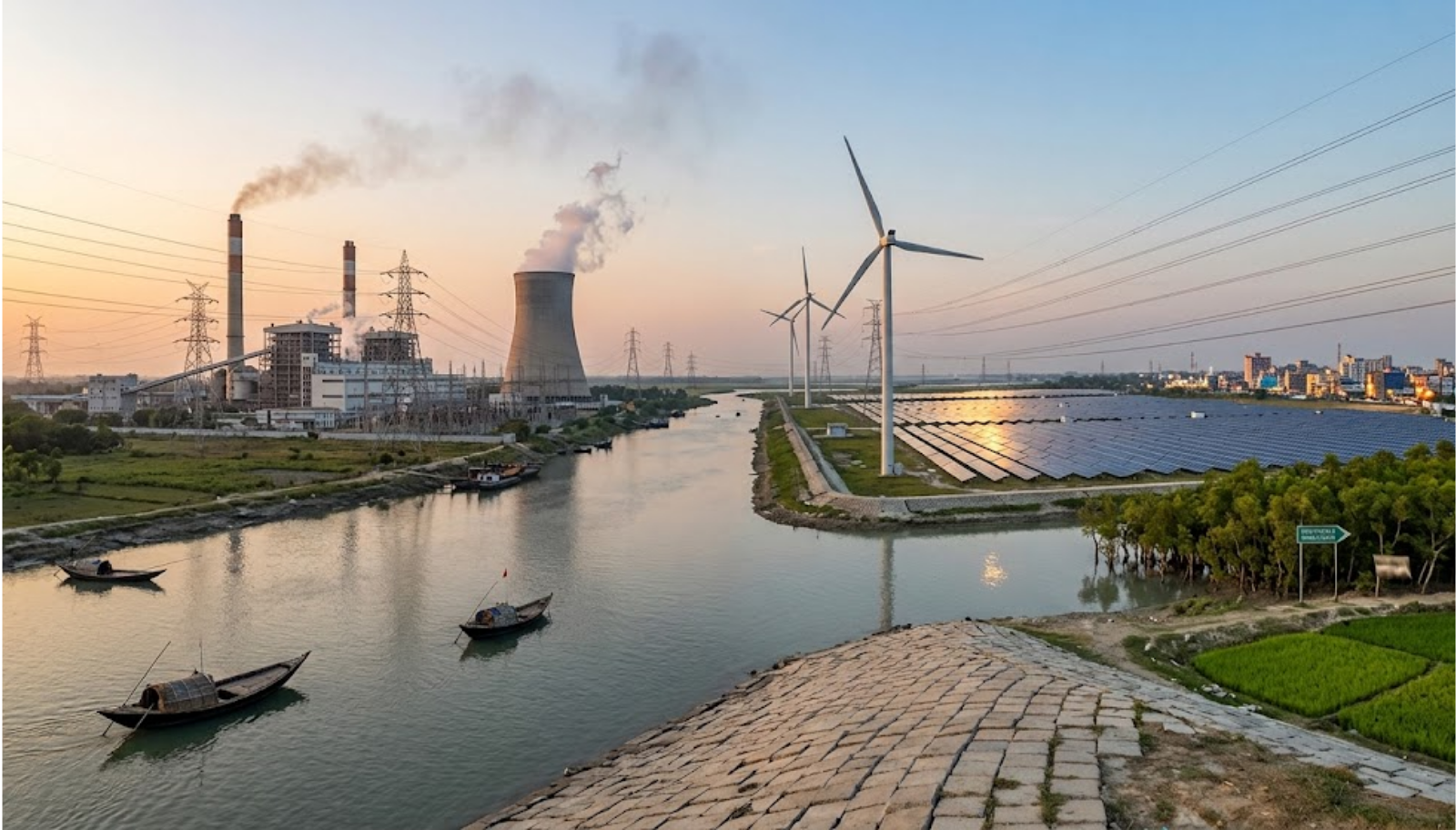
The most consequential gap in the original analysis is the near total absence of environmental degradation from the discussion. Bangladesh’s turn toward fossil fuels was less a domestic choice than a result of geopolitical diplomacy. The India backed Rampal plant, situated near the Sundarbans UNESCO World Heritage site, drew sustained opposition over risks from coal transport, ash disposal, and thermal pollution in an ecologically fragile coastal zone, while the China backed Payra plant has produced ash sludge contaminating nearby farmland and waterways. These environmental costs are structural, not incidental, each plant commits Bangladesh to decades of emissions, pollution, and land degradation.
The finding that renewables supply just 2.3 percent of grid power reflects not merely policy failure, but a generation mix shaped by diplomatic negotiation rather than national planning. Communities near these plants bear the health and environmental toll, while the foreign partners who financed them bear none of it.
What Must Be Acknowledged
Bangladesh cannot reform its power sector without publicly reckoning with how bilateral arrangements, corruption, and geopolitical diplomacy have together produced the current system. Renegotiating or exiting unfavorable bilateral contracts must become a policy priority alongside expanding renewable capacity. The environmental damage caused by diplomatically imposed fossil fuel projects must be quantified and integrated into future energy planning. The era of awarding power projects as instruments of foreign policy rather than as components of a coherent energy strategy must end. The article’s prescriptions for renewable acceleration, reserve margin reduction, and fuel reserve expansion are necessary. But unless the political architecture that created the crisis is dismantled with the same urgency, the gap between ambition and delivery will persist.
Reference: