
Rimsha Seethe
Nottingham Trent University, UK
Whether individual freedom in digital spaces should sometimes give way to collective social values is a question most Western researchers wouldn’t typically stop asking. Within liberal traditions, free will is sacrosanct: adults choose who they associate with, live with the outcomes, and society steps in only once clear harm is demonstrated.
Yet a recent study on online illicit relationships in Bangladesh raises a scenario that challenges this framework entirely. The article, authored by Farah Zahir and published in The Oniket Bulletin, documents how digitally mediated extramarital and illicit connections erode mental health, destabilize families, and degrade the social dignity of individuals, particularly women. What makes the piece analytically unsettling for an outside observer is not merely the phenomenon it describes but the implicit cultural architecture that gives the phenomenon its destructive force.
The Cultural Block: Where Dignity Becomes a Prison
The original article establishes that online illicit relationships in Bangladesh are driven by loneliness, marital dissatisfaction, emotional neglect, and the anonymity that digital platforms afford. These are familiar psychological drivers anywhere in the world. What differs is the cultural container in which they operate. In Bangladesh, as the article demonstrates, social dignity is not merely a personal attribute; it is a communal asset.
Reputation, familial honor, and social standing are held collectively, and one individual’s perceived misconduct can destabilize an entire household or kinship network. When an online relationship becomes public, it does not simply embarrass the individual; it fractures the social architecture that sustains the family.
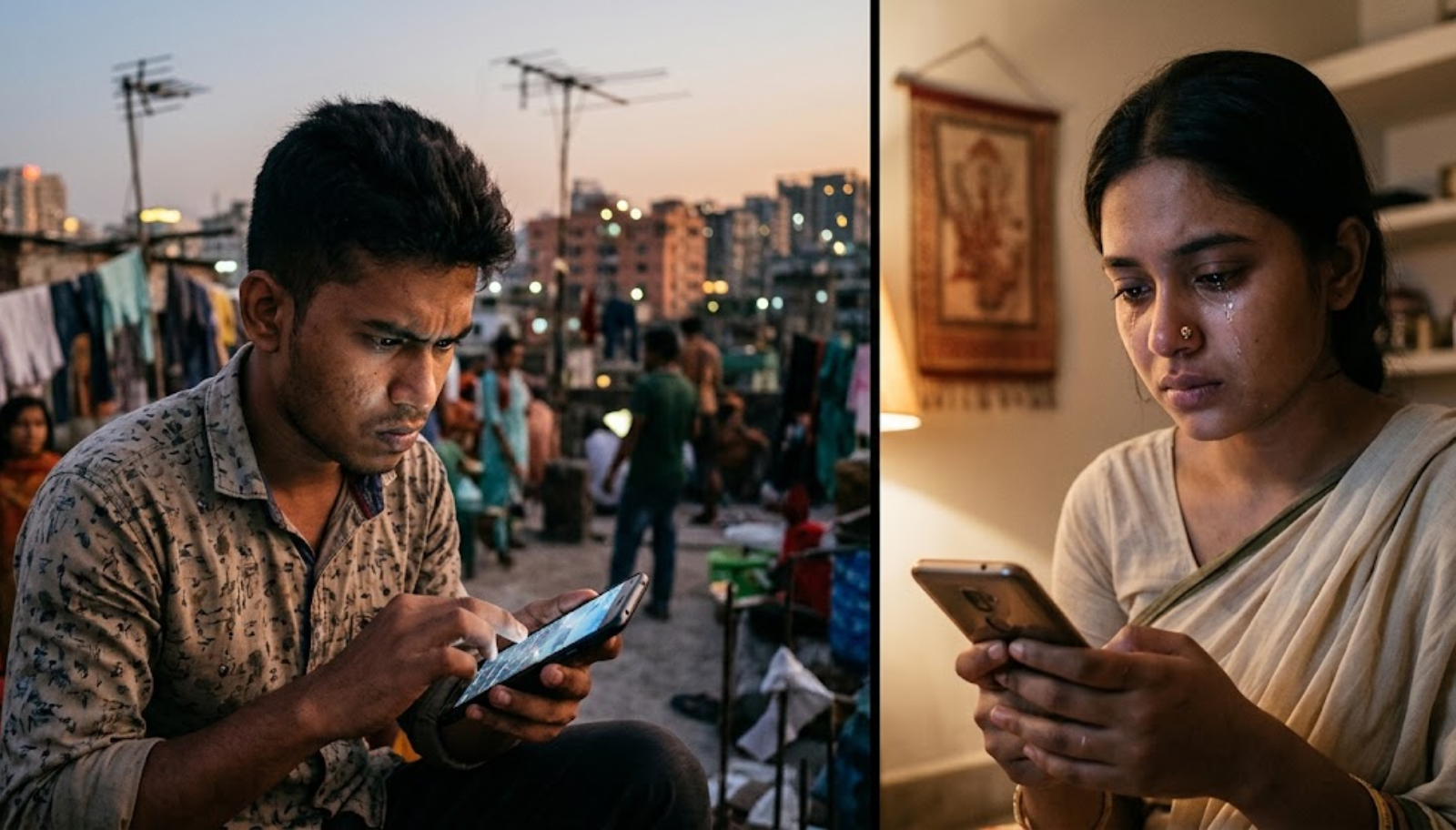
This cultural block functions as an amplifier of distress. The article reports that exposure leads to marital conflict, separation, depression, anxiety, sleep disturbance, and reduced emotional resilience, with children in affected households facing insecurity, behavioral problems, and declining academic performance. In more severe cases, exposure has been linked to self-harm and financial exploitation. The gender dimension intensifies the damage: women face harsher public criticism, victim blaming, and online harassment than men in comparable situations.
The cultural block, then, does not merely react to transgression; it punishes it asymmetrically, and in doing so, it converts private emotional struggle into public social collapse. The very mechanisms meant to protect dignity become the instruments that destroy it.
The Free Will Argument: A Critical Unpacking
The article acknowledges that individual freedom is an important social value but argues that it exists alongside responsibility toward partners, families, and communities. It further suggests that constructive reform should not aim to control private lives unnecessarily but should instead encourage informed decision making, ethical behavior, and respect for the dignity of others.
This position is measured and careful, yet it leaves a question that it does not fully resolve: can free will be meaningfully exercised when the cultural penalty for its exercise is so severe?
From the standpoint of a researcher unfamiliar with cultures where social dignity outweighs personal autonomy, the tension is striking. If a person enters an online relationship because they are lonely, emotionally neglected, or psychologically distressed, as the article documents, then the choice is already constrained by the conditions that produced the distress. Here, free will isn’t philosophical autonomy but a compressed decision made under emotional deprivation and social prohibition. Fully blaming individuals under such constraint misreads agency, yet total absolution ignores real harm to spouses, children, and communities. Neither extreme suffices.
Overcoming the Barriers: Toward a Balanced Framework
The path forward for Bangladesh cannot be a simple extension of either cultural enforcement or unrestrained digital liberty. The article recommends that mental health services should become more accessible, that digital citizenship education should cover responsible online behavior and emotional intelligence, and that families should benefit from relationship education promoting communication and empathy. These are necessary interventions. But they will not be sufficient unless they are accompanied by a deliberate cultural renegotiation of what dignity means.
Dignity in Bangladesh must be decoupled from its current role as a mechanism of communal control. This does not mean abandoning social values; it means redefining them so that a person’s worth is not destroyed by a private failing. Community organizations, religious institutions, and cultural leaders, whom the article identifies as potential contributors to positive change, must shift from stigma toward compassion, from punishment toward support.
Meanwhile, the culture needs to build a more honest language around the emotional needs pushing people toward online relationships. When feelings of loneliness, neglect, and dissatisfaction can’t be openly discussed within the family, they don’t vanish, they simply relocate to the internet’s anonymous spaces. Balanced, transparent digital communication can’t take root in a culture that treats honest talk about emotional needs as a violation in itself.
Conclusion
The challenge Bangladesh faces is not unique, but its cultural configuration makes it acute. Free will and social dignity are not inherently opposed, but in the current arrangement, they function as antagonists. The article under discussion provides an essential diagnostic, yet its prescriptions, while valuable, stop short of the cultural transformation required.
A real balance between free will and moderation in online interaction can only emerge once the conditions that distort free will, emotional deprivation, gendered punishment, and the weaponization of dignity, are openly confronted and changed. Until that happens, the digital space will keep providing what the culture withholds: a place where people feel heard, even if briefly and dangerously so.
Reference: