
Arif Reshad
University of Essex, UK
South Asia has produced genuine technology success stories over the past two decades, and Bangladesh is largely absent from that list. India built a globally competitive software services industry, then layered a homegrown startup ecosystem on top of it, producing companies with real international reach in payments, logistics, and enterprise software.
Sri Lanka, despite a much smaller economy and years of political and economic turmoil, has sustained a respected information technology and business process outsourcing sector, with local firms serving clients across Europe and North America. Pakistan, working under difficult security and macroeconomic conditions, has nonetheless produced a freelancing and outsourcing economy of meaningful scale, along with pockets of hardware and fintech innovation.
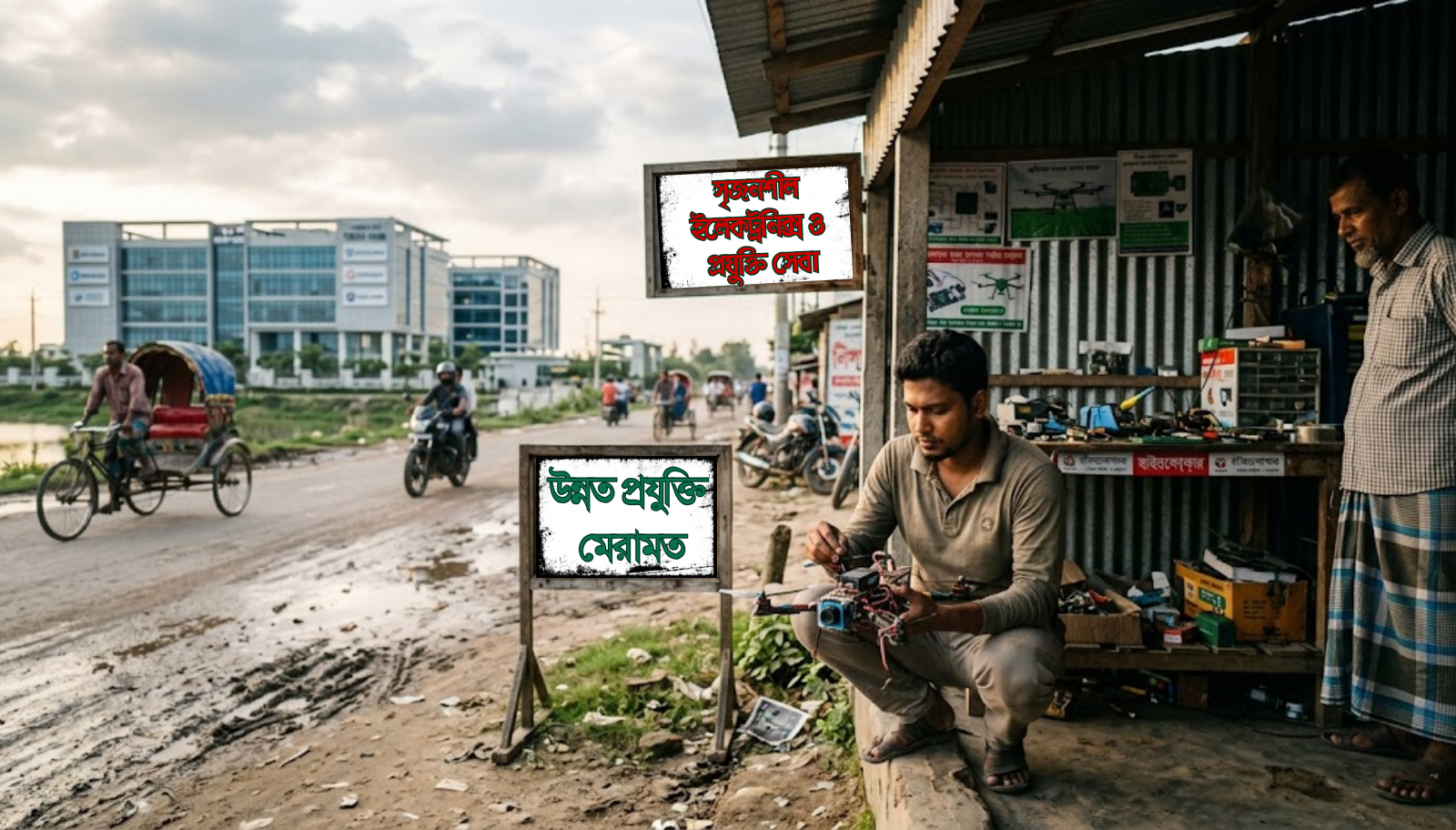
Bangladesh, by contrast, has built export strength almost entirely in garments, while its tech sector remains dominated by outsourced low value coding work, assembly of imported components, and consumption of foreign software rather than the creation of original products. The country has smartphone assembly plants and a growing freelancer base, but it has not produced a company with the regional footprint of an Indian software major or even a mid-sized Sri Lankan outsourcing firm.
Government Incentives That Never Materialized
Part of the explanation lies in incentive design. Successful regional peers built durable tax holidays, research funding, and university industry linkages that outlived individual governments. India’s software technology park scheme and later startup incentive programs survived multiple changes in ruling party because they were treated as long term national strategy rather than short term political favors.
Bangladesh’s incentive schemes for the tech sector have tended to be announced with fanfare, then poorly implemented, inconsistently funded, or redirected toward politically connected recipients rather than genuinely competitive firms. Public research funding for science and engineering remains thin relative to regional peers, and university research output rarely translates into commercial products because the institutional bridge between laboratories and industry was never seriously built.
Political Bias in Leadership and Guidance
A more direct cause is the politicization of leadership across the agencies meant to guide the sector. Appointments to key regulatory and promotional bodies have often prioritized political loyalty over technical competence, meaning the people setting standards, allocating incentives, and approving licenses frequently lack the domain expertise to evaluate genuine innovation.
This produces a guidance vacuum, entrepreneurs receive inconsistent signals about which sectors will be supported, policy shifts abruptly with changes in political leadership, and firms perceived as aligned with the opposition or with no political patron at all find themselves at a structural disadvantage regardless of the quality of their technology.
Lobbying and the Capture of Policy
Where genuine industry associations exist, they have too often become vehicles for a small number of well-connected firms to shape regulation in their own favor, rather than platforms representing the broader innovation ecosystem. Import policy, tax treatment, and licensing decisions have repeatedly favored established importers and assemblers over domestic developers attempting to build original products, because importers have deeper political relationships and more immediate lobbying capacity. The effect is a policy environment tilted toward moving finished foreign technology into the country rather than building the capacity to design and manufacture technology domestically.
The Result: Dependence on Import and Illicit Smuggling
The cumulative outcome is a tech economy structurally dependent on imports, from semiconductors to finished devices to enterprise software licenses, with very little domestic value addition. Where formal import channels are constrained by tariffs, licensing bottlenecks, or currency shortages, a persistent grey and black market in smuggled electronics and components has filled the gap for years, undermining legitimate importers and domestic assemblers alike while depriving the state of tax revenue that might otherwise have funded innovation incentives.
This creates a self-reinforcing cycle, weak domestic innovation increases reliance on imports, constrained formal import channels feed illicit smuggling, and the resulting revenue loss further starves the public investment that might have built a genuine domestic tech base.
What the Neighbors Did Differently
India, Sri Lanka, and Pakistan each faced their own governance problems, corruption, political instability, and weak institutions have touched all three at various points. What distinguished them was a degree of policy continuity around the tech sector specifically, professional bodies with enough independence to resist total political capture, and, in India’s case especially, an early decision to treat software and technical education as strategic national priorities insulated from routine political turnover.
Conclusion
Bangladesh’s failure to capture regional tech leadership is not primarily a talent problem. It is an institutional one. Reversing it will require depoliticizing the agencies that guide the sector, insulating innovation incentives from short term political favor, and closing the gap between formal trade policy and the informal smuggling economy that currently substitutes for a real domestic technology industry.