
Naima Onamika
Commissioning Editor, The Oniket Bulletin
Dr. Sharmin Bhuiya’s report, published on September 3 under the headline “Is Health the Wealth of Bangladesh, or Is Wealth Health?”, was an excellent piece of reporting. She presented a clear and well organised picture of the current state of healthcare in Bangladesh. One section of her report focused on health insurance, an issue of particular importance in the context of Bangladesh. For good reasons, I believe health insurance could play a significant role in addressing some of the country’s current healthcare challenges. That is why I believe the subject deserves more detailed discussion and analysis.
Since the discussion will cover the current state of health insurance, existing laws, gaps, challenges, limitations, the difficulties faced by ordinary citizens, examples from developed countries and possible ways to improve the situation, I plan to present the analysis in two parts.
Part One
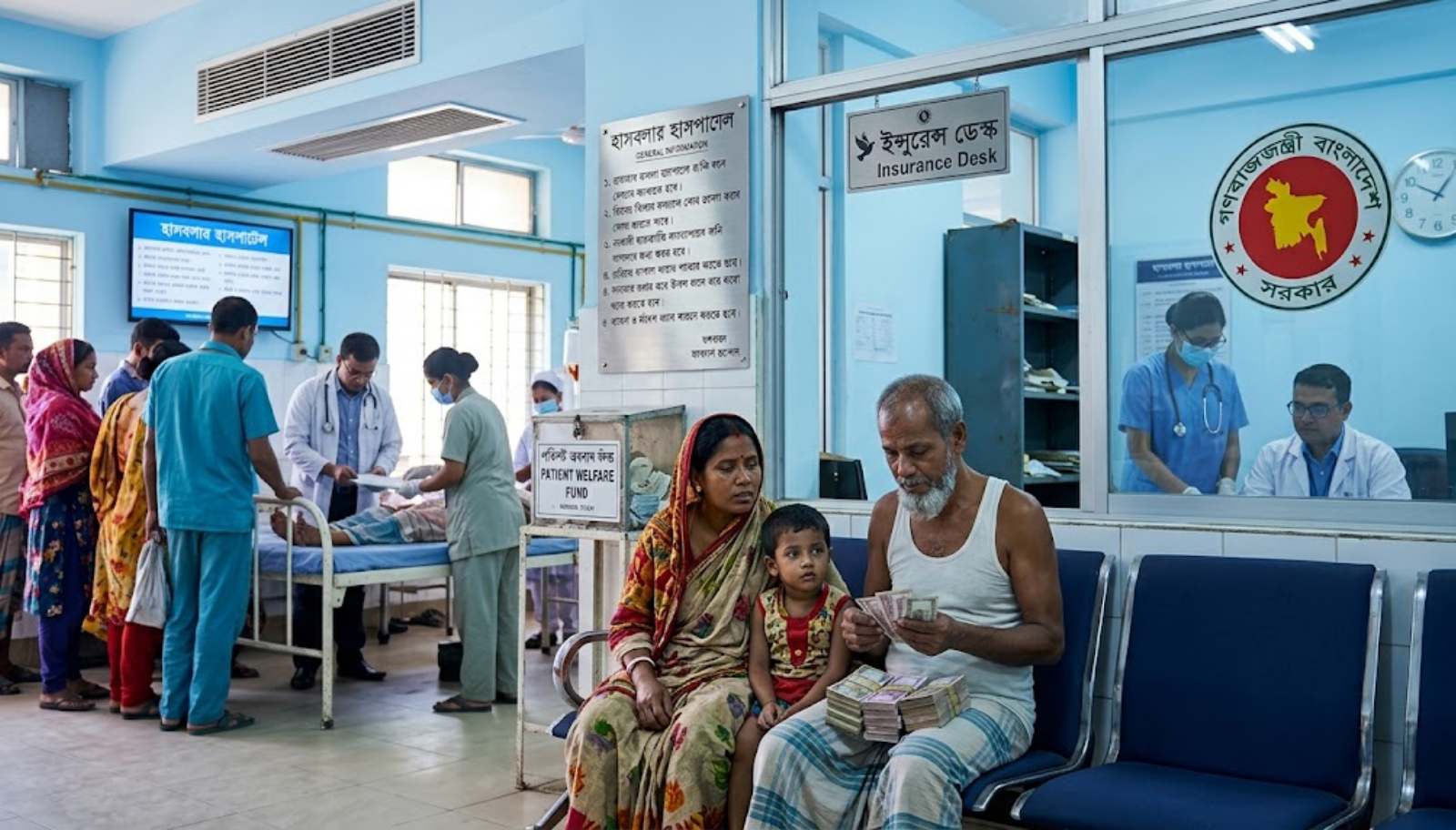
One of the biggest contradictions in Bangladesh’s healthcare sector is that medical services have expanded considerably. The private hospital and clinic sectors have grown; diagnostic centres have become more widespread and specialised medical services have expanded significantly. However, the country has failed to develop a strong health insurance system capable of sharing the financial risks associated with medical treatment.
As a result, illness can become a major financial crisis for most families. From a health economics perspective, this is a fundamental problem. No one can predict when they will need medical treatment. A major medical expense, however, can fall on any family at any time.
What Is the Core Principle of Insurance?
The basic principle of insurance is to distribute uncertain and potentially large financial risks among many people. For people with limited incomes, such risk sharing can reduce financial pressure during a crisis and provide greater peace of mind.
In Bangladesh, however, risk sharing remains extremely weak within the healthcare financing system. According to the World Health Organization, the three core functions of health financing are raising revenue, pooling financial risks and purchasing or paying for healthcare services. The fundamental question for Bangladesh, therefore, should be:
After decades of expansion in the healthcare sector, why has the country failed to develop an effective system for sharing the financial risks associated with healthcare costs?
A large share of healthcare expenditure in Bangladesh comes directly from patients and their families. According to the National Health Accounts for 2015, households had to finance around 67 percent of total healthcare expenditure from their own resources, placing Bangladesh among the countries with the highest levels of out-of-pocket healthcare spending in the Southeast Asian region. Data from subsequent years have not shown any major structural change in the problem.
According to a 2025 assessment by the World Health Organization, 41.7 percent of Bangladesh’s population faced financial hardship because of healthcare expenditure in 2025, affecting roughly 70 million people. The same assessment placed Bangladesh’s Universal Health Coverage index at only 54 out of 100.
The problem, therefore, does not end with the statement that healthcare is expensive. The deeper problem is that when people need medical treatment, there is no strong institutional financial mechanism available to help them bear the cost.
Health insurance is not a luxury financial product. Logically, it should have become an important part of the country’s social and economic risk management infrastructure. Unfortunately, such a system has not developed in Bangladesh.
Does Bangladesh Have Insurance Laws?
Clarification is necessary here. It would be incorrect to say that Bangladesh has no laws governing the insurance sector.
The Insurance Act 2010 was introduced to replace and consolidate the earlier Insurance Act of 1938. At the same time, the Insurance Development and Regulatory Authority Act 2010 was enacted, providing the legal foundation for the establishment of the Insurance Development and Regulatory Authority. The authority began its operations in 2011.
In other words, Bangladesh does have a general regulatory framework for the insurance sector. However, the infrastructure required for an effective health insurance market cannot be created through insurance law alone. A functioning health insurance market requires several interconnected systems.
A reliable framework for assessing and accrediting healthcare providers and institutions is essential. There must also be transparency in how hospitals and doctors set and publish their service fees, along with standard treatment protocols, clinical guidelines, uniform classifications for diagnoses and treatment procedures, and reliable electronic medical records.
At the same time, there must be effective systems for verifying insurance claims, preventing fraud and overbilling, and establishing contractual healthcare networks between insurance companies and healthcare providers.
Third party claims management or similar arrangements can also play an important role. Patients need an effective and transparent mechanism for filing complaints and resolving disputes, while all relevant parties must be held accountable.
Above all, Bangladesh needs a clear regulatory framework governing how health insurance is purchased, how premiums are determined and paid, and how policyholders can access their benefits. Without such an integrated framework, building public confidence in health insurance and developing a sustainable healthcare system will remain difficult.
This is where one of Bangladesh’s biggest weaknesses lies. Insurance regulation and healthcare regulation have not been developed as two interconnected parts of the same economic system.
Why Is Regulation of the Hospital Market Important for Health Insurance?
This is a particularly important issue. In a conventional life insurance policy, an insurer can assess risks with relative clarity. In health insurance, however, the insurer’s risk depends on a much wider range of factors. These include the need for medical treatment, the type of treatment required, hospital practices, doctors’ treatment decisions, the use of diagnostic tests and the cost of medical services.
Consider a simple example. Suppose an insurance company provides an individual with health insurance for an annual premium of Tk20,000. If the insurer has no reliable contractual or regulatory mechanism governing where the person will receive treatment, how much a hospital will charge for a particular condition, how many tests will be conducted, or whether a particular treatment or surgery is genuinely necessary, accurately estimating the future cost of the policy becomes extremely difficult.
The problem becomes even more complicated when hospitals and doctors differ significantly in their pricing, treatment practices and billing procedures. In such circumstances, an insurer cannot reliably estimate future claims.
Therefore, creating a health insurance market requires more than simply establishing insurance companies. Bangladesh needs a regulated system for purchasing and delivering healthcare services. This is perhaps the most important link missing in the country’s health insurance market.
The more fundamental question is this: How can an insurer develop a sustainable health insurance product in a market where future healthcare costs are difficult to estimate reliably?
Three major risks require particular attention in health insurance. First is adverse selection. People who are more likely to become ill may have a greater incentive to purchase insurance. Second is moral hazard. Once insurance coverage is available, patients or healthcare providers may have greater incentives to use more treatment or diagnostic services than are medically necessary. Third is provider induced over-treatment and fraud. Healthcare providers may increase their income by recommending additional tests, procedures or more expensive treatments.
To manage these risks, insurers need accredited hospital networks, systems for obtaining prior approval for certain treatments, claims verification, medical review, negotiated treatment prices and reliable health information. Because such infrastructure remains insufficiently developed in Bangladesh, health insurance has struggled to become a large and competitive market.
Why Has a Voluntary Private Health Insurance Market Not Developed?
When health insurance is entirely voluntary, a fundamental problem emerges. A healthy young person may think, “I am not sick, so why should I spend money on insurance?” A person facing greater health risks, on the other hand, may have a stronger incentive to purchase coverage.
As a result, a voluntary insurance pool can gradually become concentrated with higher risk individuals, pushing up the cost of insurance. As premiums increase, healthier people may become even less willing to remain insured. This creates a vicious cycle.
For this reason, many countries have not left health insurance entirely to individual choice. Some have developed tax funded public healthcare systems, while others rely on social health insurance, mandatory private health insurance or a combination of different approaches.
Bangladesh has not yet established a large-scale health insurance fund that is mandatory and capable of sharing healthcare risks and costs across different sections of the population. As a result, health insurance has remained a relatively small and limited market rather than becoming a broad social mechanism for sharing health risks.
The United Kingdom, the United States and the United Arab Emirates: Three Different Models
International comparisons are important for understanding Bangladesh’s position. The United Kingdom has a large publicly funded healthcare system through the National Health Service. Much of the cost of healthcare does not depend on individuals paying private insurance premiums.
The United States, by contrast, has a complex, multi layered insurance-based healthcare financing system. Employer provided health insurance, government health programmes and privately purchased insurance all contribute to healthcare financing.
The United Arab Emirates, meanwhile, has introduced mandatory health insurance arrangements for foreign workers and employees in the private sector in several parts of the country.
Bangladesh does not fully resemble any of these three models. It does not have the universal, tax funded healthcare coverage associated with the United Kingdom, nor does it have mandatory private health insurance covering the entire population.
As a result, the country has not developed a large and well organised risk sharing mechanism connecting the state, employers and insurance companies. The result is a system in which healthcare services are available, but financial protection for accessing those services does not exist at the same level.
Next week, the second part of this discussion will examine some of the most urgent issues surrounding health insurance and explore several practical and potentially effective ways forward.
Reference: