
Dr. Nuruzzaman Khan
Adelaide University, Australia
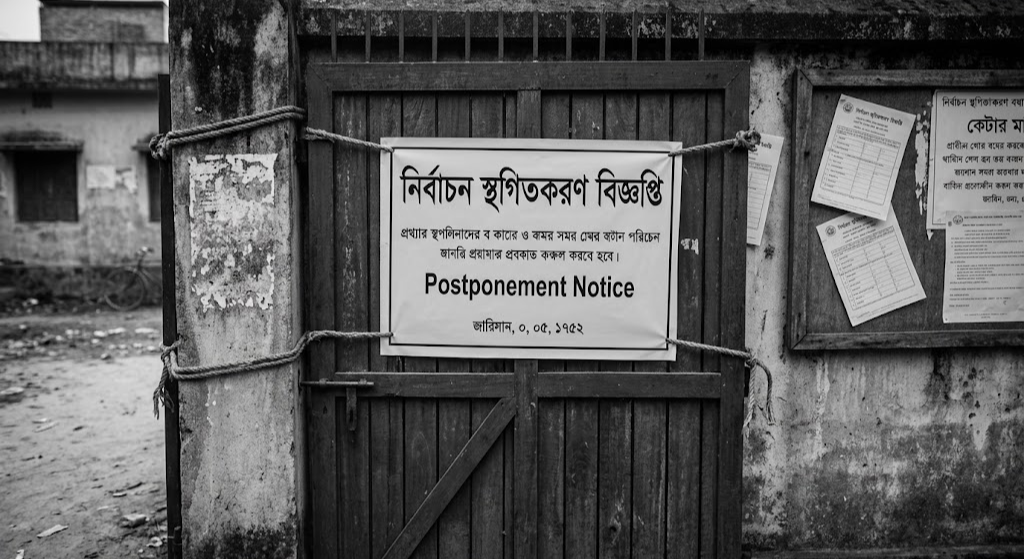
This article examines the Election Commission’s decision to rule out local government elections this year, and considers its implications for regional governance, law and order, and the protection of vulnerable citizens across Bangladesh. On its surface, the announcement that local elections will not take place in November or December is an administrative scheduling matter. Preparations had originally aimed at October, then shifted toward a planned November announcement, and now even that timeline has collapsed after the government objected that it had not been consulted on union parishad polling dates.
Stakeholder talks with political parties scheduled for late September were cancelled along with a planned law and order meeting. Beneath this bureaucratic back and forth lies a more consequential reality. Local governments, the union parishads, upazila parishads, and municipal bodies that handle everything from birth registration to dispute mediation to first response coordination during crises, will continue operating without a fresh popular mandate for months longer than expected, and possibly well into the following year given how uncertain the Commission itself now sounds about the timeline.
Why Local Governance Cannot Simply Wait
Local elected bodies are not ceremonial. They are often the first and sometimes only point of contact between citizens and the state, particularly outside major cities. When these positions are filled by caretakers, administrators, or officials serving well past their expected mandate, the accountability that elections are meant to provide begins to erode. Local representatives lose the incentive that comes from an approaching vote, oversight of local police coordination and dispute resolution weakens, and a governance gap opens precisely in the spaces where national institutions are least present.
This matters enormously for law and order at the regional level, since union parishad chairmen and local council members frequently serve as informal mediators in disputes that might otherwise escalate into violence, and as conduits for reporting emerging crime patterns to police and administration.
A Law-and-Order Backdrop That Makes the Delay Harder to Justify
The postponement does not occur in a vacuum. Bangladesh has recently confronted deeply troubling reports of child abuse and killings, with dozens of missing children found dead over recent months prompting public alarm about who is responsible for protecting the country’s most vulnerable citizens in regional and rural areas.
Alongside this, broader patterns of human rights concern, including inadequate investigation timelines, weak local accountability structures, and uneven policing capacity outside Dhaka, have drawn sustained public and civil society attention. In this context, a functioning, freshly elected local government tier is not a luxury. It is one of the few structures capable of generating community level vigilance, reporting mechanisms, and social accountability that can help prevent such tragedies and ensure faster response when they occur. Delaying local elections without a clear, published rationale risks signaling that governance continuity in the regions is a secondary concern compared to procedural disputes between the Commission and the government over consultation and scheduling.
Alternatives the Commission Could Have Pursued
Rather than an open-ended postponement, the Election Commission had several paths available. It could have proposed a phased election schedule, holding polls in administratively ready and lower risk districts first while continuing preparation and security coordination in more sensitive areas, rather than treating the entire local government tier as a single all or nothing exercise.
It could have published a firm, binding timeline with specific trigger conditions, rather than the current pattern of successive informal estimates, October slipping to November, November now ruled out, and January offered only as a guess rather than a commitment. It could also have insisted on a joint public statement with the Local Government Division clarifying the substance of the disagreement over consultation, since ambiguity about why elections were delayed does more damage to public confidence than the delay itself.
Finally, engaging political parties and civil society in parallel with, rather than after, internal government negotiations would have preserved some of the stakeholder trust that cancelling the scheduled talks has now put at risk.
Reforms That Would Strengthen the Path Forward
For local governance to check regional law and order failures, several reforms deserve consideration. A statutory requirement for advance, joint consultation between the Election Commission and the Local Government Division would prevent last minute objections like the one that triggered this postponement. Clearer legal timelines for how long local bodies may operate under caretaker administration would reduce current uncertainty.
Strengthening local units’ security coordination, including formal links between union parishad offices and child protection services, would help address recent abuse cases. Greater transparency from the Commission, publishing its security assessments rather than brief remarks, would let citizens judge whether delays are genuinely necessary.
Without such reforms, shifting dates and vague reassurances risk becoming a default, not the exception.