
Hafizur Rahman
Oniket Research Group
Bangladesh’s graduation from the least developed country (LDC) category is often presented as proof of progress. The Economic Relations Division’s Support to Sustainable Graduation Project (SSGP) which explains that graduation is assessed against three criteria: gross national income per capita, the Human Assets Index (HAI), and the Economic and Environmental Vulnerability Index. Bangladesh met the thresholds in the 2018 and 2021 reviews and it was recommended for graduation. Therefore, the HAI was not a criterion Bangladesh failed to meet. The real question is whether improvements in health and education translate into secure livelihoods and whether citizens can withstand economic shocks.
The United Nations has extended Bangladesh’s preparatory period until 24 November 2029, creating three years to address structural weaknesses. Sustainable graduation must improve ordinary people’s lives, not merely satisfy statistical thresholds.
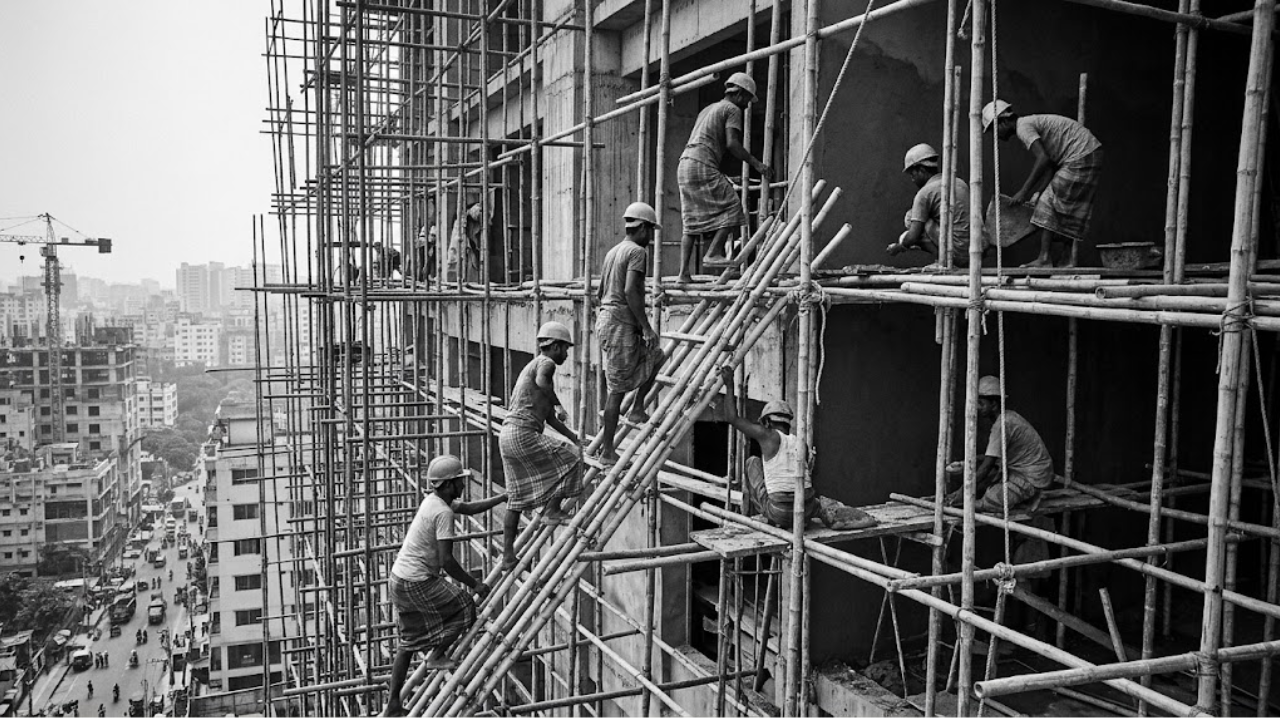
The first major gap is the prevalence of informal and insecure employment. The Bangladesh Bureau of Statistics’ Labour Force Survey 2024 found that around 84 percent of employed people, approximately 58 million workers, were in informal employment. Such work often provides no written contract, paid leave, pension contribution or reliable protection against dismissal and workplace injury. Economic growth, therefore, can depend on workers who lack security and bargaining power. A low unemployment rate can conceal this weakness: having a job is not the same as having decent work. Informality also limits access to training, finance and career progression. Women are especially exposed because they are concentrated in vulnerable jobs and face barriers to entering and remaining in paid employment.
This is a matter of citizenship and rights, not simply labour-market efficiency. Fair work should mean safe conditions, timely wages, freedom from discrimination and remedies when employers violate the law. Yet enforcement is difficult when workers are scattered across small enterprises, domestic work, agriculture and transport. The deferment should be used for one focused reform: a phased national programme to formalize employment and extend basic labour rights to informal workers.
The government should simplify worker and business registration, introduce low-cost digital employment records, and progressively enforce written agreements, wage records and safety standards. Labour inspection should be transparent and risk-based, with accessible complaint channels and protection against punishment. Small enterprises should receive technical support and temporary incentives, but should not be permanently excused from following laws. Public progress reports should track registered workers, written contracts, injury protection and timely wage payment. Regularisation would then become a route to fair work, not an exercise of paperwork.
The second major gap is the limited reach and weak targeting of social protection. Bangladesh has many safety-net programmes, but their existence does not ensure that support reaches those who actually need it. A World Bank assessment based on the Household Income and Expenditure Survey 2022 found that more than half of poor households received no social protection support. It also found that the share of benefits reaching the bottom 40 per cent fell from 51 per cent in 2016 to about 44 per cent in 2022, which suggesting that better-off groups receive an disproportionate share. Benefits are often too small to protect households from illness, unemployment, disability, old age, inflation or natural disasters. Informal workers are particularly vulnerable because they usually lack insurance, paid sick leave and unemployment protection. When income disappears, children may leave school and families may fall back into poverty and lose the human-development gains they have achieved.
The second reform should be a single, transparent social protection system with an updated national database. Instead of separate lists and unfair selection the system should identify households by income, disability, age, employment, location and climate risks. Citizens must be able to apply, correct errors and appeal exclusion through local offices and digital channels. Independent audits, public reporting and penalties for political interference are essential. The system should connect eligible informal workers to affordable, portable protection against work injury, maternity, health and old-age risks, with public subsidies for the poorest. Benefits should also be reviewed against inflation. A database alone is not enough; sufficient funding is also needed to ensure fair and effective public spending. Bangladesh’s three-year extension must not become three more years of delay. It is an opportunity to turn graduation from a national label into a social achievement. Balancing insecure work and building accountable social protection address the gap between human-development indicators and everyday realities. By 2029, success should be judged not only by exports or income per capita, but by whether workers enjoy fair conditions and vulnerable citizens can claim protection as a right for all, without discrimination or exclusion. Then that will be the suitable sustainability of graduation.
References
- https://ssgp.erd.gov.bd/sustainable-graduation/
- https://www.un.org/ldcportal/en/content/bangladesh-graduation-status
- http://bbs.gov.bd/pages/static-pages/6922ddd1933eb65569e166e7?utm_source=chatgpt.com
- https://documents1.worldbank.org/curated/en/099021125012018985/pdf/P508519-6df0b145-17b8-41a7-a1ac-3764e929ad9b.pdf?utm_source=chatgpt.com
- https://www.tbsnews.net/economy/govt-drafts-reform-roadmap-seek-delay-ldc-graduation-until-2029-1453681
- https://www.thedailystar.net/business/news/bangladesh-secures-three-year-ldc-graduation-deferment-4311036