
Shahrazad Rahman
Oniket Research Group
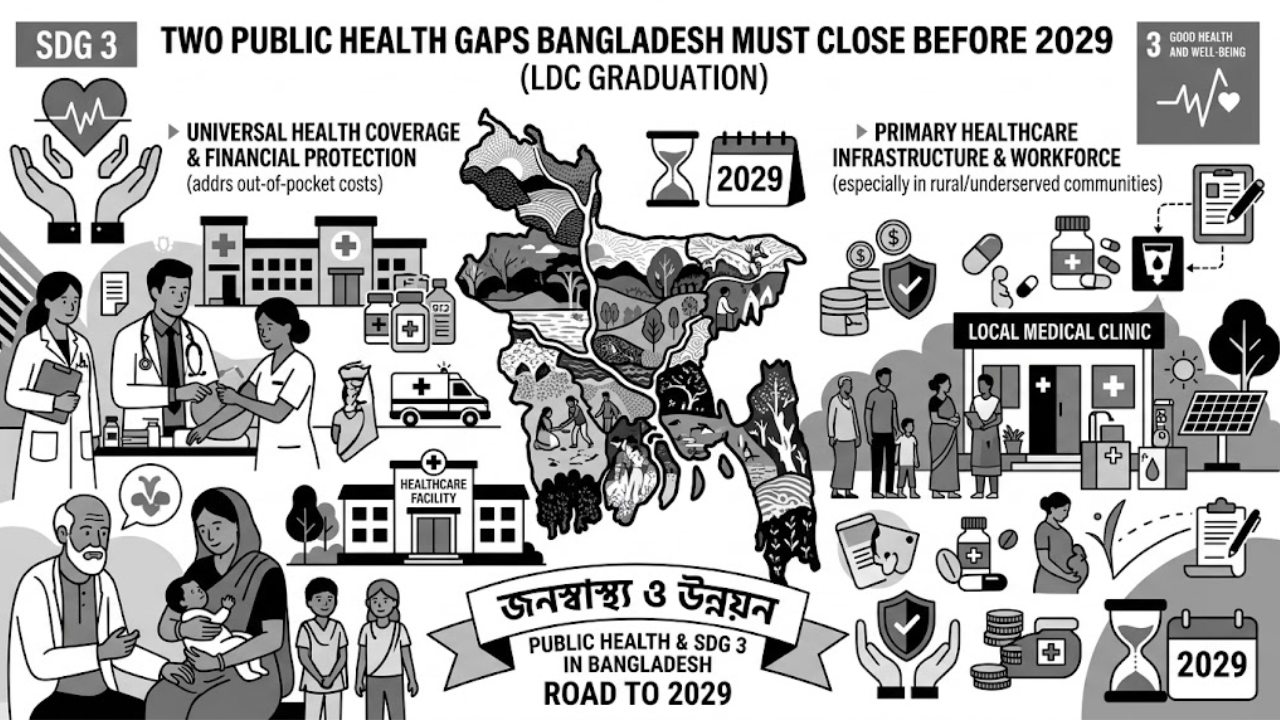
Summary: Bangladesh should use its three-year graduation extension to fix who pays for care and who delivers it: free, staffed and publicly accountable primary care.
Introduction
Bangladesh was scheduled to leave the UN’s Least Developed Country (LDC) category on 24 November 2026. It will not. The UN General Assembly has approved a three-year extension to 24 November 2029, following a request citing political, macroeconomic and external shocks [1]. It is important to note that this was not a failure to meet the criteria: the UN Committee for Development Policy found that Bangladesh comfortably exceeds all three thresholds [2]. However, meeting a statistical threshold does not guarantee affordable, quality care. This article argues that two public health gaps, financing and service delivery, could make graduation hollow, and that one targeted reform for each should be delivered within the extension period.
Gap one: households, not the state, finance care
Bangladesh spent a smaller share of GDP on health than any of the 45 LDCs in 2021, and out-of-pocket payments made up 73% of total health expenditure [3]. A WIPO-led study reports 72.5% for 2022 and a universal health coverage index of 52 out of 100, meaning only about half of needed essential services reach the people who need them [4]. Estimates vary by source, for example 68.5% in a 2026 PPRC study [5], but the pattern is consistent.
This is a right-to-health problem because affordability determines whether the right can be enjoyed in practice. The Centre for Policy Dialogue found that health costs pushed 3.74% of Bangladeshis below the US$2.15 poverty line in 2016, up from 3.11% in 2010, although these data are now dated [6]. The proposed FY2026-27 budget raises health funding to Tk 694 billion, just over 1% of GDP [7]. This is welcome. However, an allocation is not expenditure, and commentators note that persistent underspending has weakened the sector’s case for larger budgets [8]. Affordability may also come under pressure after graduation, since LDCs’ exemption from TRIPS obligations ends on graduation or in 2034, whichever is earlier [4].
Reform 1: legislate a primary-care-first financing guarantee:
Parliament should require at least half of the health budget to be spent on primary care, as the Health Sector Reform Commission recommended [9], alongside free essential medicines at union and upazila facilities. The Finance Ministry should publish quarterly spending against allocation, making underspending visible. A simulation presented at a Dhaka policy forum estimated that raising supply budgets and filling local vacancies could cut the out-of-pocket share from 69% to 51% [10]. As a modelled estimate this should be treated with caution, but it illustrates that where money is spent matters as much as how much.
Gap two: clinics without staff, and no one to answer to
Financing alone cannot deliver care without people to provide it. Bangladesh has 0.7 physicians per 1,000 people, and its ratio of doctors to nurses to technologists is 1:0.4:0.24, against a WHO-recommended 1:3:5. Only about 23% of health professionals serve rural areas, where roughly 60% of the population lives [4] (citing WHO and UKaid data). These figures are secondary and several years old, so current verification would strengthen the argument, but they point to a clear rural imbalance. One consequence is that patients bypass local facilities: around 700,000 Bangladeshis travel abroad for care each year, spending approximately US$3.5 billion [4].
Accountability compounds the problem. Analysts describe a sector affected by corruption, administrative inefficiency and political interference [11]. Citizens cannot see whether a doctor is present or medicine is in stock, so they cannot hold providers to account. This weakens the existing constitutional reference to basic medical care [9].
Reform 2: staff, and publicly report on, every union-level centre:
The government should establish the Bangladesh Health Service proposed by the Reform Commission, with rural postings tied to career progression [12]. Union centres should be upgraded to primary care centres with at least two doctors each [11]. Monthly facility data on staff attendance and medicine stock should be published, and local committees with citizen members empowered to escalate failures. Routing health procurement through the e-GP system, also recommended, would limit leakage [13]. The main limitation is delivery: implementing these reforms under an elected government will be challenging [12].
Conclusion
The extension protects exporters from a tariff shock, but it does nothing for a patient paying out of pocket in a clinic with no doctor. Progress by November 2029 can be judged by two measurable indicators: the out-of-pocket share of health spending, and the share of union centres with a doctor present. Both speak directly to citizens’ right to affordable care and to officials who can be held to account.
References
- Daily Sun. Experts urge urgent reforms as UN extends LDC graduation to 2029 [Internet]. Daily Sun; 2026 [cited 2026 Nov 3]. Available from: https://www.daily-sun.com/business/906562/experts-urge-urgent-reforms-as-un-extends-ldc-graduation-to-2029
- TBS News. UN panel recommends shorter extension for Bangladesh’s LDC graduation timeline [Internet]. The Business Standard; 2026 [cited 2026 Nov 3]. Available from: https://www.tbsnews.net/economy/un-committee-backs-bangladeshs-request-extend-ldc-graduation-preparatory-period-2029-1452531
- Centre for Policy Dialogue. Health budget of Bangladesh: enhancing efficiency for better health delivery [Internet]. Dhaka: CPD; 2025 [cited 2026 Nov 3]. Available from: https://cpd.org.bd/resources/2025/08/Health-Budget-of-Bangladesh-Enhancing-Efficiency-for-Better-Health-Delivery.pdf
- World Intellectual Property Organization. Strengthening medical technology innovation ecosystems to address non-communicable diseases in least developed countries. Geneva: WIPO; 2025. doi:10.34667/tind.58758
- Policy Planning and Research Centre (PPRC). Bridging gaps in Bangladesh’s public health system [Internet]. PPRC; 2026 [cited 2026 Nov 3]. Available from: https://www.pprc-bd.org/tag/heu/
- Centre for Policy Dialogue. A quick look on Bangladesh health budget [Internet]. Dhaka: CPD; [cited 2026 Nov 3]. Available from: https://cpd.org.bd/?p=50539
- Financial Express. Health allocation doubles, exceeds 1.0pc of GDP [Internet]. The Financial Express; 2026 Jun 12 [cited 2026 Nov 3]. Available from: https://today.thefinancialexpress.com.bd/print/health-allocation-doubles-exceeds-10pc-of-gdp-1781199532
- Dhaka Tribune. The health budget paradox [Internet]. Dhaka Tribune; 2026 Jun 26 [cited 2026 Nov 3]. Available from: https://www.dhakatribune.com/opinion/op-ed/413638/the-health-budget-paradox
- Dhaka Tribune. Reforming health systems for the future [Internet]. Dhaka Tribune; 2025 [cited 2026 Nov 3]. Available from: https://www.dhakatribune.com/amp/opinion/longform/382341/reforming-health-systems-for-the-future
- UNB. Increase health budget to reduce out-of-pocket expenditures: speakers [Internet]. United News of Bangladesh; [date unknown] [cited 2026 Nov 3]. Available from: https://unb.com.bd/category/Bangladesh/increase-health-budget-to-reduce-out-of-pocket-expenditures-speakers/108389
- Financial Express. Health budget cut runs counter to reform ambition [Internet]. The Financial Express; 2025 [cited 2026 Nov 3]. Available from: https://thefinancialexpress.com.bd/views/columns/health-budget-cut-runs-counter-to-reform-ambition
- Daily Star. Proposals by the reform commission deserve serious consideration [Internet]. The Daily Star; 2025 [cited 2026 Nov 3]. Available from: https://www.thedailystar.net/node/3888226
- Dhaka Tribune. Health reform plan puts patients first [Internet]. Dhaka Tribune; 2025 [cited 2026 Nov 3]. Available from: https://www.dhakatribune.com/bangladesh/388165/health-reform-plan-puts-patients-first