
Naima Onamika
Oniket Research Group
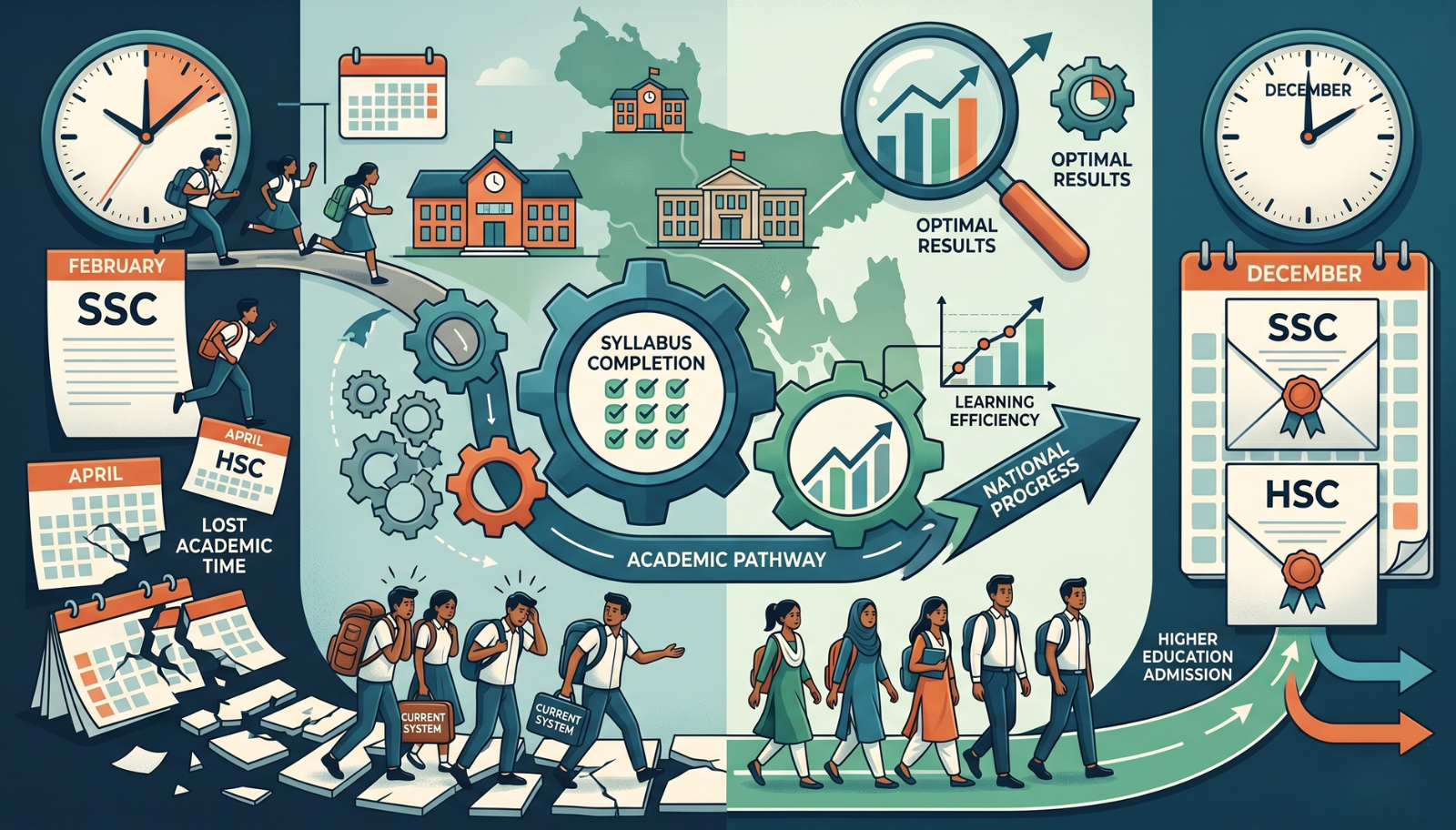
A recent news story concerning education has recently come to the centre of discussion. In the case of this published news, both discussion and criticism are equally important. Other points included in the Ministry of Education’s proposal are standardised question papers, CCTV surveillance and the idea of reducing the number of subjects, as well as the opportunities and challenges of reform. The first question that arises in the discussion is: is the decision to hold the SSC and HSC exams at the end of the year really an initiative to save students’ time, or the beginning of a new pressure?
The Ministry of Education’s recent initiative to propose ending the SSC and HSC exams by 31st December each year has brought to the fore a fundamental problem that has long been festering within the Bangladeshi education system. This is coupled with significant reform proposals such as the introduction of common question papers, CCTV surveillance in examination halls, and the reduction of the number of subjects. At first glance, these measures may seem modern, timely and necessary, but a closer look reveals they also present a complex equation of both promise and challenge.
The biggest criticism of the current examination system is its protracted nature. A student effectively loses nearly two years completing their SSC and HSC, which is a significant hindrance in an age of global competition. In that respect, the plan to finish examinations by the end of the year could accelerate the pace of academic life. This could play a positive role in faster entry into higher education, quicker participation in the workforce, and the overall enhancement of human capital skills. In other words, it is a significant step not only from an educational standpoint but also from an economic perspective.
However, it is almost certain that the implementation of this policy progress will face structural constraints. This is because the Bangladeshi education system still grapples with a teacher shortage, overcrowded classrooms, an unbalanced curriculum and a heavy reliance on coaching, all of which remain significant challenges.
If exams are to be completed by December, the time available for curriculum completion will be reduced, which will undoubtedly increase pressure on students and encourage a tendency to rush through rather than to learn constructively. While the proposal to introduce a common question paper is significant for its aim of bringing equity in assessment, there are questions about how well it aligns with reality.
Ignoring the disparities in educational standards, teacher competence, and infrastructure across the country’s various education boards, implementing a single question paper risks leaving students from marginalised regions at a competitive disadvantage. Consequently, the potential for creating new inequalities, rather than achieving the desired equality, cannot be ruled out.
On the other hand, the initiative to install CCTV in examination halls could help ensure transparency and accountability. It is thought to play an effective role in preventing cheating and irregularities. However, the financial cost, maintenance, and ensuring technical capability are a major challenge, especially in centres in rural and underdeveloped areas.
The proposal to reduce the number of subjects could also have a dual impact. On the one hand, it would help to reduce students’ stress, but on the other, it would risk limiting the breadth and multidisciplinary of education. Consequently, in making this decision, not only the pressure of examinations but also the overall standard of education and the development of skills must be taken into consideration.
Overall, this reform initiative by the Ministry of Education is a necessary policy advancement that helps to meet the demands of the times. However, if implemented without adequate preparation, pilot projects, and measures to reduce regional disparities, this initiative could fail to deliver the expected benefits and instead create new crises. This transformation of the education system is therefore not merely a matter of altering timetables; it is the beginning of a profound structural reform, and a coordinated, pragmatic approach is essential for its success.




Thank you for this insightful article on the topic.