
Desk Report
Oniket Desk
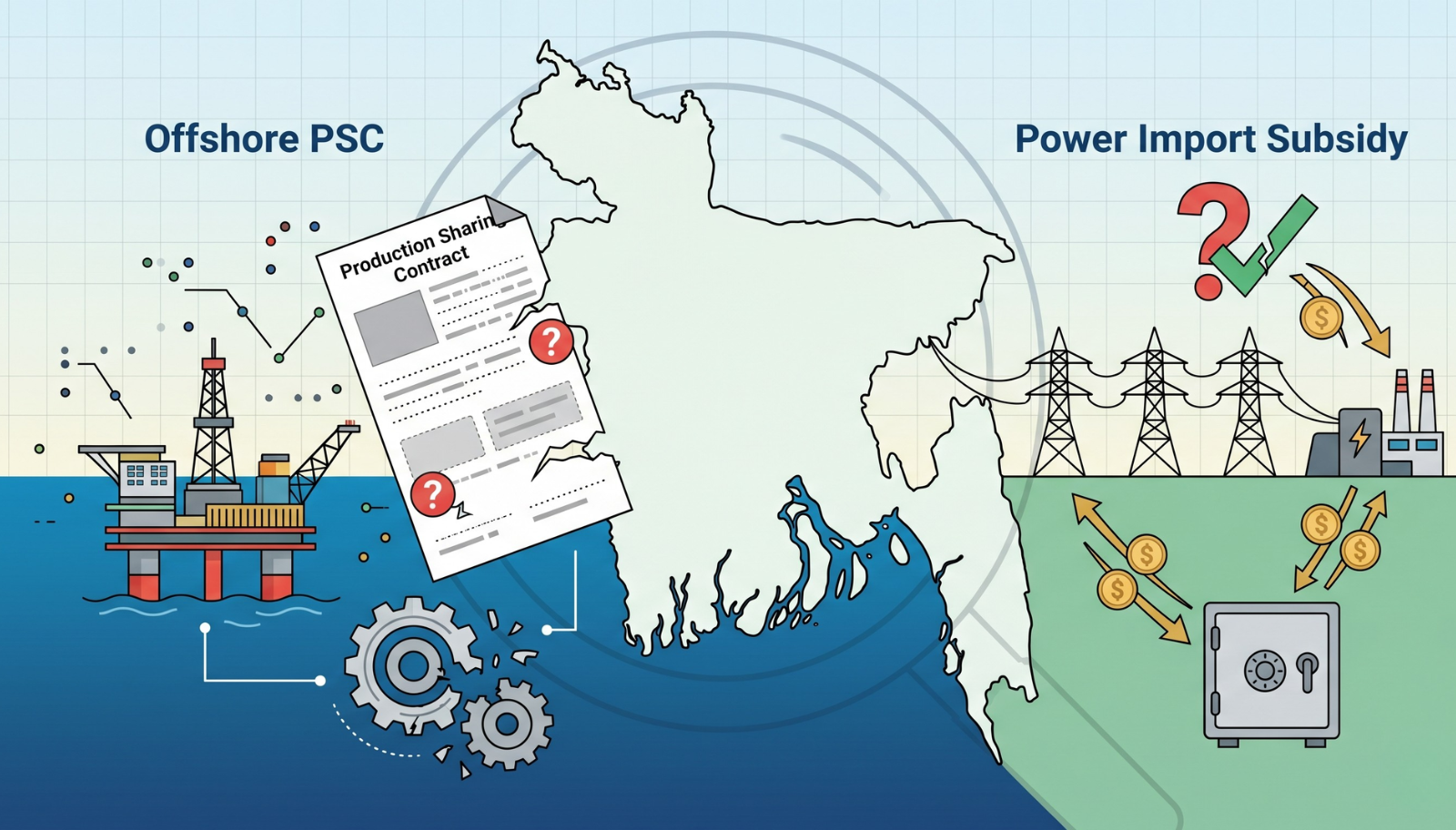
The Cabinet Committee on Economic Affairs has granted in-principal approval to two significant energy sector measures: the Bangladesh Offshore Model Production Sharing Contract (PSC) 2026, and a partial subsidy arrangement for electricity imports from state-owned plants, joint ventures, and private sources in India and Nepal including Adani Power Jharkhand.
Taken together, these decisions signal a government under pressure to resolve a chronic energy deficit. Taking critically, they raise questions that in-principal approval cannot answer.
The Offshore PSC 2026: Promise Without Sufficient Scrutiny
A modernised offshore PSC framework is long overdue. Bangladesh’s Bay of Bengal holds substantial unexplored hydrocarbon potential, and the absence of a competitive, investor-friendly PSC has been a primary deterrent to international oil companies for over a decade. In that context, the PSC 2026 is a welcome directional shift. However, in-principal approval of a draft framework is not the same as a rigorous policy instrument.
The critical details such as the government-to-contractor profit-sharing ratios, cost recovery ceilings, fiscal stabilisation provisions, local content requirements, and dispute resolution mechanisms are precisely the terms that determine whether the PSC attracts serious investment or merely signals intent.
Bangladesh’s past PSC negotiations have been marked by opacity and terms that were either excessively generous to contractors or insufficiently predictable to attract frontier exploration players. Without publishing the draft PSC for independent technical and legal review, including input from BAPEX, independent petroleum economists, and civil society, the approval process risks reproducing the same governance deficits that left previous offshore blocks unexplored. A model contract that is not publicly scrutinised before finalisation is a missed opportunity for transparency and long-term credibility.
Furthermore, the PSC framework must be accompanied by a clearly articulated national depletion and revenue management policy. Offshore exploration, if successful, will generate revenues over a decade or more. Without a sovereign wealth or stabilisation fund mechanism, those revenues are vulnerable to political expenditure pressures rather than strategic national investment.
The Power Import Subsidy: Pragmatic but Structurally Concerning
The decision to bring electricity imports (including from Adani Power Jharkhand) under the government’s subsidy list is presented as a measure to ensure uninterrupted power supply. The pragmatic logic is understandable given Bangladesh’s persistent supply-demand gap. However, extending subsidies to power imports raises multiple structural concerns that the approval process does not appear to have addressed.
First, subsidising imported electricity from private foreign generators, particularly from a supplier as commercially and reputationally contested as Adani, entrenches a fiscal and political dependency that is difficult to reverse. The subsidy architecture effectively commits public funds to support a supply arrangement that bypasses the discipline of competitive procurement. Second, the partial nature of the approval (granting subsidy status selectively across different import sources) introduces pricing distortions that complicate rational energy system planning. Third, there is no indication of a sunset clause or review mechanism tied to the subsidy, raising the prospect of open-ended fiscal exposure.
The Broader Policy Gap
Considered together, both decisions reflect a reactive rather than strategic energy policy posture. Bangladesh needs not merely new contracts and subsidy extensions, but a comprehensive integrated energy plan that sequences domestic offshore development, renewable energy scaling, import dependency reduction, and fiscal sustainability within a coherent twenty-year framework. Approving individual measures in isolation, even, if necessary, in the short term is not a substitute for that architecture. The government should treat these in-principal approvals as the beginning of a policy conversation, not its conclusion.