
Farah Zahir
Oniket Research Group
The National Emergency: A Crisis Without Age Boundaries
Bangladesh is currently navigating a period of profound social turbulence. Despite the economic strides of 2026, the country is facing what human rights watchdogs describe as a “sexual violence epidemic.” Data from early 2026 reveals a staggering 27% rise in reported rape cases compared to the previous year, with a chilling 70% of victims being minors under the age of 18. However, this crisis is not limited to the young. Recent studies indicate that elderly women are increasingly vulnerable to physical and social abuse, often within their own homes, where they are viewed as “financial burdens” rather than respected matriarchs. This breakdown of the social fabric, affecting everyone from the schoolgirl to the grandmother, demands a solution that goes beyond police intervention. It requires a fundamental shift in the national mindset, rooted in the classroom.
Why “Sex Education” is Actually “Safety Education”
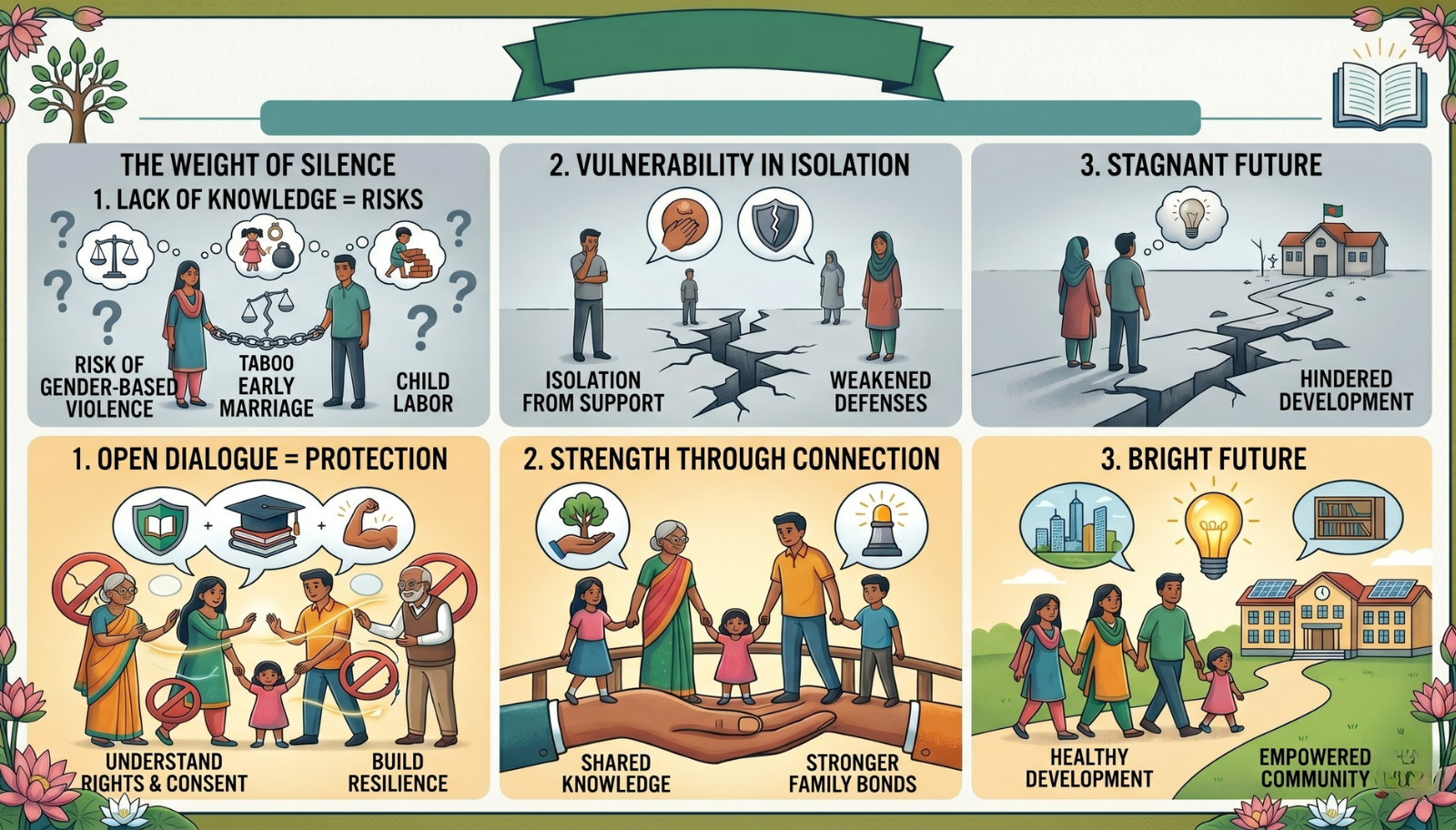
The primary reason sexual crimes persist is the “Information Gap.” Predators thrive on the silence of their victims. When children are not taught the language of bodily autonomy or the concept of “consent,” they lack the tools to identify abuse when it happens. This ignorance is often weaponized as “innocence,” but in reality, it is a dangerous vulnerability. A “meaty” and effective curriculum does not focus on promoting sexual activity; rather, it is a rigorous framework for National Safety. It teaches children to recognize “safe vs. unsafe” touch, empowers teenagers to understand healthy relationship boundaries, and provides adult women with the awareness of their legal rights. By rebranding “Sex Education” as “Child Safety and Wellbeing,” the Education Department can bypass the political friction and focus on the universal human right to be safe from harm.
Bridging the Religious Divide: A Strategy of Inclusion
The complexity surrounding this topic is often amplified by a “moral panic” that suggests such education is incompatible with religious values. However, a deeper look into Islamic scholarship reveals strong themes of modesty (haya), the sanctity of the human body, and the absolute requirement to protect the vulnerable. The current stagnation in the 2026 curriculum, where inclusive content was recently halted,is a result of this misunderstanding.
To move forward, the Education Department must stop treating religious leaders as obstacles and start treating them as partners in protection. A curriculum co-developed with credible religious voices can frame safety as a moral and spiritual duty. When a local Imam and a schoolteacher both tell a child, “Your body belongs to you, and no one has the right to touch it without your permission,” the taboo is shattered, and a shield of protection is built around the community.
Strategic Points for National Awareness & Crime Prevention
To effectively stop crimes against all women, from toddlers to the elderly, we recommend the following four-pillar approach:
Mandatory Reporting for Educators: Schools must be transformed from passive environments into active surveillance hubs. Legislation should be passed requiring all teachers and administrators to report suspected abuse immediately, backed by a legal immunity framework to protect whistleblowers.
The “MenCare” Ally Model: Crimes against women are, at their root, a problem of male behavior. Education must target young boys and men to dismantle “toxic masculinity” the idea that power equals dominance. Engaging men as allies in protecting their sisters, mothers, and grandmothers is the only way to break the cycle of violence.
Protection for the Matriarchs: Awareness campaigns must highlight the rights of elderly women. Many crimes against the elderly are “crimes of silence” committed by family members. Financial empowerment and legal aid for senior citizens must be linked to the education system to ensure the “respect” promised by our culture is backed by law.
Article 17 Reform: The Bangladesh Constitution (Article 17) guarantees the right to education. This should be legally interpreted to include “Health and Safety Education.” Making this a justiciable right allows civil society to hold the government accountable for any curriculum omissions that leave children and women unprotected.
The Cost of Inaction
As Bangladesh moves toward its 2026 graduation from Least Developed Country status, it cannot leave half of its population behind in a state of fear. The ‘Silence’ we maintain today is the permission we give to the criminals of tomorrow. Safety is not a ‘Western concept’; it is a fundamental human requirement. By bringing this education into the light, we are not losing our values, we are finally living up to them. The Education Department has the power to stop these crimes before they happen. It is time to choose the safety of our daughters and mothers over the comfort of our taboos.

