
Farah Zahir
Oniket Research Group
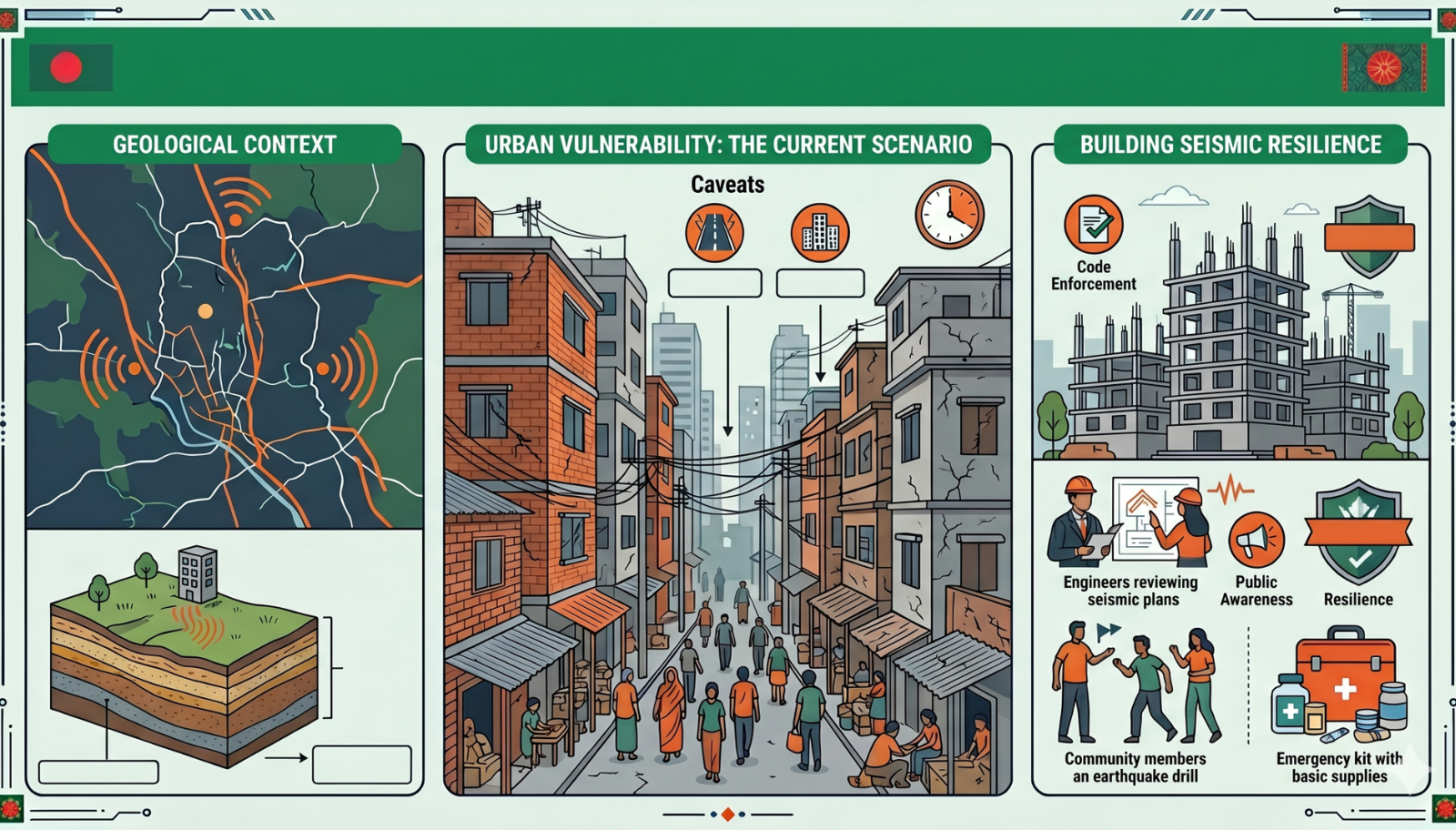
The geological silence that once defined the Bengal Basin was decisively broken on the morning of November 21, 2025, when a magnitude 5.5–5.7 earthquake struck near Narsingdi. While the 26 seconds of shaking resulted in ten deaths and hundreds of injuries, its true impact lies in the revelation that Dhaka’s seismic threat is far less predictable than previously modeled. This event, followed by a secondary tremor in December, originated from a poorly understood reactivated basement fault south of known active zones, signaling a shift in the regional tectonic behavior.
Bangladesh sits at the volatile convergence of the Indian, Eurasian, and Burma plates, and recent probabilistic analysis now places the likelihood of a magnitude 6.0 or greater event at a staggering 75.6% within the next five years. This is no longer a “potential” threat; it is a mathematical certainty for which the city remains fundamentally unprepared.
The crisis is exacerbated by a lethal combination of hyper-density and environmental degradation. Dhaka, home to nearly 24 million people, operates as a megacity where structural integrity has been sacrificed for rapid expansion. The widespread filling of natural wetlands in areas like Rampura and Turag has created a high susceptibility to soil liquefaction, a phenomenon where water-saturated earth loses its strength during shaking, effectively turning solid ground into a fluid state.
Compounding this is the annual groundwater depletion of up to three meters, which progressively weakens building foundations across the city. While the Bangladesh National Building Code (BNBC 2020) provides a robust technical roadmap for safety, its implementation remains a ghost in the machinery of urban governance. Most Dhaka’s 350,000 buildings exist in a state of non-compliance, representing a man-made disaster waiting to be triggered by a natural one.
From a policy perspective, the fault lines are equally systemic. The primary challenge confronting the government is not a lack of regulation, but a chronic failure of enforcement and fragmented institutional accountability. Currently, disaster management is paralyzed by overlapping jurisdictions between RAJUK, various City Corporations, and the Fire Service, creating a vacuum where no single authority is truly responsible for seismic prevention.
Unlike resilient global cities such as Tokyo or Istanbul, Dhaka lacks a centralized, mayoral-led command chain. This administrative friction is a choice, not a budget constraint; enforcing BNBC compliance for utility connections and bank financing requires political will, not massive expenditure. Furthermore, the economic argument for inaction, often cited as “cost-prohibitive”is a fallacy. A major earthquake could inflict up to $69 billion in economic damage, whereas global evidence proves that every dollar invested in preparedness saves four dollars in future recovery costs.
To mitigate the inevitable, the administration must transition from reactive damage control to proactive structural resilience. This begins with the mandatory risk-tiering and retrofitting of essential infrastructure, schools, hospitals, and emergency hubs, followed by the immediate deployment of a seismic Early Warning System (EWS). Using low-cost accelerometers along the border, such a system could provide Dhaka with the critical seconds needed to shut down gas lines and halt public transport.
Furthermore, the government must institutionalize national earthquake drills to reach the 65% of residents who currently lack any formal preparedness training. The Narsingdi earthquake of 2025 was not a catastrophe itself; it was a final, merciful warning. The window to enforce 100% building code compliance and restructure disaster governance is open, but as the plates continue to shift, that window is rapidly closing.
References
1. Samm-A, A., Kamal, A.S.M.M., Hossain, M.S., & Rahman, M.Z. (2025). Probabilistic seismic hazard mapping for Bangladesh using updated source models. Geomatics, Natural Hazards and Risk. https://doi.org/10.1080/19475705.2025.2454537
2. Sumon, M. (2025, November 22). Earthquake risk in Dhaka under magnitude 6.5, 7.0, and 8.0 events. Nature Insights. https://www.natureinsights.earth/post/earthquake-risk-in-dhaka-under-magnitude-6-5-7-0-and-8-0-events
3. Rezwan, M.M. (2025). Seismic hazard assessment for Bangladesh: Integration of statistical analysis and machine learning following the 2025 Narsingdi earthquake. Zenodo. https://zenodo.org/doi/10.5281/zenodo.17685817
4. DeshKal News. (2025, November 20). Dhaka’s earthquake risk exposed amid growing seismic activity. https://www.deshkalnews.com/news/9934
5. Observer BD. (2025, December 3). Earthquake risks and structural vulnerabilities in Bangladesh. https://observerbd.com/news/556598
6. The Diplomat. (2025, December 2). The latest earthquake was a warning sign: Bangladesh isn’t ready. https://thediplomat.com/2025/12/the-latest-earthquake-was-a-warning-sign-bangladesh-isnt-ready/
7. Noor, M.A. (2025, November 27). After Narsingdi’s jolt, a national push for seismic resilience is overdue. The Daily Star. https://www.thedailystar.net/opinion/views/news/after-narsingdis-jolt-national-push-seismic-resilience-overdue-4044326
8. Ansary, M.A. (2025, April 4). Beyond the fault lines: A roadmap to earthquake resilience for Bangladesh. The Business Standard. https://www.tbsnews.net/thoughts/beyond-fault-lines-roadmap-earthquake-resilience-bangladesh-1107971
9. Rahman, M.M., Asikunnaby, Chaity, N.J., Abdo, H.G., & Almohamad, H. (2023). Earthquake preparedness in an urban area: the case of Dhaka city, Bangladesh. Geoscience Letters, 10, 28. https://doi.org/10.1186/s40562-023-00281-y
10. Al-Hussaini, T.M., Hamza, S., Nakib, M.A., Islam, S., & Kamal, M. (2023). Low-cost methods for early warning to geohazards. IUGG 2023. https://gfzpublic.gfz.de/pubman/item/item_5021751