
Sheikh Selim
Oniket Research Group
Bangladesh is currently at a critical juncture in its agricultural development. As a nation that is both densely populated and climate vulnerable, its capacity to sustain a growing population is contingent on the effective management of its irrigation infrastructure, both in the present and in the decades to come.
The Present Landscape
The data is from the Ministry of Agriculture. The agricultural practices in Bangladesh, encompassing both cultivation and livestock agriculture, are heavily reliant on groundwater extraction. The country’s water management infrastructure is characterised by the operation of approximately 1.6 million irrigation pumps, of which around 80 percent are diesel-powered. This dependency carries a steep environmental cost: massive carbon emissions, annual diesel imports bills exceeding $900 million, and accelerating depletion of aquifers.
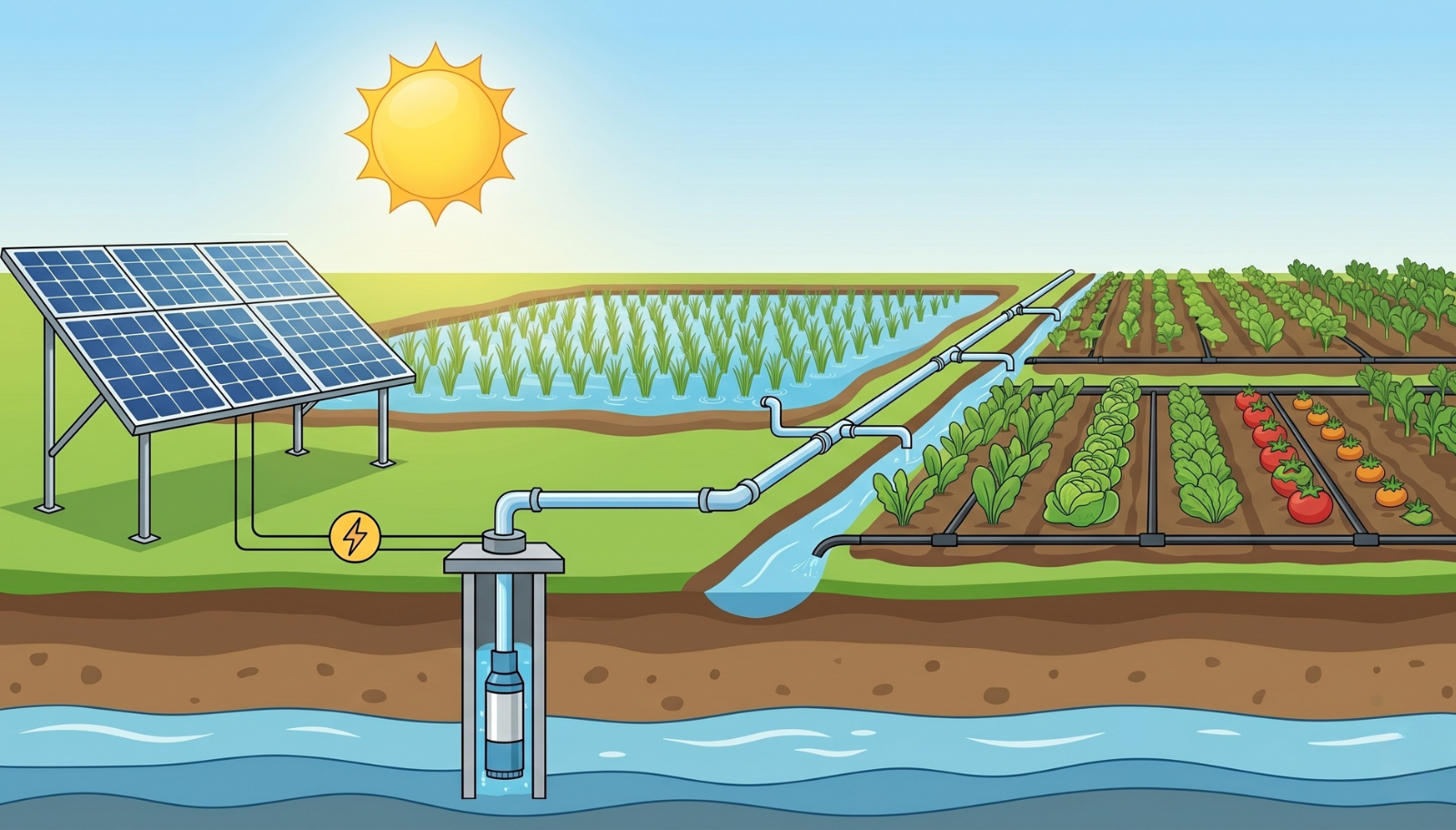
In the north-west, there has been a steady decline in groundwater levels, which has had a detrimental effect on the sustainability of the predominant Boro paddy season. Nevertheless, it is evident that change is already in progress. Solar powered irrigation pumps (SIPs) have emerged as a transformative technological innovation. Operating under a fee-for-service model, private operators install and manage solar pumps, selling water to farmers who pay only for what they use.
Research has demonstrated that farmers who transition from diesel to solar energy experience a reduction in energy costs of 20 to 30 percent, accompanied by a negligible increase in total water consumption. Alternate Wetting and Drying (AWD) technology, which facilitates the periodic desiccation of rice fields between irrigations, holds considerable promise in terms of reducing water usage by up to 40 percent while in tandem diminishing methane emissions without compromising yields. The utilisation of the Internet of Things in smart irrigation systems is a recent development that has begun to be discussed in academic circles. Initial pilot projects have demonstrated quantifiable improvements in water use efficiency and crop productivity.
Policy Challenges
Notwithstanding these technological advances, structural and institutional obstacles persist in impeding large scale adoption. Firstly, there is an absence of a dedicated standalone policy for solar irrigation within the renewable energy framework of Bangladesh. Solar pumps are subject to the overlapping mandates of multiple agencies, namely SREDA, IDCOL, BRDB, and BADC, resulting in fragmented governance, poor coordination, and inconsistent implementation.
Secondly, current subsidy structures remain oriented towards diesel and grid electricity, inadvertently discouraging the market shift towards cleaner alternatives. Thirdly, the governance of groundwater resources remains deficient. There is an absence of a comprehensive real-time monitoring system, and the implementation of extraction limits is largely unenforceable. This creates a paradox where solar irrigation, designed to be environmentally friendly, could accelerate groundwater depletion if deployed without safeguards.
Fourthly, the issue of technology access is inequitable. It is evident that smallholder farmers, predominantly women and marginal cultivators in flood-prone or coastal zones, continue to be marginalised in terms of both the economic benefits and knowledge networks surrounding emerging irrigation technologies.
The Way Forward
A coherent and forward-looking irrigation policy agenda for Bangladesh must be founded upon four pillars. Firstly, the implementation of a dedicated Solar Irrigation Policy is imperative. This policy should encompass the consolidation of governance, the streamlining of agency mandates, and the linkage of subsidies to water efficiency performance as opposed to their current linkage to mere technology adoption.
Secondly, the establishment of a national groundwater monitoring network is imperative, accompanied by the implementation of aquifer-specific extraction ceilings, particularly in high-stress districts such as Rajshahi, Pabna, and Bogra.
Thirdly, the scaling up of climate-smart practices such as AWD and managed aquifer recharge through mandatory integration into agricultural extension services is recommended.
Fourthly, the investment of financial resources in inclusive technology pathways is imperative, with a particular emphasis on facilitating access for marginal farmers through targeted financial instruments, cooperatives, and mobile-based advisory services.
Bangladesh has already demonstrated its capacity to achieve transformative scale in the field of renewable energy. The deployment of solar home systems, which has reached 4.5 million rural households, serves as a testament to the efficacy of coordinated policy implementation. The same ambition, applied with urgency and precision to irrigation, has the potential to simultaneously secure food production, protect groundwater, and reduce agricultural emissions. The existence of technology is an established fact. The imperative is unambiguous. It is imperative that the political will to govern is demonstrated at this juncture.