
Iftekhar Rahman
Verdant Global
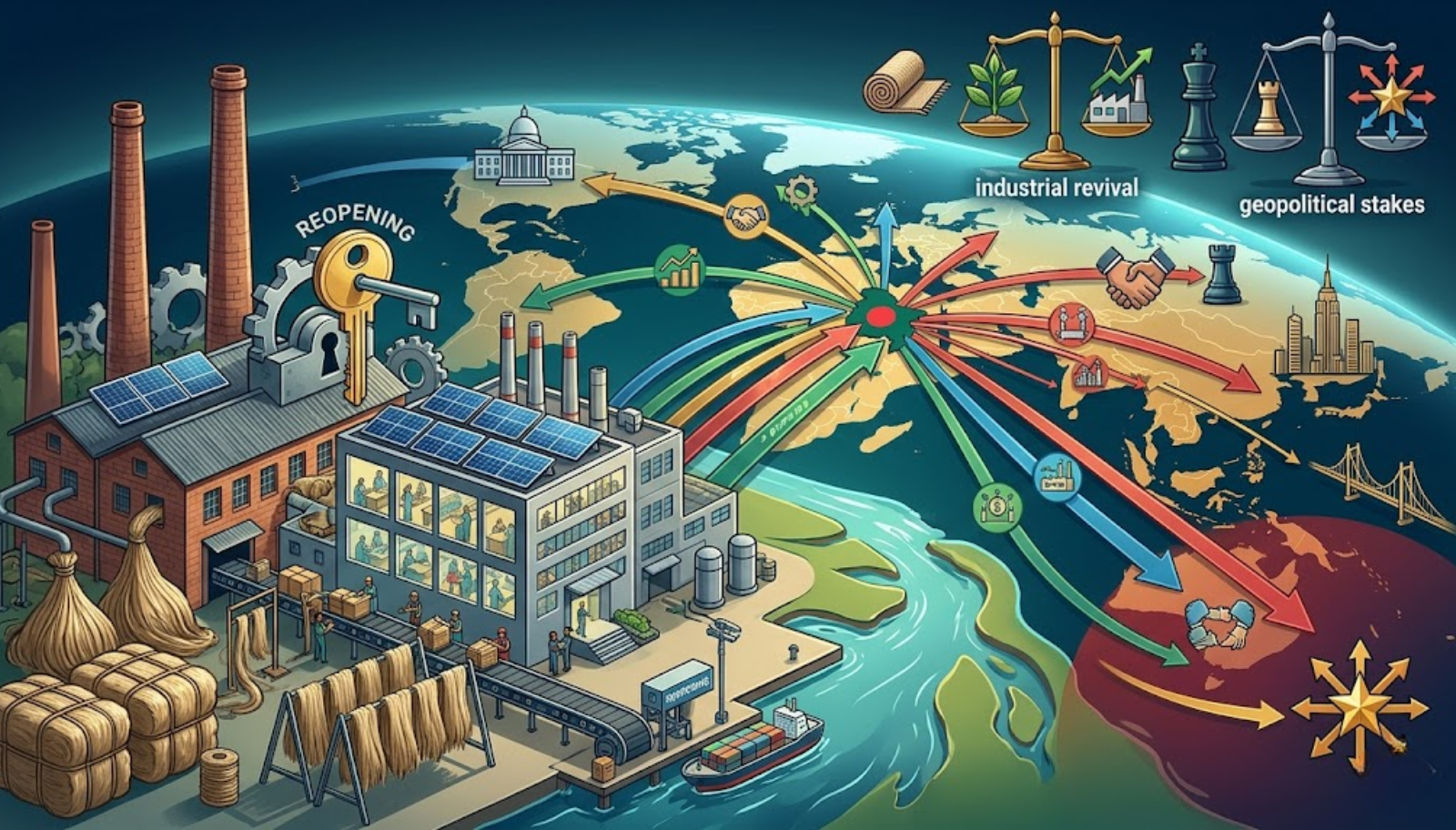
The renewed high-level focus on reopening Bangladesh’s closed textile and jute factories should not be read merely as a domestic employment initiative. Its return to the Prime Ministerial agenda after years of policy dormancy suggests a wider strategic calculation. Bangladesh is entering a more demanding geopolitical trade environment, where industrial capacity, market access, input origin, supply-chain resilience and regional bargaining power are increasingly interlinked. The question is not simply whether dormant factories can be reopened, but whether they can be rebuilt as commercially viable, export-oriented and strategically relevant industrial assets.
Why Now: Industrial Revival as Statecraft
The timing is significant. Bangladesh’s export economy remains heavily dependent on ready-made garments, with around 40% of RMG exports going to the European Union and 18% to the United States in 2024.¹ This concentration creates both scale advantage and vulnerability. Any disruption in preferential access, buyer sourcing strategy, tariff policy, logistics corridors or compliance expectations can directly affect employment, foreign exchange earnings and macroeconomic stability.
Closed textile and jute assets therefore represent more than idle industrial capacity. If selectively modernised, they could support employment, strengthen domestic backward linkages, reduce import dependence and improve Bangladesh’s negotiating position with international buyers. However, this must not become a return to the old state-owned industrial model. Reopening outdated capacity without productivity reform would create fiscal exposure rather than strategic resilience.
Post-LDC Graduation and Market Access Risk
One major reason this issue has resurfaced is Bangladesh’s approaching post-LDC (Least Developed Country) trade transition. The European Union’s ‘Everything But Arms’ arrangement removes tariffs and quotas for imports of goods, except arms and ammunition, from Least Developed Countries.² For Bangladesh, this preferential access has been central to apparel competitiveness. After graduation, the country may face more demanding tariff and compliance conditions. Independent analysis by the International Growth Centre estimates that the average EU tariff on Bangladeshi apparel could rise from 0% to approximately 12% if preferences are lost.³
This makes textile reopening strategically relevant. If reopened mills can support spinning, weaving, fabric processing and traceable domestic inputs, they could strengthen Bangladesh’s rules-of-origin position and reduce exposure to preference erosion. Reopening is therefore part of Bangladesh’s post-LDC trade-preparedness strategy.
India, Transit Risk and Regional Bargaining Power
The jute dimension carries an even clearer geopolitical angle. Bangladesh has a natural advantage in raw jute and jute goods, but regional access cannot be taken for granted. India imposed port restrictions in 2025 on selected goods from Bangladesh, including jute and textile-related products, limiting their movement through land ports.⁴ Reuters also reported that India withdrew a trans-shipment facility that had allowed Bangladeshi exports to third countries through Indian land borders, a move expected to increase logistics costs and affect export competitiveness, particularly for ready-made garments.⁵
This gives the revival agenda clear geopolitical weight. Bangladesh cannot rely only on low-cost production if regional transit, border access and market routes can shift quickly. A revived jute industry should therefore be export-diversified, targeting the EU, UK, Japan, Gulf states and climate-conscious packaging markets. Jute should be repositioned not as a legacy commodity, but as a green industrial export asset.
US-China Realignment and Input-Origin Diplomacy
A further consideration is global supply-chain realignment. International buyers continue to diversify sourcing exposure and place greater emphasis on traceability, compliance and supply reliability. Bangladesh can benefit from this shift only if it deepens backward linkage and offers credible domestic input capacity.
Recent US-Bangladesh trade developments show that input origin is becoming part of trade diplomacy. Reuters reported that Bangladesh secured a reduced 19% US tariff framework, with exemptions for certain textiles and garments made with US materials.⁶ This is directly relevant to reopening textile factories. Future competitiveness may depend not only on low-cost assembly, but also on whether cotton, fibre, yarn and fabric inputs satisfy strategic sourcing, tariff and traceability requirements. Reopened mills could support Bangladesh in a world where supply chains are shaped by geopolitics as much as price.
Foreign Exchange and Industrial Resilience
There is also a macroeconomic dimension. Bangladesh’s dependence on imported textile inputs creates pressure on foreign exchange, particularly during periods of reserve stress, currency weakness or external financing uncertainty. Modern domestic textile capacity could reduce import intensity, preserve foreign exchange and strengthen export value retention. This is not merely a financial issue. Countries under external payment pressure have weaker negotiating power with suppliers, lenders and trading partners. Industrial deepening can therefore support both economic resilience and diplomatic flexibility.
Green Industrial Positioning and Development Finance Readiness
Jute revival also aligns with the global shift away from plastic and towards biodegradable materials. This gives Bangladesh a stronger sustainability narrative and may improve the investability of selected mills where modernisation is linked to cleaner production, product diversification and export-market demand. However, jute’s green potential is not automatically bankable. It becomes credible only when supported by technology upgrades, environmental safeguards, quality certification and commercially viable offtake channels.
The World Bank has noted that Bangladesh’s export diversification agenda includes helping non-RMG firms improve environmental, social and quality compliance and integrate into global value chains.⁷ Reopening jute and textile mills could support that broader diversification agenda if projects are structured with bankable feasibility studies, transparent procurement, labour compliance and measurable productivity targets. Political announcements alone will not attract credible capital.
Conclusion
The Prime Ministerial revival of closed textile and jute factories is geopolitically significant because it responds to multiple pressures at once: post-LDC market risk, India-related transit uncertainty, US and EU sourcing requirements, input-origin diplomacy, foreign exchange resilience and the global sustainability transition.
The wrong approach would be to reopen old mills as employment shelters. The right approach would be to rebuild selected assets as modern, export-linked, climate-aligned and commercially governed industrial platforms. Reopening factories may restore jobs. Strategically rebuilding them could strengthen Bangladesh’s industrial sovereignty, export resilience and geopolitical bargaining power.
References
¹ World Trade Organization, Bangladesh: Working towards a sustainable export future (Geneva: WTO, 2024).
² European Commission, Everything But Arms (EBA) (Brussels: European Commission).
³ International Growth Centre, Can Bangladesh absorb LDC graduation-induced tariff hikes? Evidence using product-specific price elasticities of demand and markups for apparel exports to Europe (London: IGC, 2024).
⁴ Government of India, Directorate General of Foreign Trade, Notification No. 21/2025-26: Port restriction on import of certain goods from Bangladesh to India (New Delhi: DGFT, 27 June 2025).
⁵ Reuters, ‘India withdraws transhipment facility for Bangladesh exports via land borders’ (9 April 2025).
⁶ Reuters, ‘Bangladesh secures reduced 19% US tariff, exemption for some apparel made with US material’ (9 February 2026).
⁷ World Bank, Diversifying Exports for Better Jobs in Bangladesh (Washington, DC: World Bank, 27 February 2026).