
Sheikh Selim
Oniket Research Group
Bangladesh is one of the world’s most fish-abundant nations by geography and one of the most paradoxical by outcome. The country’s vast network of rivers, beels, haors, baors, and floodplains constitutes an inland fishery of extraordinary ecological richness, while its 710-kilometre coastline opens onto a Bay of Bengal estimated to harbour more than 740 aquatic species.
Fish provides approximately 60 percent of the nation’s animal protein intake, sustains the livelihoods of tens of millions of people, and contributes meaningfully to export earnings and agricultural GDP. And yet the common property fisheries that underpin this entire edifice are in measurable, accelerating decline. Their ecological integrity eroded by overexploitation, governance failure, elite capture, and the compounding pressures of climate change. Against the benchmarks of the United Nations Sustainable Development Goals (UNSDG), the gap between Bangladesh’s fisheries potential and its fisheries reality is not merely a sectoral problem. It is a systemic failure with direct implications for poverty, hunger, ecological sustainability, and social equity.
The SDG Framework and the Fisheries Sector
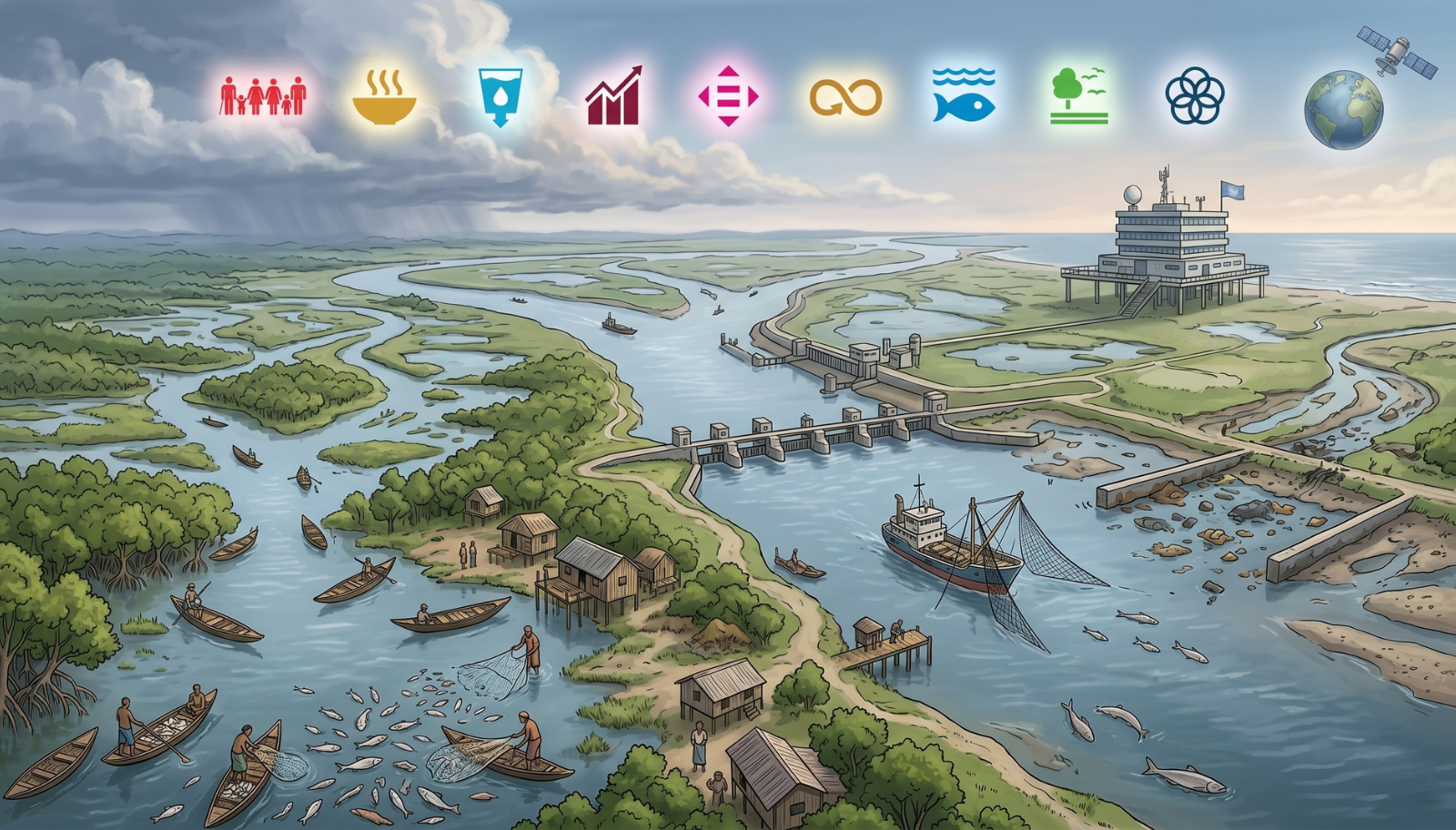
Bangladesh’s common property fisheries intersect with at least four of the seventeen SDGs in ways that are direct and measurable. SDG 14 (Life Below Water) provides the most explicit mandate, calling for sustainable management of marine and freshwater resources, the elimination of destructive fishing practices, and the protection of aquatic ecosystems. SDG 1 (No Poverty) is implicated because professional and artisanal fishers constitute one of Bangladesh’s most chronically impoverished occupational groups, whose access to common property water resources is the primary determinant of their livelihood security.
SDG 2 (Zero Hunger) is engaged through the fisheries sector’s central role in national nutritional security. SDG 15 (Life on Land) is relevant through the haor and floodplain wetland ecosystems, whose biodiversity and productivity depend on governance regimes that current policy consistently fails to provide.
On each of these dimensions, Bangladesh’s progress is inadequate. Marine fish species recorded in the Bay of Bengal have declined from 475 in 1971 to approximately 394 by the early 2020s, a loss of more than 16 percent of documented species in half a century of unmanaged exploitation. Artisanal fishers report that the effort required to earn a modest weekly income has doubled over two decades, as industrial trawlers encroach on coastal zones designated exclusively for small-scale fishers.
In the inland open water fisheries, the picture is equally sobering, including declining catch rates, shrinking wetland habitats, and a jalmahal leasing system that systematically excludes the poorest fishing communities from the very common property resources upon which their survival depends.
The Governance Crisis and the Common Property Problem
The governance of Bangladesh’s inland open water fisheries represents one of the most extensively documented failures of natural resource management in the region. The jalmahal leasing system, which remains the primary mechanism for allocating fishing rights to government-owned waterbodies, was designed with revenue generation as its primary objective rather than ecological sustainability or equitable access. Leases are awarded to the highest bidder for periods of one to three years … arrangements that are structurally incompatible with conservation, as no rational lessee will invest in habitat protection or fish sanctuaries when the lease horizon offers no return on that investment.
The outcome is predictable and well-evidenced: lessees maximise extraction within the lease period, depleting fish stocks, degrading aquatic habitats, and leaving the waterbody ecologically diminished for subsequent communities.
More damaging still is the elite capture that pervades the leasing process. Despite successive policy reforms such as the New Fisheries Management Policy of 1986, the open access declaration of 1995, and the transfer of smaller waterbodies to youth groups, vested interests linked to local political structures have consistently captured the benefits intended for genuine fishing communities. Local power elites, moneylenders, and politically connected youth organisations routinely outcompete or suppress the bids of professional fishing communities, effectively privatising the commons for short-term profit while professional fishers are reduced to dependent labour on waters their ancestors freely used.
Open access declarations, meanwhile, have paradoxically produced worse outcomes than managed systems, such as removing formal restrictions without establishing any conservation alternative, creates conditions in which the most powerful actors extract the most resources while the poorest bear the ecological cost.
This governance failure is compounded by critical institutional fragmentation. The Ministry of Land holds custodianship of all waterbodies; the Ministry of Fisheries and Livestock is responsible for their biological management; the Ministry of Youth and Sports administers smaller waterbodies; local government bodies manage yet another category. These overlapping and often conflicting jurisdictions produce coordination failures, revenue disputes, and the effective absence of any integrated management authority capable of applying conservation principles across a connected aquatic system in which fish, by biological necessity, do not respect administrative boundaries.
Policy Imperatives to Close the Gap
Closing the gap between Bangladesh’s SDG commitments and its fisheries reality requires intervention across five domains simultaneously. First, the jalmahal leasing system must be fundamentally reformed and replaced by a community-based tenure framework that grants genuine fishing communities secure, multi-year access rights in exchange for verified conservation responsibilities, including the establishment and maintenance of permanent fish sanctuaries as a condition of tenure. This reform requires a unified legislative instrument that consolidates the currently fragmented authority over waterbody management under the Ministry of Fisheries and Livestock, with the Ministry of Land retaining title but devolving operational jurisdiction.
Second, community-based fisheries management (proven in pilot projects across Bangladesh’s haor and beel systems to improve both fish stocks and fisher incomes) must be scaled from isolated projects into a national programme with sustained government funding, rather than remaining dependent on short-cycle donor financing that cannot support the multi-generational commitment that sustainable resource management requires.
Third, marine protected areas must be expanded and enforced with genuine resources. The existing marine reserve and the Nijhum Dwip Marine Protected Area are insufficient in coverage and chronically underpoliced. Industrial trawlers routinely operate in zones reserved for artisanal fishing, with minimal accountability. A dedicated fisheries monitoring, control, and surveillance system that incorporates vessel tracking technology and meaningful penalty enforcement is a prerequisite for SDG 14 compliance.
Fourth, fisheries policy must be climate proofed. Haor wetlands face increasing flash flood intensity; river fisheries face altered hydrological regimes; coastal fisheries face sea-level rise and salinity intrusion. A national fisheries adaptation strategy, integrated with the Bangladesh Delta Plan and the National Adaptation Programme of Action, is conspicuously absent and urgently required.
Fifth, gender equity must be embedded in fisheries governance. Women constitute a substantial but systematically excluded part of the fisheries value chain, engaged in post-harvest processing, marketing, and subsistence fishing. But they are absent from formal decision-making in community-based management bodies and invisible in fisheries policy design. SDG 5 mandates their inclusion; current practice denies it.
Bangladesh’s fisheries are among the country’s most vital and most neglected common assets. Without urgent and comprehensive policy reform, the nation will approach the 2030 SDG deadline having simultaneously depleted a resource that sustains tens of millions of its poorest citizens and forfeited the ecological dividend that sustainable management of that resource could have generated. The commons, once lost, are not easily reclaimed.
Keep reading… Flash Floods in the Haor Wetlands: Agricultural Losses, Farmer Distress, and the Imperative for Disaster Response




Comment on “A Diminishing Commons: Bangladesh’s Open Water Fisheries, the UN Sustainable Development Goals”