
Farah Zahir
Oniket Research Group
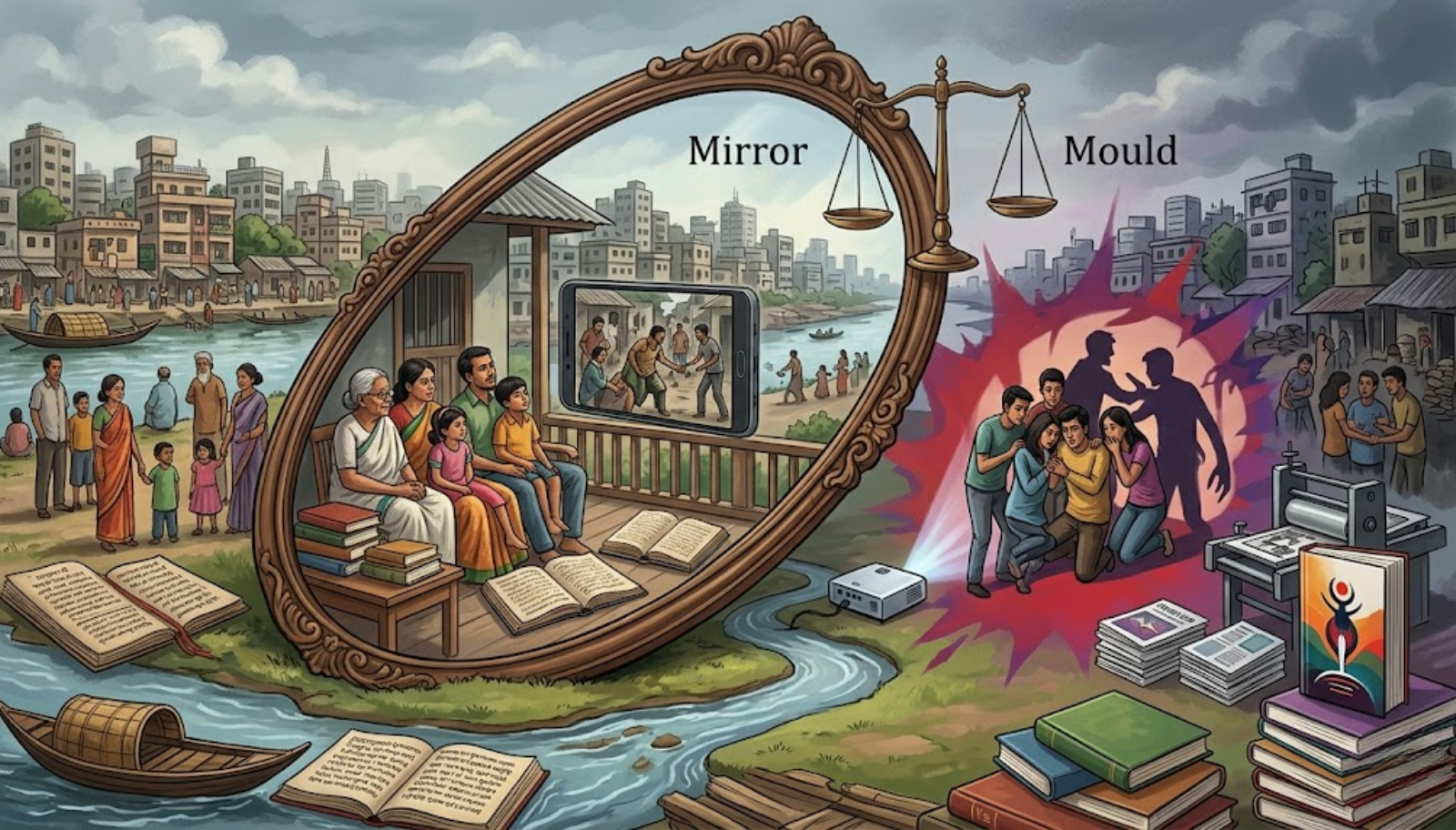
The question of whether art reflects society or shapes it is among the oldest in cultural theory. In Bangladesh, this question has acquired urgent contemporary relevance. A disturbing surge in sexual violence with 96 rape cases recorded in just the first two months of 2025 alone, is unfolding alongside the rapid expansion of unregulated OTT platforms and a literary culture increasingly drawn to transgressive and crime-saturated narratives. The relationship between these two trajectories is neither simple nor linear. It is bidirectional, mutually constitutive, and deeply implicated in the mental health and social welfare of a population navigating rapid modernisation without adequate institutional safeguards.
The OTT Expansion and Its Unregulated Content Landscape
Bangladesh’s OTT ecosystem encompassing local platforms like BongoBD, Bioscope, and Hoichoi alongside global entrants like Netflix and Amazon Prime has grown exponentially since the COVID-19 pandemic accelerated digital consumption. Unlike traditional broadcast television, which operates under established censorship frameworks, OTT platforms in Bangladesh exist in a regulatory vacuum. Content creators have used this freedom productively exploring social issues, gender politics, and institutional corruption with an authenticity that censored media never permitted. However, the same absence of regulatory architecture has enabled the proliferation of content featuring graphic sexual violence, normalised predatory behaviour, and aestheticised criminality material whose psychological effects on a young, impressionable viewership deserve far more serious critical attention than they currently receive.
The problem is not that OTT content depicts social crimes, realist storytelling has always engaged with darkness. The problem is how it depicts them. When sexual violence is framed as entertainment, when the perpetrator is portrayed with narrative complexity that shades into romanticisation, and when the survivor’s trauma is deployed for dramatic effect rather than moral reckoning, the content does not merely reflect social pathology it participates in producing it. Research consistently demonstrates that repeated exposure to normalised portrayals of aggression, particularly sexual aggression, desensitises viewers to the severity of those acts. For adolescent male viewers in Bangladesh, many of whom receive no formal sex education and whose concept of gender relations is formed more by media consumption than institutional guidance, this desensitisation is not an abstraction. It is a documented pathway to attitudinal and behavioural change.
Literary Culture and the Crime Narrative Economy
The same analytical lens must be applied to Bangladesh’s literary culture, where crime fiction, pulp thrillers, and narratives centred on sexual transgression have claimed growing commercial prominence. The argument that popular literature merely reflects existing social realities is insufficient. Literature even popular, commercial literature actively constructs the moral frameworks through which readers interpret experience. When crime literature consistently depicts women as victims whose violation drives a male protagonist’s story arc, it does not neutrally represent gender dynamics; it reproduces and legitimises them. The mental health implications extend beyond perpetrators. Survivors of sexual violence who encounter their experiences aestheticised in mainstream fiction and streaming content report intensified shame, reduced help-seeking behaviour, and compounded trauma responses a social welfare cost that is entirely invisible in current policy discussions about content regulation.
Mental Health, Social Welfare, and the Feedback Loop
The relationship between social crime and cultural content operates as a feedback loop rather than a unidirectional causal chain. Societies with high rates of gender-based violence produce cultural content that reflects that violence but that content, in turn, shapes the normative environment in which future violence either escalates or is restrained by social sanction. Bangladesh currently sits at a particularly dangerous point in this loop. Rapidly rising sexual crime statistics, an OTT sector with no content standards framework, a literary market with no critical discourse on representational ethics, and a mental health system utterly unequipped to process the downstream psychological consequences, these are not separate problems. They are a single interconnected crisis.
Moral policing, the vigilante enforcement of behavioural norms, frequently targeting women has also risen in direct proportion to the availability of content that frames women’s autonomy as transgressive. This is the perverse inverse of the content-crime relationship: OTT content that genuinely challenges patriarchal norms is met with organised social violence, while content that reinforces them proliferates uncritically.
The Policy and Cultural Reform Imperative
Bangladesh urgently requires a content standards framework for OTT platforms that is constituted not by censorship but by representational ethics, guidelines developed collaboratively between content creators, mental health professionals, gender rights advocates, and regulatory bodies. This is not a call for artistic restriction; it is a call for artistic responsibility of the kind that mature creative industries exercise voluntarily. Literary institutions must similarly invest in critical discourse around how crime and sexual violence are represented, rather than treating commercial popularity as the sole measure of cultural value. Schools and universities must integrate media literacy into curricula so that young audiences develop the analytical capacity to engage critically with content rather than absorb it uncritically.
The question is not whether OTT and literary content are leading social crimes or following them. The honest answer is that they are doing both simultaneously, and Bangladesh’s policy institutions have yet to reckon seriously with either direction of that relationship.
Keep reading… The Curation Crisis: Algorithmic Dissemination and the Erosion of Editorial Integrity

