
Sheikh Selim
Oniket Research Group
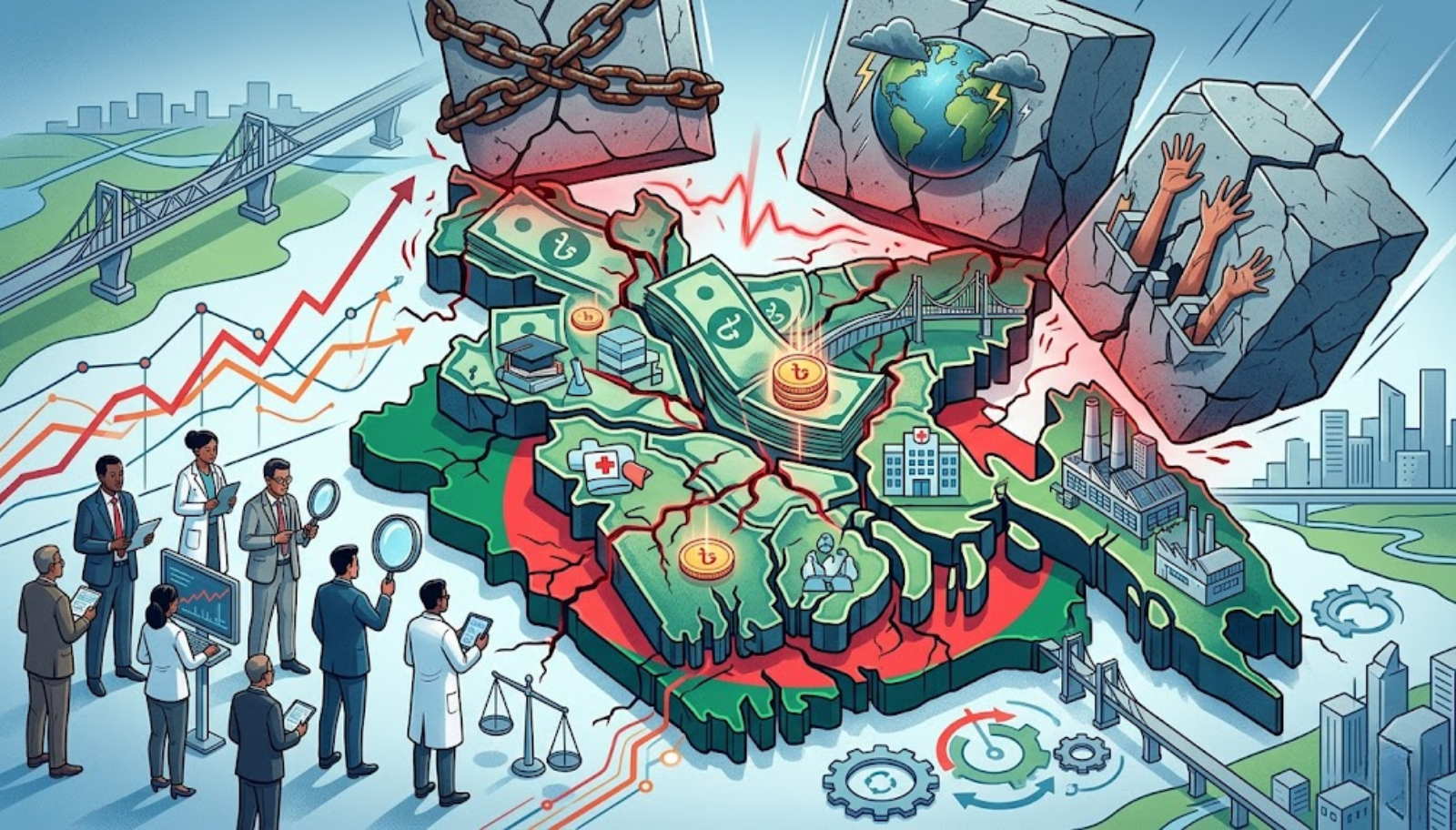
Bangladesh’s national budget has long functioned as a statement of aspiration rather than a precise instrument of economic governance. The FY2025–26 budget, presented against a backdrop of persistent inflation, a fragile external account, IMF programme conditionalities, and a population whose cost of living has risen sharply over consecutive years, continued this tradition. It is ambitious in its headline numbers, uneven in its structural ambition, and insufficiently responsive to the compounding fiscal and social pressures that now define Bangladesh’s economic moment.
As the government prepares to table the FY2026–27 budget, an honest accounting of what the last budget failed to deliver is not merely an academic exercise, it is the essential foundation for doing better.
Revenue: The Perennial Shortfall
The most structurally damaging feature of Bangladesh’s recent budgets, including FY2025–26, is the chronic and widening gap between revenue targets and revenue performance. The National Board of Revenue consistently falls short of its collection targets, often by margins that force mid-year expenditure compression, crowd out development spending, and increase dependence on domestic and external borrowing. Bangladesh’s tax-to-GDP ratio (hovering around eight to nine percent) remains among the lowest in Asia and indeed among lower-middle-income countries globally at a time when comparable economies collect significantly more as a proportion of national income.
This is not primarily a problem of economic size. It is a problem of tax architecture and enforcement culture. The income tax base remains extraordinarily narrow, with a disproportionate share of direct tax revenue drawn from a small segment of salaried formal sector employees who cannot evade through withholding. Meanwhile, large segments of the self-employed professional class, the trading sector, real estate, and the informal economy contribute negligible amounts relative to their actual economic activity. The FY2025–26 budget did not introduce the structural reforms necessary to meaningfully widen this base. This is a failure that the forthcoming budget must not repeat.
Inflation and the Cost of Living Crisis
For ordinary Bangladeshi households, the most immediate economic reality of the past two years has been the relentless erosion of purchasing power. Food inflation, which bears heaviest on low and middle-income families who spend the largest share of their income on food, has remained stubbornly elevated. Energy costs, following subsidy adjustments made partly in compliance with IMF programme requirements, have transmitted through the production and logistics chain into consumer prices across virtually every commodity category. The result is a cost of living crisis that official inflation figures, which many economists regard as understated, only partially capture.
The FY2025–26 budget’s social safety net provisions, while nominally expanded, did not scale proportionately with the real income losses experienced by the population in the lower three quintiles. Transfer values under the vulnerable group feeding programs, old age allowances, and disability support schemes remain far below the level needed to offset the purchasing power losses of the past two inflationary years. The forthcoming budget must substantially increase the real value of social protection transfers (and not merely their nominal allocations) and must index them to a credible food price indicator to prevent erosion in future years.
Development Budget: Ambition Without Execution
Bangladesh’s Annual Development Programme has for years been characterized by a persistent implementation deficit. Large capital allocations are made, modest proportions are actually spent, and year-end rush expenditure (possibly motivated by the fear of lapsing funds rather than project readiness) produces waste, quality compromises, and inflated contractor claims. The FY2025–26 ADP was no exception. Key infrastructure projects, particularly in energy, transport, and urban services, continued to experience delays rooted in land acquisition bottlenecks, procurement inefficiencies, and inadequate project preparation.
The fiscal cost of this implementation failure is significant. Bangladesh borrows domestically at high real interest rates and externally with increasing difficulty to finance development spending that is then not executed on schedule. The carrying cost of borrowed funds against unspent project allocations represents a measurable drag on fiscal sustainability that receives insufficient analytical attention in pre-budget discussions.
Banking Sector and Fiscal Risk
A dimension of fiscal risk that the FY2025–26 budget addressed inadequately is the contingent liability embedded in Bangladesh’s banking sector. Non-performing loans, concentrated in state-owned commercial banks but increasingly evident in private banks as well, represent a potential call on public finances that is not transparently reflected in budget documents. Recapitalization of state banks has been a recurring fiscal expenditure that consumes resources without producing the systemic reform needed to prevent recurrence. The forthcoming budget must begin the process of transparent fiscal accounting for banking sector contingent liabilities, even if full resolution remains a multi-year undertaking.
Energy Subsidy and the Fiscal Burden
The energy sector continues to impose a severe and inadequately rationalized fiscal burden. Capacity payments to independent power producers (many operating under agreements whose terms are commercially unfavorable to the state) absorb a substantial share of the energy budget without producing commensurate power supply reliability. The adjustment of retail energy prices, while fiscally necessary, has not been accompanied by the efficiency reforms, competitive procurement frameworks, and renewable energy investment that would reduce the long-term structural cost. The budget must allocate meaningfully toward renewable transition not merely as a climate commitment, but as a fiscal strategy for reducing the energy sector’s claim on public resources.
The 2026–27 Tax and Fiscal Reform to look into
The forthcoming budget faces a defining choice: continue the pattern of ambitious targets, structural deference, and social inadequacy, or use the moment of IMF engagement and political transition to introduce the foundational fiscal reforms that Bangladesh’s development trajectory urgently requires.
On the revenue side, the introduction of a universal self-assessment income tax system with credible third-party verification, drawing on National Identity Card, property registration, vehicle ownership, and banking transaction data, must become the central tax reform initiative. Property taxation, currently grotesquely underutilized relative to the actual value of Bangladesh’s real estate stock, represents the single largest untapped revenue source and must be made a priority for municipal and national fiscal reform simultaneously.
On the expenditure side, a zero-based review of all subsidy programs including energy, agriculture, and food must be conducted to distinguish between subsidies that protect genuine welfare objectives and those that primarily benefit non-poor consumers or commercially connected enterprises. Subsidy savings must be transparently redirected to social protection and human capital investment rather than absorbed into deficit reduction alone.
Bangladesh stands at a fiscal crossroads. The structural vulnerabilities exposed by recent years (that includes, but not limited to, low revenue mobilization, inflationary pressure, execution deficits, banking fragility, and an energy sector in fiscal distress) are not cyclical inconveniences. They are systemic challenges that incremental budgeting cannot address. The FY2026–27 budget has the opportunity to be the budget that chooses structural honesty over comfortable ambition. Whether that opportunity is taken will determine not only the fiscal trajectory of the next year, but the credibility of Bangladesh’s development promise for the decade beyond.
Keep reading… Lending Rates, Energy Authority and Regulatory Burdens in Bangladesh– A critical analysis.


A very thoughtful and timely piece by Sheikh Selim. He has captured Bangladesh’s budgetary pressure with clarity and balance, particularly the structural revenue weakness, inflationary pressure on households, development budget execution gaps, banking-sector risks, and the urgent need for credible fiscal reform.
An important contribution to the current policy discussion.