
Farah Zahir
Oniket Research Group
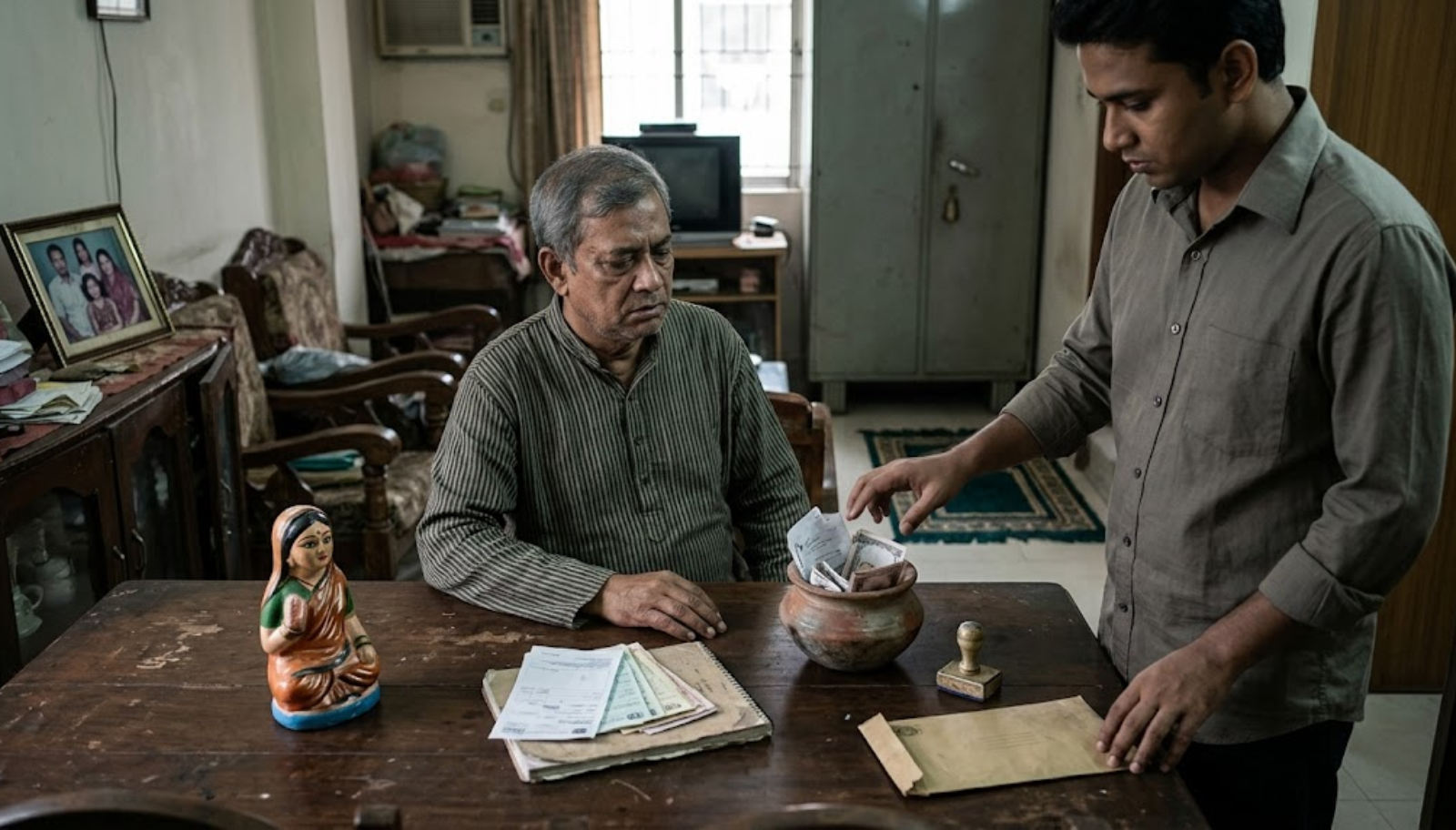
A profound paradigm shift in sociological research reveals that the domestic sphere operates as the critical site where corrupt income is systematically received, spent, and legitimized in Bangladesh. Moving beyond traditional institutional critiques that focus solely on bureaucracies, this analysis exposes how the homemaker woman occupies a position of profound ambiguity, simultaneously a victim of patriarchal dependency, a beneficiary of illicit prosperity, and an active driver of the moral economy sustaining corruption.
The Rural Frontier: Patriarchy, Survival, and the Moral Pragmatism of Necessity
In rural settings, this accommodation functions as a calculated survival strategy; severe constraints on female mobility and financial autonomy mean that questioning a husband’s bribes or commissions risks domestic violence and social abandonment. Here, accepting illicit funds to secure a tin roof or pay school fees reflects a structural moral pragmatism that incrementally normalizes transgressive behavior for future generations.
The Urban Shift: Status Signaling, Aspirational Pressures, and the Unspoken Contract
In contrast, the dynamic within the rapidly expanding urban middle classes of Dhaka and Chittagong shifts toward intense social competition. In these peer networks, neighborhoods, private school admissions, and luxury goods serve as visible social signaling mechanisms. The urban homemaker, as the primary manager of this social presentation, unconsciously motivates corruption through the insidious language of aspiration. Expressing longings for better apartments or holidays exerts constant implicit pressure on the breadwinner to produce income beyond his legitimate salary. This establishes an unspoken family contract: the homemaker provides management of the family’s social face and receives material security, while systematically suppressing any moral interrogation regarding the source of wealth.
The Cognitive Architecture of Complicity: Rationalization and Intergenerational Transmission
This domestic complicity is reinforced by sophisticated psychological compartmentalization. Homemakers deploy comparative justifications, the belief that “everyone does it”- to dissolve individual responsibility into collective absolution. Furthermore, the cognitive architecture of the household allows a woman to decouple a husband’s private corrupt transactions from his public performance of religious piety and family devotion. The gravest long-term cost of this moral accommodation is its intergenerational reproduction, where children internalize corruption as a legitimate strategy rather than a transgression, rendering top-down reforms like office digitization or CCTV monitoring largely ineffective.
Workplace-to-Household Policy Frameworks: Mitigating the Consumption-Integrity Gap
A critical policy gap in Bangladesh’s anti-corruption architecture is the complete decoupling of workplace ethics from the domestic realities of employees. Current frameworks, such as the National Integrity Strategy (NIS), remain rigidly confined to the office floor, ignoring the household consumption pressures that drive mid-level officials to live beyond documented means. To mitigate this, Bangladesh must pioneer Workplace-to-Household Integrity Policies. Public and private institutions should introduce mandatory, dual-signature lifestyle and asset disclosures that require explicit annual validation by both the employee and their spouse, effectively dismantling the domestic “silent contract.” Additionally, workplaces must establish institutionalized Spousal Financial Literacy and Empowerment Channels, providing homemakers with independent economic awareness and legal protection frameworks against domestic retribution. By actively bridging the workplace-household divide, policy can transform the domestic environment from an engine of moral accommodation into a frontline defense against systemic corruption.

