
Sheikh Selim
Chief Editor of TOB
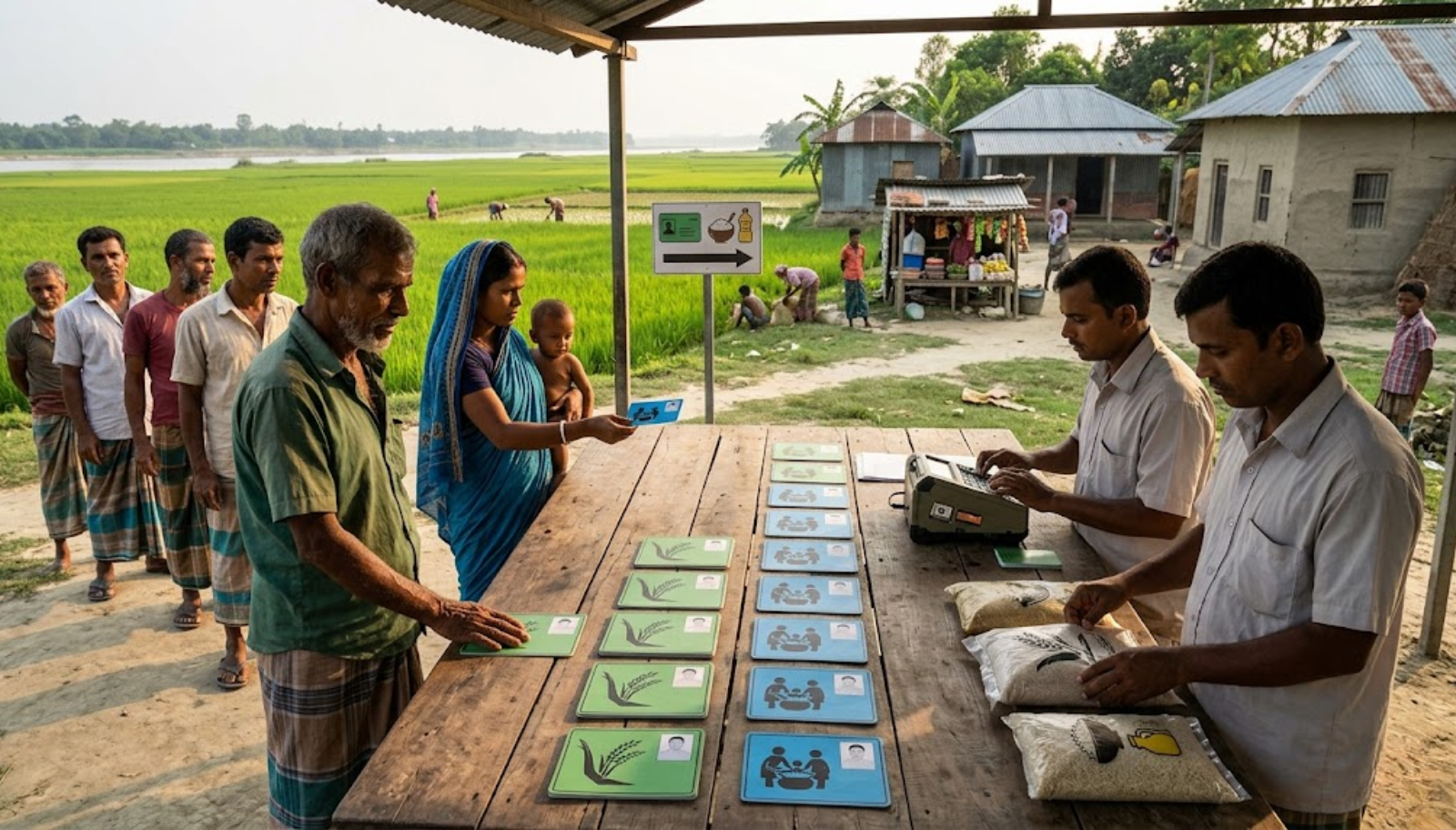
Recently, the Bangladesh government has introduced two flagship social protection instruments, namely. the Farmer Card and the Family Card. These are framed as transformative tools for delivering targeted subsidies to the rural poor and agricultural communities.
On the surface, these initiatives represent a rational modernisation of the country’s subsidy architecture, moving away from blanket support toward digitally mediated, identity-based allocation. In practice, however, the story is considerably more complex and threaded through with structural inefficiencies, funding pressures, equity concerns, and political calculations that deserve rigorous public scrutiny.
The Farmer Card: Promise and Structural Weakness
The Farmer Card was introduced with the stated objective of ensuring that agricultural subsidies (primarily for fertiliser, seeds, and diesel fuel) reach actual farmers rather than being siphoned off by middlemen, dealers, and politically connected intermediaries. In principle, this is an admirable and necessary reform. Bangladesh’s agricultural subsidy system has historically suffered from severe leakage, where a substantial proportion of budgetary allocations intended for small and marginal farmers was captured by larger landowners, input dealers, and local political elites who controlled distribution networks.
However, the challenge of optimal allocation remains daunting. Bangladesh’s agricultural landscape is extraordinarily patchy. Millions of farmers cultivate plots of less than one acre, operate seasonally, and shift between farming and non-farm labour throughout the year. Creating a reliable, updatable digital registry of this population requires a level of data infrastructure, administrative capacity, and ground-level verification that Bangladesh’s bureaucratic machinery has not yet demonstrated it can consistently deliver. In practice, farmer card registration has been uneven across districts, with better-connected and more literate farmers (often those who need subsidies least) more successfully navigating the registration process than marginal, elderly, or female-headed farm households who need them most.
There is also a land tenure problem at the heart of the scheme. A significant proportion of Bangladesh’s actual cultivators are sharecroppers and tenant farmers who do not hold formal land titles. Since card eligibility has in many implementation contexts been linked to land ownership documentation, these cultivators (among the most economically precarious in the agricultural sector) risk systematic exclusion from the very programme designed to protect them. Without reform to include tenancy-based eligibility criteria, the Farmer Card risks replicating the inequities of the system it was meant to replace.
Funding Challenges: Fiscal Pressure in a Constrained Economy
The funding dimensions of these subsidy programmes are equally fraught. Bangladesh’s public finances are under significant strain. Foreign exchange reserves have faced pressure, inflation has eroded household purchasing power, and debt service obligations, including on large infrastructure loans, are growing. The agricultural subsidy budget, though substantial in absolute terms, is perpetually under pressure from competing fiscal priorities including education, health, and debt repayment.
The Farmer Card system, if scaled effectively, would require not only the subsidy expenditure itself but significant ongoing investment in digital infrastructure maintenance, biometric verification systems, grievance redressal mechanisms, and trained field-level staff. These administrative costs are rarely fully accounted for in the headline budget figures presented to the public. There is also the risk of fiscal duplication where the Farmer Card and Family Card systems overlap in beneficiary populations without adequate coordination, leading to either double-counting or gaps in coverage that waste public resources while leaving the genuinely vulnerable unassisted.
Family Card and the Compounded Question of Equity
The Family Card, designed to provide subsidised essential commodities including rice, oil, and lentils to low-income urban and rural households through a government-managed distribution network, adds another layer of complexity to this already intricate system. When examined alongside the Farmer Card, the combined architecture of these two programmes raises serious questions about social and regional equity.
Regional disparities in implementation capacity across Bangladesh’s eight divisions mean that the quality and reliability of benefit delivery varies enormously. Districts with stronger local government institutions, better digital connectivity, and more capable upazila-level administration (typically in and around Dhaka and Chittagong divisions) are likely to see more effective card utilisation than remote or historically under-served areas such as Sylhet’s haor regions, the coastal belt of Barisal, or the Chittagong Hill Tracts, where geographic isolation and ethnic minority status compound existing disadvantages. In effect, the card-based system risks systematically favouring those who are already better served by the state.
Social discrimination also operates within the system. Women, persons with special needs, ethnic minorities, and religious minorities have historically faced disproportionate barriers in accessing state benefit programmes that require documentation, local authority endorsement, and navigation of bureaucratic processes shaped by social hierarchies. Without legally enforceable inclusion mandates and independent monitoring bodies, the combined card system may entrench rather than reduce the discrimination it nominally seeks to address. The net effect could be a programme that looks comprehensive on paper but produces a two-tier outcome, reliable support for the moderately poor with social and institutional access, and persistent exclusion for the most marginalised.
The Political Calculus: Subsidies as Electoral Currency
No serious analysis of these programmes can ignore the political economy that drives them. Agricultural subsidies and food support cards are among the most powerful tools available to incumbent governments in Bangladesh for consolidating rural electoral support. Farmers and low-income households represent the dominant share of the voting population, and the timing of card distribution programmes (frequently accelerating ahead of national or local elections) is difficult to attribute solely to administrative planning cycles.
The discretionary nature of local-level card allocation creates structural opportunities for political patronage. Where union parishad chairmen and upazila officials control lists of beneficiaries, party loyalty can quietly become an unofficial eligibility criterion. Opposition supporters, religious minorities, and communities perceived as politically hostile to the ruling party have, in multiple documented instances across Bangladesh’s recent political history, found themselves excluded from or delayed in accessing state benefit programmes. This is not incidental to the design of these systems. It is an emergent feature of any subsidy architecture that lacks genuine institutional independence in targeting and oversight.
The Farmer Card and Family Card represent genuinely worthwhile policy ambitions such as the digitisation of social protection, the elimination of middlemen, and the direct empowerment of the poor. But ambition is not delivery. Without independent targeting mechanisms free from political interference, enforceable inclusion standards for marginalised groups, transparent funding accounting, and robust grievance systems, these cards risk becoming instruments of the very inequality they were designed to dismantle. Bangladesh deserves social protection architecture built for its people, not for its electoral calendar.
Keep reading… Before the Sacrifice: Bangladesh’s Livestock Policy Dilemma Ahead of Eid Ul Adha