
Sheikh Selim
Chief Editor, TOB
As Eid Ul Adha approaches annually, Bangladesh faces a recurring and unresolved tension at the heart of its agricultural economy. This tension can be defined as the contest between local livestock producers who strive to meet the nation’s demand for sacrificial animals and the powerful import lobby which pushes for large-scale cattle imports, primarily from India and Myanmar.
This annual (and once in a year) policy dilemma extends beyond the confines of a mere seasonal market management question. The analysis sheds light on the intricate contradictions inherent in Bangladesh’s agricultural trade structure and the ongoing challenges in resolving these contradictions. This unresolved debate carries significant consequences for rural livelihoods, food security, price equity, and the long-term competitiveness of the domestic livestock sector.
The Scale of Demand and the Local Supply Response
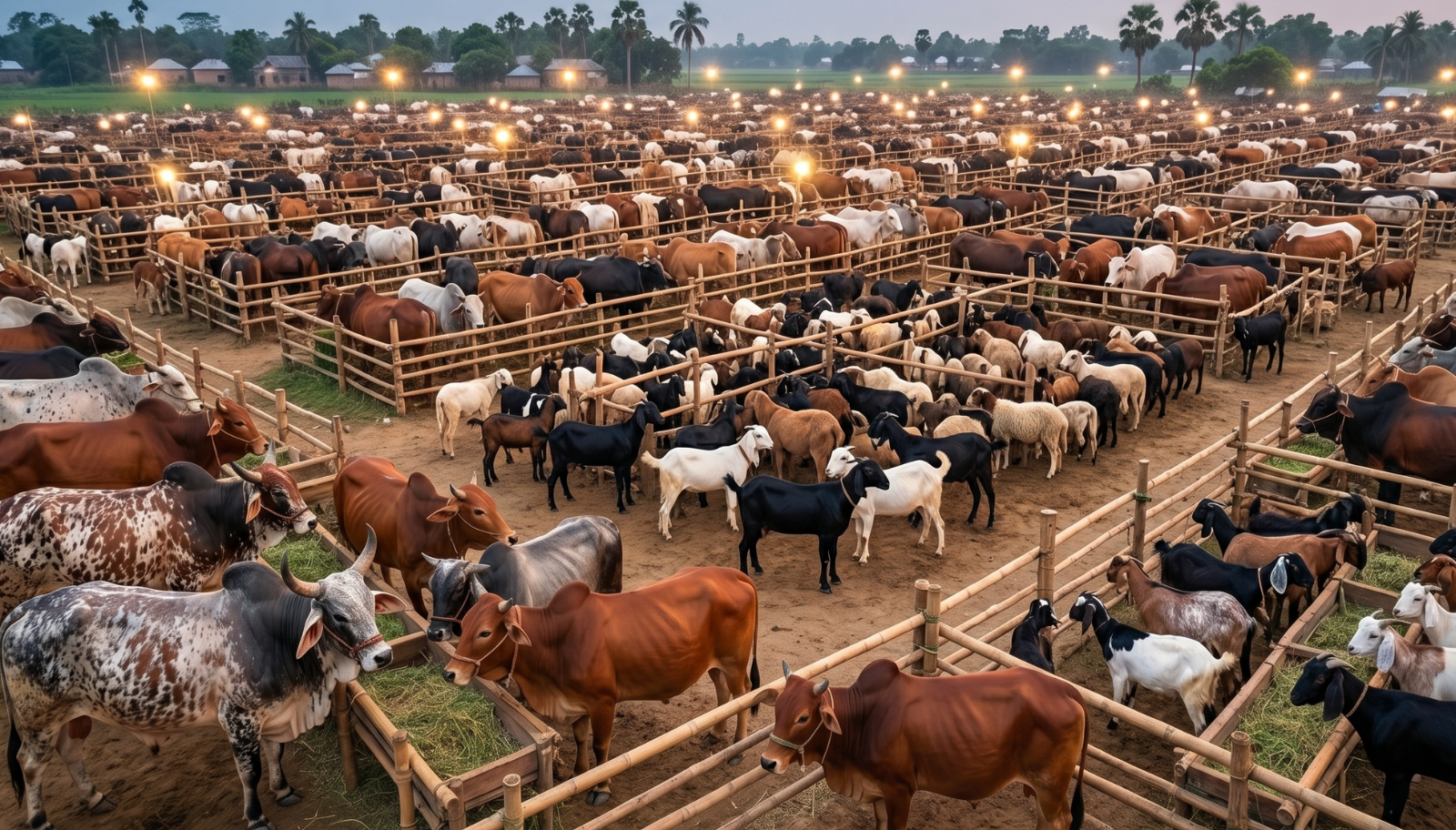
Eid Ul Adha is responsible for one of the largest concentrated livestock demand events on the planet. It is estimated that during the festival period, Bangladesh sacrifices more than one crore animals, representing billions of taka in transactions that are compressed into a matter of days. In recent years, there has been a notable increase in the number of livestock kept by farmers in Bangladesh. The Department of Livestock Services has repeatedly reported that the local supply is now sufficiently robust to meet Eid demand without the need for significant imports. This assertion is corroborated by the observable proliferation of cattle fattening enterprises, commercial dairy farms, and smallholder livestock rearing operations across Mymensingh, Rajshahi, Pabna, and the char lands of northern Bangladesh.
This debate invariably resurfaces on an annual basis. Import advocates argue that domestic supply is inflated in official estimates, that price control requires competitive pressure from imports, and that without foreign cattle, urban consumers (particularly in Dhaka and Chittagong) would face prohibitively expensive sacrificial animals. Local farmers and their representatives vigorously contest each of these claims, arguing that import permissions consistently arrive too early in the market cycle, thereby depressing prices at a time when domestic producers are ready to sell and have invested heavily in animal fattening over the preceding months.
The Challenges Posed by Agricultural and Trade Policy
The fundamental policy failure in agriculture is the absence of a reliable, transparent, and independently verified national livestock census that provides real-time supply data. The absence of credible numbers has resulted in the decision-making process regarding imports being influenced by factors such as political pressure (or interest), the actions of traders, and anecdotal price signals, rather than being grounded in empirical evidence. This discrepancy in information consistently favours importers, who can reliably claim a supply deficit that official data is insufficiently robust to reliably contradict.
The trade policy dimension is equally problematic. Bangladesh’s reliance on Indian cattle imports has, historically, engendered a structural vulnerability. India has been observed to restrict cattle exports with little to no notice, citing domestic or political considerations. This has resulted in Bangladeshi markets experiencing sudden supply disruptions, which importers subsequently use to argue for emergency permissions granted without rigorous scrutiny. This reliance has also been demonstrated to encourage the clandestine movement of livestock across national borders, a practice that has been shown to result in the loss of customs revenue for the government, the introduction of disease threats such as foot-and-mouth disease and lumpy skin disease within the livestock supply chain, and the disruption of the price discovery process within formal marketplaces.
Domestic farmers, conversely, face considerable challenges due to the highly uneven nature of the playing field. The burden of feed cost inflation, driven by rising prices of maize, rice bran, and oil cake, is shouldered entirely by them. Furthermore, these farmers are confronted with these challenges without access to affordable agricultural credit, reliable veterinary services, or organised market infrastructure.
The absence of a structured cold chain logistics system for livestock is a pervasive issue, particularly in the context of transporting cattle from northern districts to southern and eastern markets. This inadequate infrastructure results in substantial weight loss, injury, and mortality, consequently leading to a decline in overall profitability. Conversely, importers profit from well-established cross-border trade networks, reduced per-unit costs attributable to economies of scale, and political connections that facilitate regulatory processes.
Essential Reforms for Achieving a Level Playing Field
The establishment of authentic equity between domestic producers and import interests necessitates the implementation of reforms across a series of interconnected policy domains. However, the majority of these necessitate structural reforms. Firstly, the government must commission and publish an independently audited national livestock supply assessment at least three months prior to Eid. It is imperative that import decisions are made transparently based on verified supply gap data, rather than on trader representations. The implementation of this specific reform would result in an immediate reduction in the potential for politically motivated import permissions that are detrimental to domestic producers. However, this is often overlooked. For three months prior to this Eid, the government is often preoccupied with controlling Ramadan prices ahead of Eid Ul Fitr.
Secondly, livestock import tariffs (or quantity restrictions) should be restructured as a dynamic, supply-responsive instrument that automatically rises when domestic supply is assessed as adequate and falls only when a genuine and independently verified deficit exists. This non-linear tariff or quantity restriction is a matter of extensive research. This mechanism has the potential to supersede the prevailing discretionary import permission system, which is susceptible to rent-seeking and political favouritism, with a rules-based framework that is both accessible to importers and domestic producers, and conducive to effective planning.
Thirdly, the establishment of a dedicated Livestock Producer Support Fund, financed through a modest levy on animal feed imports, is recommended. The Fund should provide subsidised veterinary services, affordable short-term credit for Eid-season fattening operations, sustainable fattening level assessments and transport cost support for cattle moving from production districts to major urban markets. Concurrently, the government should allocate funds to the development of organised livestock market infrastructure, encompassing digital auction platforms that facilitate farmers’ access to buyers nationwide, thereby eliminating the reliance on local intermediaries who currently amass a disproportionate share of the value chain.
Safeguarding the Livestock Farmer Who Supplies the Festival
Bangladesh’s local livestock farmers represent the unheralded foundation of Eid Ul Adha. These individuals invest significant resources, including their savings, land, and labour, months in advance to provide the sacrificial animals that are purchased by millions of families as an act of religious devotion and communal solidarity. A trade and agricultural policy environment that is consistently detrimental to their efforts through the introduction of imports at inopportune times, inadequate support infrastructure, and opaque decision-making is not merely an economic injustice; it is a policy failure that erodes rural livelihoods and long-term food system resilience.
It is imperative to recognise that reforms which serve to level the playing field do not constitute protectionism. These measures represent the minimum obligations that the government of Bangladesh is bound to fulfil about its agricultural community.