
Desk Report
Oniket Desk
The mass uprising of July and August 2024 that ended fifteen years of Awami League rule and forced Sheikh Hasina from power was not merely a political transition. It was, by any serious reading, a foundational rupture. It was a moment in which the legitimacy of the existing constitutional order was tested in the streets and found insufficient.
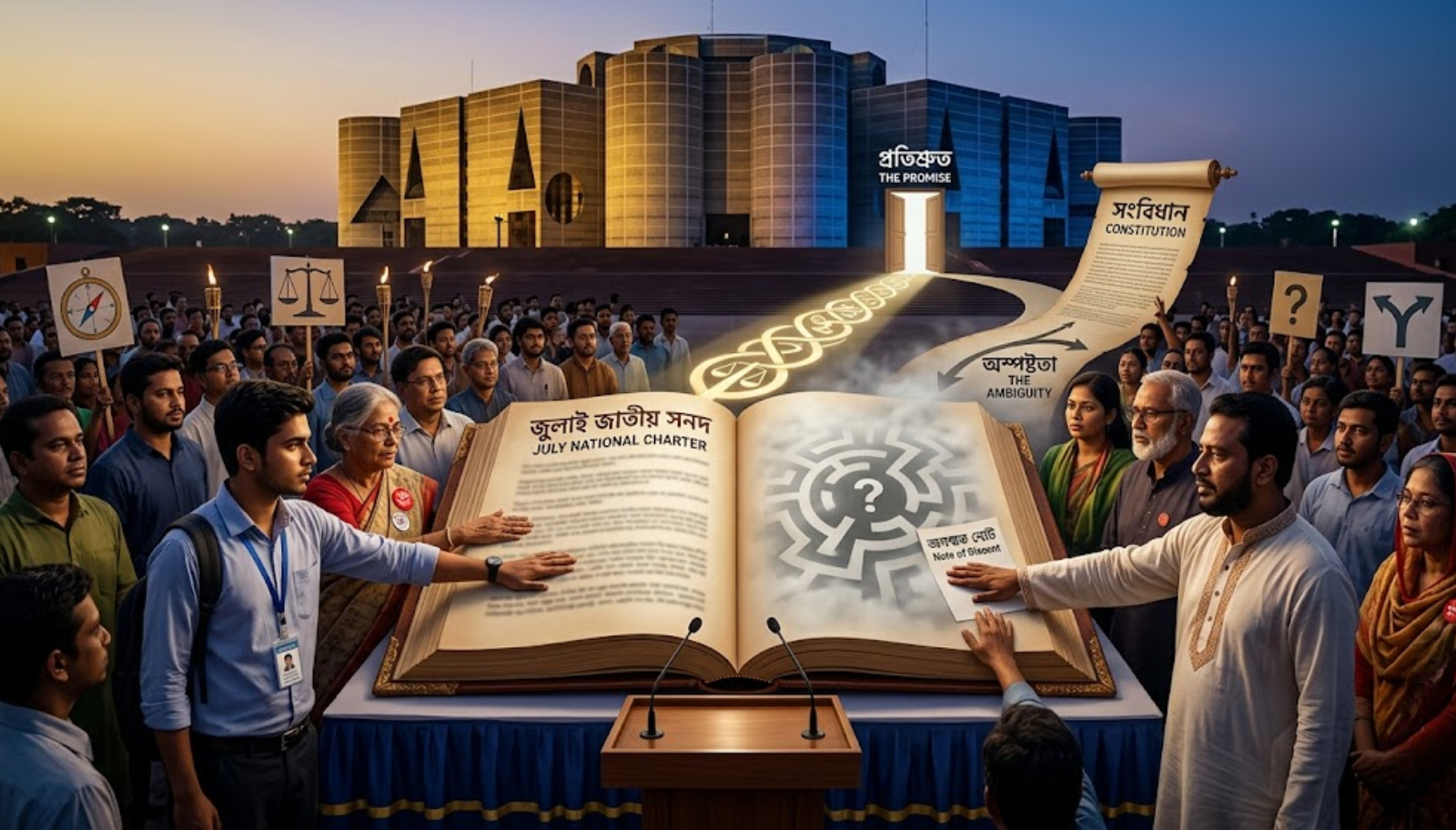
The July National Charter 2025, the proclamation that emerged from that rupture as the articulated mandate of the uprising, carries within it both the democratic aspirations of a generation and a set of legal and constitutional complexities that Bangladesh has not yet fully reckoned with.
What the National Charter Is, and What It Is Not
The July National Charter is neither a constitution nor a statute. It is a political charter … a document of revolutionary intent, asserting the values, demands, and transformative expectations of the student-led movement that dismantled one of South Asia’s most entrenched authoritarian governments. Its core commitments include accountability for the killings carried out during the uprising, structural reform of state institutions that were systematically captured by partisan interest over the preceding decade, electoral system overhaul, and a reimagining of the relationship between citizens and state power.
The complexity begins precisely here. A charter born of revolution derives its authority not from legal procedure but from political legitimacy, i.e from the moral weight of the movement behind it. That is an enormously powerful but also fundamentally unstable foundation.
The July National Charter has no defined legal status within Bangladesh’s existing constitutional framework. It cannot be enforced by courts. It cannot override legislation. And yet the interim government led by Professor Muhammad Yunus has governed with explicit reference to its mandate, creating a practical reality in which a document of uncertain legal standing exerts considerable political authority over state decisions.
The Constitutional Fault Lines
Bangladesh’s Constitution of 1972, even as amended over its turbulent history, provides no mechanism for an uprising-installed interim administration of the kind now governing the country. The current arrangement rests on political consensus and the functional acquiescence of the military and civil bureaucracy, not on constitutional procedure. This creates a compounding ambiguity: decisions made by the interim government, reform commissions it has appointed, and any constitutional changes it proposes will all face fundamental questions of legitimacy and legal continuity once an elected government takes office.
If the National Charter’s reform agenda, particularly proposals around restructuring the electoral commission, curtailing executive dominance over the judiciary, reforming local government architecture, and potentially revisiting the constitutional provisions that had enabled one-party parliamentary supermajority control, is implemented through executive order or ordinance rather than through a properly elected parliament, those changes will be constitutionally vulnerable. Future governments, depending on their political disposition, could challenge, reverse, or simply ignore reforms enacted outside the regular constitutional amendment process under Article 142.
Consequences for Citizen Rights
The implications for citizens are not abstract. The period since August 2024 has seen both genuine rights restorations including the release of political prisoners, relaxation of press restrictions, the reopening of civic space and troubling new patterns. Thousands of cases have been filed against Awami League leaders and activists, some reflecting genuine accountability for documented abuses and others appearing to reflect political retribution or the exploitation of a weakened opponent.
The legal system, already structurally compromised by years of partisan interference, is being asked to process an extraordinary volume of politically charged cases without having been meaningfully reformed. The risk is that the National Charter’s promise of accountability becomes, in practice, selective justice … a reshuffling of which citizens are protected and which are exposed, rather than a genuine extension of equal legal protection.
The Political Stakes
For Bangladesh’s established political parties, principally the BNP, which had the clearest electoral interest in a rapid transition to a voted government (which it has formed now, as officially elected), the National Charter represents a double-edged instrument. Endorsing it fully risks legitimising a reform process that could constrain or disadvantage them while in power. Opposing it openly risks alienating the student movement constituency that helped create the political space in which the BNP now operates freely after years of suppression.
The July National Charter is, in the end, a document that accurately reflects the complexity of the moment that produced it. It carries genuine democratic promise. It also carries the inherent legal fragility of all revolutionary mandates that have not yet been converted into durable constitutional architecture.
Whether Bangladesh can bridge that gap, i.e translating the moral authority of the uprising into institutionally grounded, rights-protecting, and democratically accountable governance, is the defining political question of this period. The National Charter sets the aspiration. The hard, unglamorous work of constitutional and legal reform must now provide the foundation.