
Sheikh Selim
CE of Oniket Research Group
Bangladesh finds itself at a critical juncture, confronted with one of its most economically significant and socially destructive industries. Tobacco occupies a paradoxical position in the national economy. On the one hand, it generates billions in revenue. Conversely, it imposes an even more substantial burden of death, environmental destruction, and social harm on the very population from which it derives its profits.
The ability to comprehend this paradox, and to chart a course through it, has emerged as one of the most pressing governance challenges confronting Bangladesh as it progresses toward its 2041 development aspirations and its international Sustainable Development Goal (SDG) commitments.
A Nation Addicted – The Public Health Crisis
The magnitude of tobacco use in Bangladesh is astounding. According to the findings of the National NCD Risk Factors Survey (NCD-RFS) of 2022, the proportion of adults aged 18–69 who use tobacco products in some form was found to be approximately 39.4%, with 54.7% of male respondents and 25.4% of female respondents falling into this category. This figure is significantly higher than the global male smoking prevalence of 28.1% and female prevalence of 4.7% reported by the WHO.
According to recent estimates, the adult smoking population in the country is approximately 20.9 million, while the prevalence of smokeless tobacco use among adults is 28%, a figure that positions Bangladesh as one of the world’s leading tobacco-consuming nations.
The repercussions of this phenomenon are disastrous. In 2018 alone, tobacco was responsible for approximately 126,000 deaths in Bangladesh, accounting for 13.5% of all deaths that year. By 2021, the death toll had escalated to 130,135, constituting nearly 12% of the national mortality total. It is estimated that approximately 1.5 million adults currently suffer from illnesses attributable to tobacco use, and over 61,000 children under the age of 15 are afflicted by diseases caused by secondhand smoke exposure.
Tobacco has been identified as a significant risk factor for the four most prevalent non-communicable diseases: cancer, cardiovascular disease, respiratory disease, and diabetes. The industry employs aggressive marketing strategies targeting lower-income demographics and youth. Among adolescents aged 13–15, 6.9% already use tobacco in some form, with a higher percentage of boys among this group, at 9.2%. This statistic is of particular concern, as it is indicative of a potential increase in the future health burden of the nation.
Revenue Reality: A Net Economic Loss
The tobacco industry’s primary political shield is its revenue contribution. The Bangladeshi cigarette market was valued at nearly BDT 420 billion (over US$4.5 billion) in 2022, dominated by British American Tobacco Bangladesh with a market share of over 84.5%. The economic contribution of the tobacco sector to GDP was estimated at BDT 229.11 billion (US$2.7 billion) in 2018, and the government collected Tk 22,810 crore in tobacco tax revenue in fiscal year 2017–18 alone (WHO data).
However, a thorough examination of the financial data reveals a contradictory narrative. In 2018, the total economic cost of tobacco-related death and disease in Bangladesh was 305.6 billion Bangladeshi takas (equivalent to 3.6 billion U.S. dollars). This figure represents 1.4% of the country’s GDP. Direct healthcare expenditures amounted to BDT 84 billion, while the loss of productivity due to premature death and disability attributable to tobacco use accounted for an additional BDT 221.7 billion. It is imperative to note that the economic contribution of tobacco to GDP was BDT 76.54 billion less than the annual costs it imposed, indicating a net loss to the Bangladeshi economy.
In fiscal year 2017–18, the government collected Tk 22,810 crore in tobacco tax, yet the economic cost of tobacco use from lost productivity and healthcare was Tk 30,560 crore amounting to a shortfall of nearly Tk 8,000 crore (The Daily Star, 2025). This is not a revenue engine; it is a subsidised catastrophe.
Compounding the problem is Bangladesh’s complex, tiered ad valorem tax structure, which allows smokers to easily switch to cheaper brands when taxes rise, preventing consumption from falling while tobacco companies retain their market. The sale of single-stick cigarettes at prices as low as Tk 10 ensures that tobacco remains accessible to schoolchildren and the poorest citizens. The government holds a stake of more than 9% in BATB through direct and state-owned assets, creating an institutional conflict of interest that has already manifested in striking ways, including granting BATB and JTI exemptions from COVID-19 lockdown restrictions in 2020, citing cigarettes as an “essential commodity” under a 1956 law.
The Environmental Cost: A Forgotten Dimension
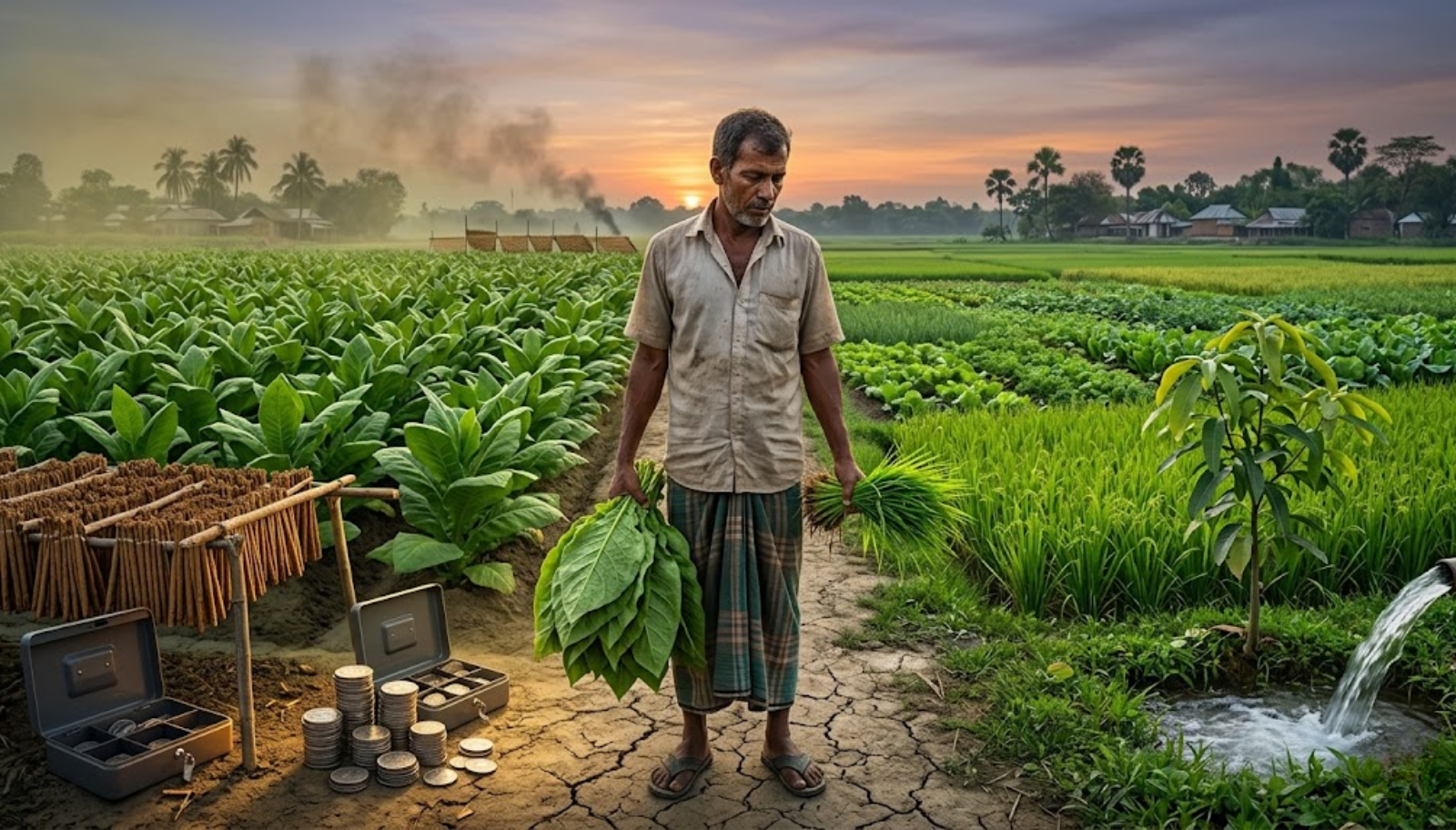
Bangladesh’s role as the world’s 12th largest tobacco producer carries severe environmental consequences that are rarely factored into economic analyses. In 2022, 92,326 tonnes of tobacco were produced on 40,600 hectares of agricultural land that could otherwise have been used to grow food. Tobacco cultivation contributes directly to deforestation, soil erosion, and water contamination. Research conducted in northern Bangladesh found that habitat diversity, faunal diversity, and floral diversity have all deteriorated significantly in tobacco-growing regions, with soil fertility declining sharply after a decade of tobacco farming.
The environmental cost of tobacco curing, which requires the burning of enormous quantities of wood fuel, compounds the deforestation crisis. A 2020 study found contamination of both soil and water in tobacco-growing areas, with the pesticide aldicarb (classified as “extremely hazardous” by the WHO and banned in 125 countries) detected at significantly elevated levels.
The practice of tobacco farming poses a significant threat to the livelihoods of approximately 800,000 individuals residing in the Bandarban and Cox’s Bazar districts. These individuals rely on the Matamuhuri river for sustenance, as well as for fishing and the cultivation of food crops. It is estimated that 16,242 tons of cigarette butts are generated as toxic waste in Bangladesh annually. These phenomena do not constitute peripheral externalities; rather, they are structural ecological damage accumulating unnoticed in rural communities.
Social Norms: Changing but Slowly
Beyond statistics, tobacco shapes social behaviour and norms in Bangladesh in deeply entrenched ways. Smokeless tobacco use is not a marginal phenomenon; it is the dominant form of tobacco consumption for women, with 28% of Bangladeshi women using products such as betel quid with zarda and pan masala. The normalisation of tobacco use across gender, class, and geography makes demand reduction particularly challenging. The industry has historically exploited this cultural embedding, marketing to the poor and the young, where price sensitivity is highest and awareness of health consequences lowest.
The issue of child labor in tobacco farming and bidi production is a well-documented social harm that persists. It is estimated that at least half of the workforce in the Bangladeshi bidi industry is aged between 4 and 14, earning between US$0.77 and US$1.57 per day. This figure appears on the U.S. Department of Labor’s 2022 List of Goods Produced by Child Labor or Forced Labor.
In tobacco-farming communities, research documents a rise in addiction among youth, social conflict, and a gradual erosion of community cohesion alongside modest improvements in material infrastructure. Consequently, the tobacco industry perpetuates cycles of poverty while concurrently providing immediate monetary gains.
Bangladesh, the SDGs, and the 2040 Commitment
Bangladesh’s tobacco problem sits at the intersection of multiple UN Sustainable Development Goals, making it a litmus test for the country’s broader development commitments. SDG 3 (Good Health and Well-Being) is directly undermined when tobacco causes one in eight deaths nationally and absorbs 8.9% of the healthcare budget.
SDG 1 (No Poverty) is compromised when tobacco spending diverts 4.2% of per capita GDP away from basic household needs and when tobacco-related illness pushes families (already paying 73% of healthcare costs out-of-pocket) into poverty. SDG 2 (Zero Hunger) suffers when 40,600 hectares of productive agricultural land grow a non-food cash crop under unfair contract arrangements with multinational companies. SDG 15 (Life on Land) is violated by deforestation, soil degradation, and the destruction of aquatic ecosystems. SDG 8 (Decent Work) is contradicted by child labour, poverty-trap farming contracts, and hazardous occupational health conditions.
Bangladesh was the first country to sign the WHO Framework Convention on Tobacco Control in 2003 and ratified it in 2004. In 2016, the government pledged to make Bangladesh tobacco-free by 2040 … a goal now fourteen years away.
A landmark proposed amendment to the Smoking and Tobacco Products Usage (Control) Act includes banning designated smoking areas, prohibiting tobacco companies’ CSR activities, banning single-stick sales, eliminating tobacco display at points of sale, and increasing graphic health warnings from 50% to 90% of packaging, alongside a proposed ban on e-cigarettes.
Balancing the Equation
Balancing revenue, public health, environmental sustainability, and social equity requires the government to abandon the false choice between revenue and lives. Evidence from international experience is clear: well-designed specific excise taxes that consistently outpace inflation and income growth reduce consumption while increasing revenue in the medium term, as the price elasticity of demand for tobacco is well-established. Bangladesh must move from its complex, pro-industry tiered system to a simplified uniform specific excise structure that closes the switching loophole exploited by tobacco companies.
The government must also address its conflict of interest by divesting its stake in BATB and prohibiting senior civil servants from holding seats on tobacco company boards. These actions would align with the provisions outlined in Article 5.3 of the WHO Framework Convention on Tobacco Control (FCTC), which Bangladesh has yet to implement. The 1% Health Development Surcharge, which currently generates approximately US$71 million annually, must be earmarked and allocated to cessation services, NCD prevention programs, and support for tobacco farmers transitioning to alternative crops.
For the more than 10 million rural households dependent on tobacco cultivation, the path forward is not abrupt prohibition but structured transition. The government, in partnership with development organisations and research institutions, must develop viable alternative crop models, backed by the same contract-farming infrastructure and market access that tobacco companies have long provided. Without this, public health gains will come at a severe cost to rural livelihoods.
The tobacco industry in Bangladesh generates revenue in full view of the public while internal costs are often underreported. These costs are associated with adverse health effects, including hospital visits due to tobacco-related illnesses, degraded river systems, stunted children, and premature burials of adults.
A nation aspiring to upper-middle-income status, SDG achievement, and tobacco freedom by 2040 cannot continue to allow the silence to persist. The salient issue is not whether Bangladesh possesses the financial resources to take action. The extant evidence demonstrates, in a compelling and repetitive manner, that it is unable to withstand the consequences of failure.
Are tobacco taxes really working in Bangladesh? | The Daily Star. (2025). https://www.thedailystar.net/opinion/views/news/are-tobacco-taxes-really-working-bangladesh-4005541
Bangladesh Country Profile – Tobacco Tactics. (2026). https://www.tobaccotactics.org/article/bangladesh-country-profile/