
Sheikh Selim
Oniket Research Group
Bangladesh’s agricultural economy stands at an inflection point. For decades, the sector has been understood primarily through the lens of food security (e.g. rice self-sufficiency, flood-resistant crop varieties, smallholder support) rather than through the lens of commercial value creation. That framing is rapidly becoming inadequate. As Bangladesh’s middle class expands, as urbanisation accelerates, and as the global demand for halal food products grows, the country’s agricultural base is beginning to function as the foundation of a modern agribusiness economy.
The question is no longer whether that transformation will happen, but how fast, how equitably, and with what institutional architecture it will proceed.
BRAC: The Integrated Agribusiness Model
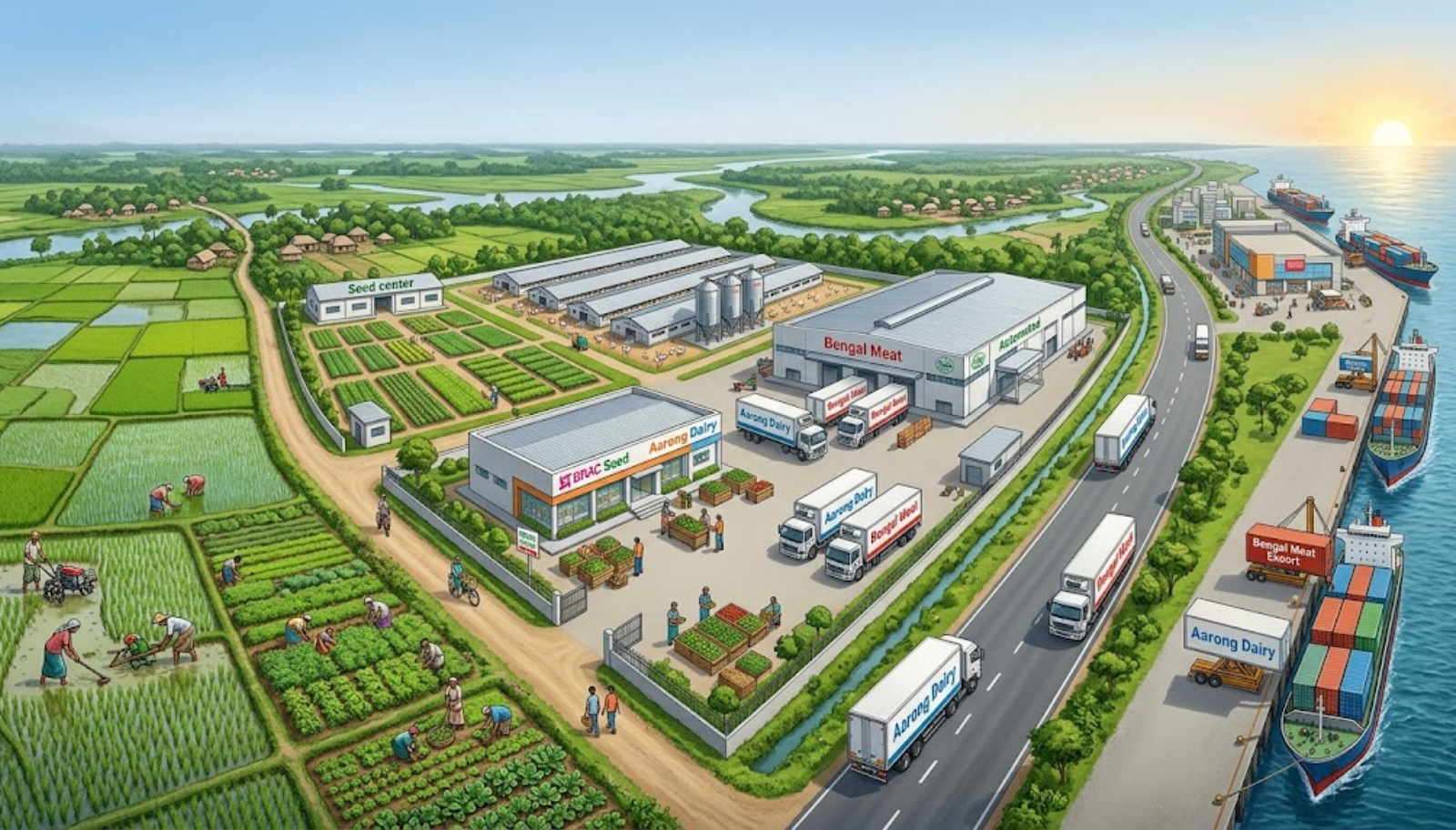
No institution better illustrates both the potential and the complexity of agribusiness development in Bangladesh than BRAC. What began as a rural development organisation has evolved into one of the most vertically integrated agricultural enterprises in the country, operating across seeds, poultry, dairy, fisheries, and retail in a model that deliberately bridges the gap between smallholder production and urban consumer markets.
BRAC’s seed enterprise supplies improved varieties to farmers across Bangladesh, directly addressing one of the most persistent productivity constraints in the agricultural sector. Its poultry operations, encompassing feed mills, day-old chick production, and technical support networks for backyard and commercial farmers, have helped professionalise a sector that once operated almost entirely outside formal value chains. Most visibly, BRAC’s Aarong Dairy brand has demonstrated that Bangladeshi consumers will pay for quality-assured, branded dairy products, and that smallholder milk producers can be connected to that premium market through systematic collection networks, quality testing, and cold chain infrastructure.
The BRAC model’s most important contribution to the future of Bangladeshi agribusiness is conceptual as much as operational. It demonstrates that the country’s fragmented smallholder farming base (long regarded as a structural barrier to commercialisation) can be integrated into modern value chains without displacing the farmers themselves. Contract farming arrangements, input supply linkages, guaranteed offtake agreements, and embedded technical assistance can convert millions of individual smallholders from subsistence producers into participants in a commercial agricultural economy. That integration, scaled beyond BRAC’s own operations through policy support and private sector replication, represents the most promising pathway to agricultural productivity growth and rural income improvement available to Bangladesh.
Bengal Meat: The Export Ambition
Bengal Meat Processing Industries represents a different dimension of the agribusiness future, namely, the processed food export market. Operating a modern, automated abattoir facility with international halal certification standards, Bengal Meat has positioned itself to serve both the growing domestic premium meat market and, increasingly, export markets in the Middle East and Europe where demand for certified halal processed meat products is substantial and expanding.
The significance of Bengal Meat extends beyond its own operations. Bangladesh has a substantial and historically underdeveloped livestock sector. Cattle rearing, goat farming, and poultry production are widespread economic activities among rural households, but the absence of modern slaughtering, processing, and cold chain infrastructure has historically prevented the sector from capturing the value-added premium that processed and packaged meat products command in domestic and international markets.
Bengal Meat demonstrates that this infrastructure is buildable in Bangladesh and that international quality and certification standards are achievable. It is, in effect, a proof of concept for a processed meat export industry that could generate foreign exchange and rural income at scale if replicated across the country with appropriate investment and regulatory support.
The Policy Imperatives for an Agribusiness Future
Neither the BRAC model nor the Bengal Meat model can scale to their potential without deliberate policy support in three areas. Cold chain infrastructure, such as refrigerated storage, transport, and retail, remains critically underdeveloped outside Dhaka, causing post-harvest losses that the Food and Agriculture Organisation estimate at between twenty and thirty percent of perishable production value annually. Government investment in cold chain logistics, and regulatory frameworks that entice private investment into the sector, would unlock value that is currently simply discarded between farm and consumer.
Contract farming legislation, providing legal certainty for the offtake agreements that make integrated agribusiness models viable for smallholders, remains incomplete and inconsistently enforced. Without legal protection for farmers who enter commercial production arrangements, the trust required to sustain those arrangements is difficult to build on a scale. And export market development through halal certification infrastructure, international trade promotion, and food safety regulatory alignment with key export market standards requires sustained institutional investment that the agricultural ministry has not historically prioritised against its food security mandate.
Bangladesh’s agribusiness future is not hypothetical. BRAC and Bengal Meat have already demonstrated their shape. The task now is to build the policy environment in which that shape becomes the norm rather than the exception.