
Farah Zahir
Oniket Research Group
In India, a billion people revere Sachin Tendulkar as a national icon in a register entirely separate from politics. Similarly, APJ Abdul Kalam, a missile scientist and later president, is remembered not for political authority, but for the quality of his mind and the simplicity of his character. In Bangladesh, no equivalent figure exists. The national symbolic landscape is dominated, overwhelmingly and almost exclusively, by political leaders. Their portraits line institution walls, their names grace airports, bridges, and universities, their biographies fill school textbooks, and their faces cover currency notes and government letterheads.
Bangladesh has produced scientists, Nobel laureates, writers, musicians, athletes, and scholars of genuine international distinction. Yet, none of them come close to the cultural altitude routinely occupied by the country’s political figures. This is not an accident; it is the product of a system that has been deliberately constructed to make it so.
The Machinery of Political Iconography
The state in Bangladesh has functioned, under virtually every administration, as a machinery for producing and maintaining political celebrity. The tools used are comprehensive and mutually reinforcing. Public institutions are named after political leaders and their families. Universities, hospitals, stadiums, bridges, and international airports carry political names that serve simultaneously as acts of governance and acts of mythmaking.
School curricula treat political history as the primary narrative of national identity, meaning that children learn who held power rather than who discovered, built, or created. National awards, from the Shadhinaota Padak to the Ekushey Padak, are distributed through processes controlled by political establishments that prioritize ideological alignment with the ruling party over the objective significance of achievement. Even the architecture of everyday public space, such as the mandatory portrait of the head of government in every government office, continuously reinforces the message that political leadership is the apex of national significance.
When power changes hands, the iconography is simply redirected rather than dismantled. Sheikh Mujibur Rahman’s image dominates under one dispensation, and Ziaur Rahman’s legacy is foregrounded under another. What remains constant across all political transitions is the fundamental principle that political figures own the symbolic space of the nation, and the state’s resources will be used to ensure that this ownership is maintained.
What Happens to the Achievers
Bangladesh has produced achievers of remarkable distinction who, in most countries, would be household names and sources of sustained national inspiration. Maqsudul Alam led the team that decoded the genome of the jute plant, a scientific achievement of direct economic relevance to a nation built on jute, yet he received a week of newspaper coverage and was largely forgotten. Mohammad Attaul Karim became a distinguished optical physicist recognized internationally, but he achieved little domestic name recognition beyond specialist circles. Zahir Raihan produced films of lasting artistic and historical importance and was a genuine intellectual force, but his celebrity has never approached that of politicians of far lesser distinction.
The case of Dr. Muhammad Yunus is the most instructive and the most damning. As the most globally recognized Bangladeshi in history, winner of the Nobel Peace Prize, and pioneer of microfinance, he is a figure celebrated on every continent. However, he spent a decade being systematically attacked, legally harassed, and institutionally undermined by the state. This occurred precisely because his international stature existed independently of political patronage and therefore represented an implicit challenge to the monopoly on national iconic status. Bangladesh had, in Dr. Yunus, a ready-made, non-political national icon of world-historical proportions, but the political establishment’s response was to treat his independence as a threat rather than a national asset.
The Syndicate of Recognition
The deeper problem is entirely structural. In Bangladesh, recognition, which is the formal acknowledgment that a life or achievement is worthy of national celebration, flows almost entirely through channels controlled by political actors. Private media, dependent on advertising from politically connected businesses and regulatory goodwill from the state, calibrates its coverage of national achievement accordingly.
Civil society organizations capable of independently elevating non-political figures are themselves largely aligned with one political formation or another, making their endorsements partisan rather than national. The cricket board is chaired by political appointees, cultural bodies distribute fellowships through political processes, and the naming committee for public institutions answers directly to the executive.
Even when exceptional individuals rise to national prominence, such as Shakib Al Hasan did through cricketing performance, their celebrity is quickly channeled through political structures. Award ceremonies become political events, and endorsements become political associations. The achiever is welcomed into the national symbolic landscape on the condition that they accept a position within the political hierarchy of significance, not as an independent alternative to it.
Redefining the Role: What National Heroes and Representatives Should Do
To break this cycle, a nation must redefine what a national hero is and outline what their role should be for the country and its people. True national heroes should not be passive symbols or political instruments, rather, they must serve as the standard-bearers of a nation’s collective intellect, ethics, and potential.
Anchors of National Unity and Inspiration
A true national hero must transcend partisan lines to provide a sense of shared pride. Their primary role within the country is to inspire the next generation by proving that excellence is attainable through merit, intellect, hard work, and character, rather than political loyalty. When a scientist, an artist, or an educator is celebrated nationally, it signals to citizens that contributing to human knowledge and societal well-being is the highest form of achievement. They should act as living blueprints for civic virtue and professional mastery.
Ambassadors of Soft Power and Global Representation
As international representatives, non-political icons are the ultimate architects of a country’s global image. When a nation is represented on the world stage by its Nobel laureates, pioneering innovators, and cultural maestros, it projects an image of sophistication, resilience, and intellectual maturity. These representatives build international bridges that politics cannot. They humanize the nation, cultivate global goodwill, and attract investment and collaboration based on mutual respect and shared human advancement, rather than geopolitical transactions.
The Essential Functions of True National Icons
They must anchor national identity in merit, creativity, and ethical integrity, showing that greatness exists beyond the corridors of power.
They must champion critically think and progress, utilizing their platforms to address existential societal challenges like education, poverty, and scientific advancement.
They must represent the country’s conscience, serving as independent voices who can guide the public and critique systemic flaws without a partisan agenda.
Breaking the Monopoly
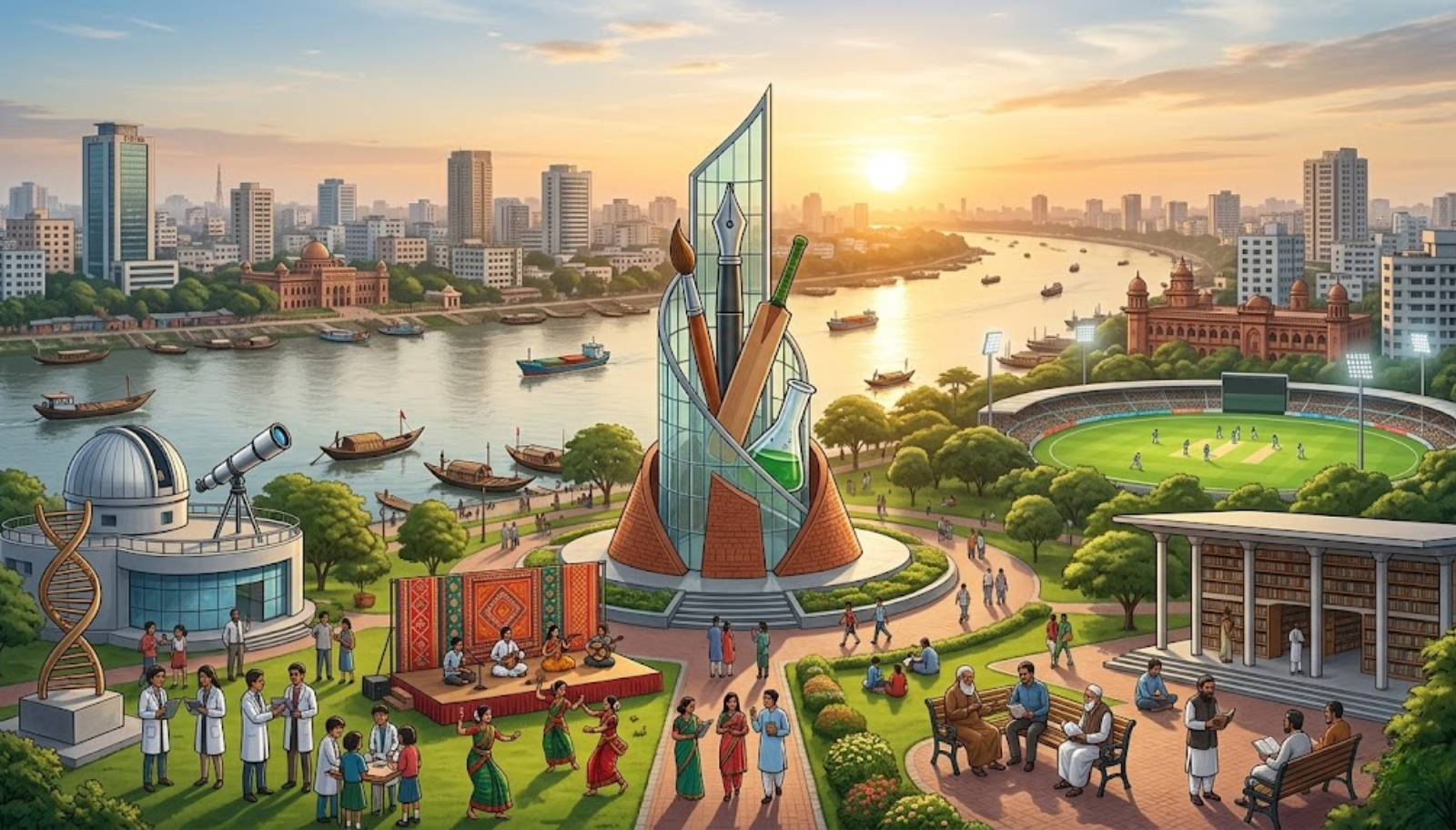
The reason Bangladesh has never had a sustained, non-political national role model is not because the country lacks extraordinary people. It is because the country lacks independent institutions, such as genuinely autonomous media, a depoliticized national awards system, a school curriculum built around achievement rather than ideology, and a civil society capable of elevating figures outside party structures. In other nations, these very institutions perform the vital work of building and sustaining non-political national icons.
A nation’s role models ultimately reveal its deepest values. A country that can only produce political celebrities is a country whose institutions have decided, implicitly but consistently, that power is the highest form of distinction. Until Bangladesh builds the institutional capacity to recognize and celebrate achievement independent of political alignment, its most talented citizens will continue to be either ignored, co-opted, or attacked, and its children will grow up with no model of national greatness that does not wear a party badge.




A thoughtful and timely article. Bangladesh should honour its political history, but national recognition must not remain confined to political figures alone. Scientists, educators, writers, artists, athletes and social innovators also deserve sustained visibility in our public institutions, school curricula and national conversations.
The most important contribution of this article is its call for independent systems of recognition. A confident nation is one that celebrates merit, creativity, integrity and service to society, regardless of political affiliation.