
Sheikh Selim
Oniket Research Group
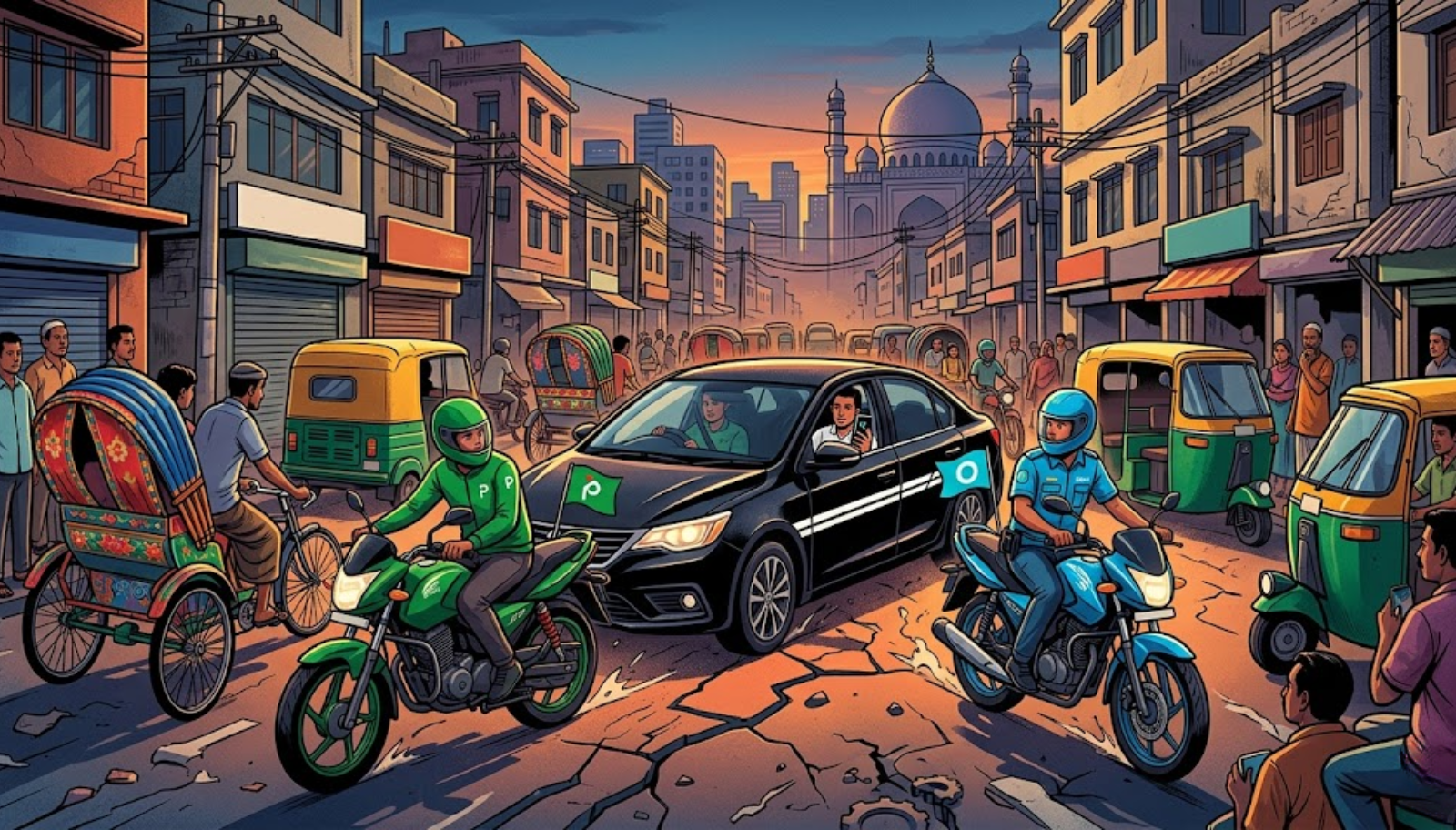
The urban transport landscape of Bangladesh has undergone significant transformation in recent years, largely due to the proliferation of app-based ride-sharing platforms. In the densely populated cities of Dhaka and Chattogram, three names predominate in the discourse: Uber, a multinational corporation, Pathao, a domestic enterprise, and O Bhai, a local competitor, are the three primary actors in this field.
Uber is a global giant, Pathao is a homegrown champion, and O Bhai is a local competitor serving a uniquely Bangladeshi niche. Collectively, these products constitute a market with an estimated valuation of 259 million US dollars in 2023, and it is projected that this figure will reach one billion dollars within the next several years.
Yet beneath this growth lies a landscape fractured by unequal competition, pricing tensions, and a workforce in open revolt against the platforms they depend upon.
Three Players, Three Identities
Uber entered Bangladesh with the weight of global capital and an established international brand. It offers car and motorcycle services, has strong safety infrastructure, and commands the premium end of the market. Its customer support is generally regarded as more responsive than its local rivals, and its brand recognition among corporate users and expatriates is significant.
Pathao, a forerunner in the field of transportation network services, was established in Bangladesh in 2015. Initially operating as a motorcycle ride-sharing service, the company subsequently diversified its offerings to encompass food delivery and car hailing services. It is the most locally attuned of the three platforms, with a profound understanding of Dhaka’s geography, commuter habits, and price sensitivities. The company has strategically positioned itself as the economical and accessible choice, successfully garnering a substantial and devoted following among younger urban commuters.
O Bhai, a venture of the MGH Group, occupies a distinctive and underappreciated niche. Unlike its rivals, it caters specifically to the CNG auto-rickshaw segment alongside car services, filling a gap that Uber and Pathao have not fully addressed. It was also the first ride-sharing app in Bangladesh to offer booking via WhatsApp, a meaningful innovation in a country where app literacy and smartphone storage are not universal. O Bhai’s model reflects a more granular understanding of the Bangladeshi urban traveller, particularly those who rely on CNG transport as a daily affordable option.
The Pricing Problem and Its Roots
The most contentious dimension of this three-way competition is pricing, and its consequences are felt most acutely by drivers. A notable distinction emerges in the commission structure between the two companies. Uber imposes a commission of up to 25 percent, whereas Pathao’s commission rate is capped at 15 percent. The Dhaka Ride-sharing Drivers Union has issued a demand for all platforms to reduce their commissions to a maximum of 12 percent. In April 2026, drivers operating with Uber and Pathao organized protests in Dhaka, demanding a minimum fare of BDT 300 and a per-kilometer rate of BDT 35. These demands were rooted in the escalating costs of fuel and vehicle maintenance, which, according to the protestors, rendered the prevailing rate structure unsustainable.
The commission gap between Uber and Pathao is not merely a number. It represents a structural imbalance between a global company with deep investor-backed pockets and a local platform that must balance competitiveness with financial viability. Uber can afford to subsidize lower passenger fares through its global capital reserves, undercutting Pathao and O Bhai in the short term while eroding the local market’s capacity to sustain homegrown alternatives. This is the classic pattern of predatory pricing in a digital marketplace, and Bangladesh’s regulatory framework has not yet developed the tools to address it.
The phenomenon of pricing pressure has given rise to a parallel economy. The phenomenon of khep, a colloquial term for drivers bypassing platforms entirely to take off-app rides at negotiated fares, has become so widespread that over 60 percent of surveyed Dhaka commuters reported using it in 2023. Drivers who opt to circumvent the commission structure may accrue greater earnings per trip; however, they forgo the platform’s provisions for insurance, traceability, and dispute resolution.
In response to these developments, both Uber and Pathao have introduced subscription models that charge drivers a fixed daily or monthly fee rather than a per-ride commission. This shift indicates an acknowledgement that their previous commission structures were financially unsustainable. However, these new subscription models do not yet represent a comprehensive solution to the underlying imbalance in the industry.
Wider Concerns for Passengers and the Transport Ecosystem
Beyond pricing, all three platforms face shared concerns around safety, surge pricing, and accountability. Off-platform rides eliminate the traceability and insurance that app-based journeys provide for commuters. Surge pricing during rain, rush hours, and public holidays has the effect of making rides unaffordable for lower-income passengers precisely when they need transport most. The regulation of driver conduct, vehicle condition, and minimum service standards is inconsistently enforced across all platforms.
What Competition Policy Must Deliver
A fair and functional ride-sharing market in Bangladesh requires a competition policy framework that addresses both structural imbalances and consumer protections simultaneously.
The Bangladesh Competition Commission should investigate whether pricing practices employed by global entrants on digital platforms constitute predatory behavior designed to undercut and eventually absorb local competitors. In instances where substantiated findings align with these principles, the imposition of corrective pricing floors and conduct obligations becomes priority.
The government should establish a statutory maximum commission rate applicable to all ride-sharing platforms operating in Bangladesh, replacing the current voluntary and uneven rate structures. A legislated cap of 12 to 15 percent, as demanded by driver unions, would reduce the off platform khep economy and stabilise driver incomes without eliminating platform viability.
The implementation of dynamic surge pricing should be subject to a regulatory ceiling that is published for the purpose of transparency. Platforms should be required to disclose their surge multipliers to passengers prior to trip confirmation. Uncapped surge pricing can be regarded as a regressive tax on passengers with fewer transportation alternatives.
In addition, BRTA and the Ministry of Road Transport should develop a dedicated regulatory framework for the CNG app-based segment, giving O Bhai and similar services a clear operating environment that acknowledges their structural differences from motorcycle and car platforms.
The ride-sharing market in Bangladesh is a genuine economic asset. To protect it from monopolization and ensure the livelihood of the hundreds of thousands of drivers who sustain it, regulation must be implemented that is both intelligent and equitable. This regulation must be designed with the digital economy it governs in mind.

