
Desk Report
Oniket Research Group
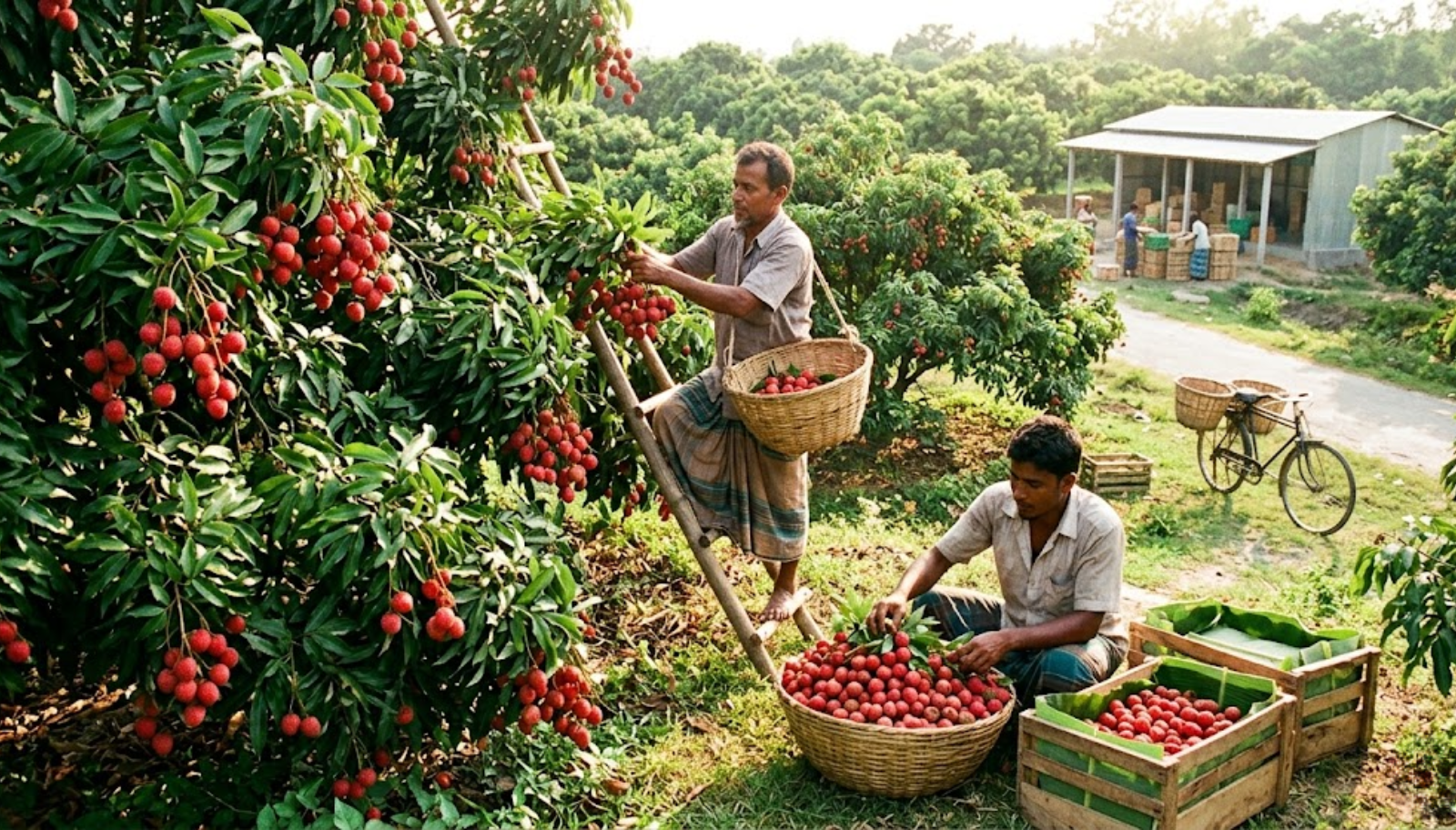
Ishwardi in Pabna district has long held its title as Bangladesh’s litchi capital, and this season’s record harvest of more than 40,000 tonnes is a powerful testament to the region’s agricultural potential. Yet behind the headline numbers lies a story that demands urgent policy attention. Farmers who cultivated bumper yields found their earnings fall well short of expectations, as a prolonged heatwave and a surge in post-Eid supply compressed market prices to their lowest levels in years. The contrast between record production and reduced returns reveals a structural gap that national and regional agricultural policy must now move decisively to close.
The Case for Climate-Resilient Agricultural Policy
The heatwave that blanketed Ishwardi during the peak harvest window exposed a fundamental vulnerability in the region’s litchi sector. Temperatures consistently above 35 degrees Celsius caused widespread discolouration and black spotting across the Bombay variety, one of the most commercially valued fruits in the region. Farmers reported that even trees yielding 7,000 to 8,000 litchis could produce fewer than 5,000 marketable fruits. This climate-induced quality loss directly eroded farmer income and underscores the need for a national policy framework that integrates climate resilience into horticultural planning. The government should fast-track research into heat-tolerant litchi varieties, expand agronomic advisory services, and fund shade management and microclimate protection techniques deployable across smallholder orchards. Regional agricultural extension offices must be empowered with adequate staffing, technology, and resources to support farmers adapting to increasingly volatile weather patterns.
Post-Harvest Infrastructure as a National Priority
A defining challenge this season was the simultaneous arrival of large volumes of litchi in the market immediately after Eid-ul-Azha, when buyer demand had already moderated. During peak harvest, 40 to 50 truckloads of litchis were dispatched daily from Ishwardi alone to markets across the country. Without adequate cold storage, processing facilities, or staggered market entry mechanisms, this concentration of supply inevitably pushed prices downward. A farmer who harvested 120 trees earned approximately Tk 8 lakh against an expectation of more than Tk 10 lakh, a gap that reflects infrastructure failure rather than agricultural underperformance. National policy must prioritise investment in decentralised cold chain infrastructure across major horticultural zones. Government-supported cold storage units refrigerated transport subsidies, and community-level preservation facilities would allow farmers to hold produce and release it to market in a manner that stabilises prices and protects earnings throughout the season.
Market Reform and Price Stabilisation Mechanisms
The price received by Ishwardi farmers for Bombay litchis fell to Tk 2,000 per thousand for premium quality and as low as Tk 1,500 for lower grades, levels that farmers described as the worst in recent memory. Agriculture officials acknowledged the disappointment while noting that overall production volume would sustain profitability in aggregate. The litchi trade across Pabna district is expected to reach Tk 1,000 crore this season, with Ishwardi contributing more than Tk 700 crore. These figures confirm the economic scale of the sector and strengthen the argument for a formalised minimum support price mechanism for commercially significant horticultural crops. Regional agricultural boards should be authorised to intervene when farm gate prices fall below a fair threshold, either through direct procurement or through the activation of buffer market operations that absorb excess supply and prevent price collapse during peak harvest periods.
Export Diversification and Value Addition as a Growth Strategy
Ishwardi’s Bombay and China-3 litchi varieties are among the most sought-after in the country and carry significant export potential that remains largely untapped. A structured national export promotion policy for premium horticultural products could open markets across South Asia, Southeast Asia, and the wider diaspora community. Investment in grading, packaging, and food safety certification infrastructure at the regional level would enable farmers and traders to meet international quality standards. The Department of Agricultural Extension, which monitored more than 3,100 hectares of litchi cultivation in Ishwardi this season, is well placed to serve as the institutional anchor for a regional agro-export development programme that elevates Bangladeshi litchis to a globally recognised brand.
Building a Future-Proof Horticulture Sector
The story of Ishwardi’s litchi season is ultimately a story of immense productive capacity meeting inadequate policy infrastructure. The farmers of Pabna have demonstrated that Bangladesh can deliver world-class horticultural output; the cultivation covered 4,620 hectares across the district this year, with production expected to surpass 50,000 tonnes in total. The responsibility of government at both national and regional levels is now to build the policy environment that converts that output into stable, rewarding, and climate-resilient livelihoods. With focused reforms in post-harvest management, market regulation, climate adaptation, and export development, Ishwardi’s litchi orchards can become a flagship model for sustainable agricultural prosperity across Bangladesh.