
Naima Onamika
Commissioning Editor, The Oniket Bulletin
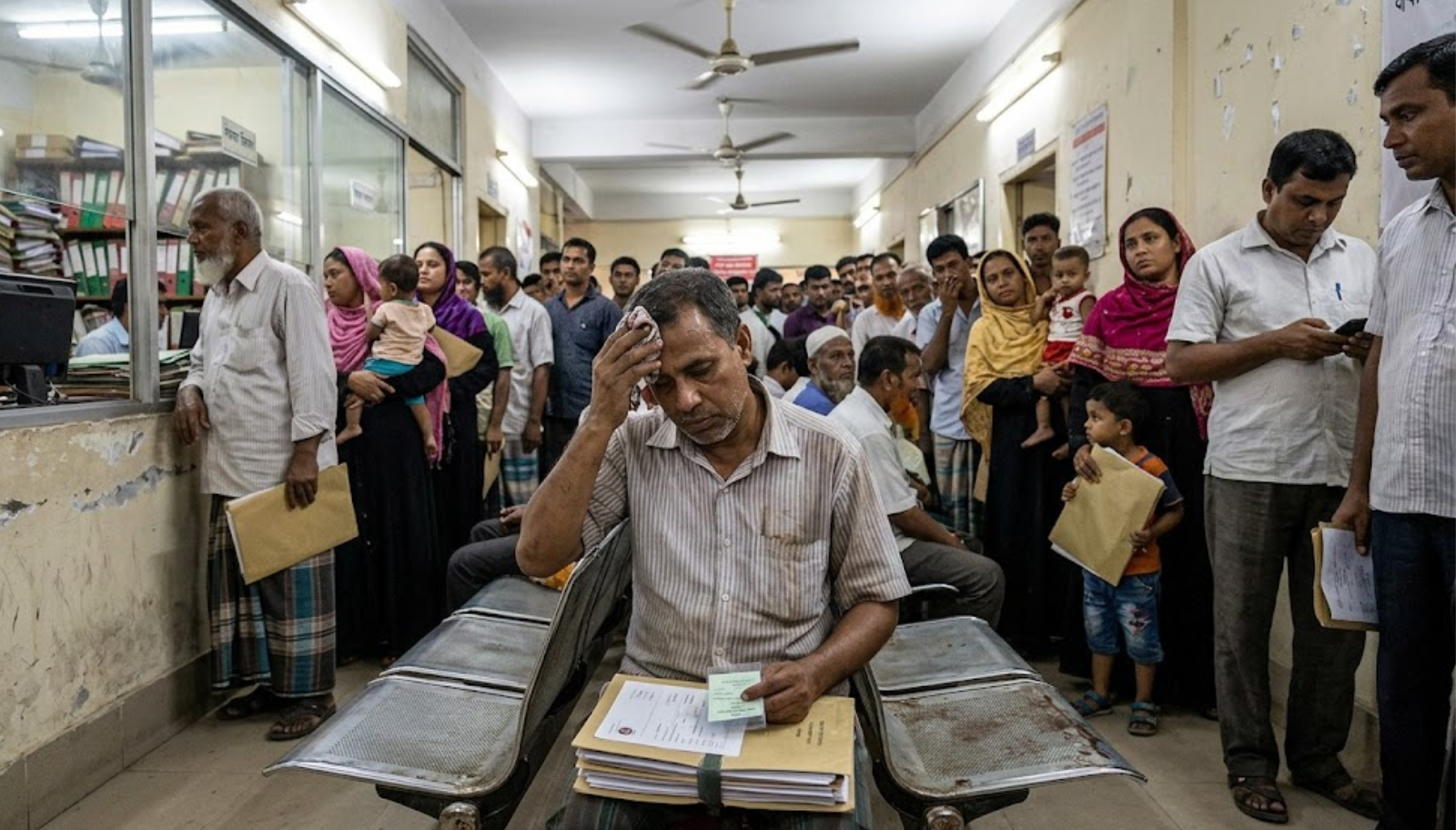
In a modern state, a national identity card and passport are far more than administrative documents. They are proof of citizenship, gateways to public services, and essential tools that connect citizens with the state. Yet in Bangladesh, obtaining or correcting these documents often becomes a frustrating and exhausting experience for ordinary people. Thousands of citizens face lengthy delays, complicated procedures, and repeated visits to different offices for simple tasks such as correcting information, updating records, or collecting passports. As a result, the very system designed to confirm a person’s identity frequently becomes a major source of hardship.
The Burden of Bureaucratic Complexity
Today, the National Identity Card (NID) is required for almost every aspect of civic life in Bangladesh. It is essential for banking, land registration, business transactions, tax payments, government benefits, and voting rights. Despite its importance, correcting errors or updating information on an NID remains a difficult process for many citizens. Applicants often wait months to fix a minor spelling mistake in their name, correct a date of birth, or update family information. In many cases, repeated visits to local offices fail to produce any meaningful progress.
What makes the situation even more troubling is that many of these errors are not caused by the applicants themselves. They often originate from mistakes made during data entry or administrative processing. Nevertheless, the responsibility for correcting those mistakes falls entirely on the citizen. This raises an important question: why should citizens bear the burden of correcting errors that were created by the system itself?
A Double Burden for Marginalised Citizens
Another challenge lies in the gap between social realities and administrative procedures. Many children in Bangladesh are raised by grandparents, relatives, or legal guardians rather than their biological parents. However, existing forms and database structures often fail to properly recognise these family arrangements. As a result, citizens can face unnecessary complications when registering or updating their identity records.
This issue goes beyond technical limitations. When administrative systems fail to recognise legitimate guardianship arrangements, individuals may experience forms of social and institutional exclusion. The problem is therefore not simply about paperwork; it is also about dignity, fairness, and equal access to citizenship rights.
When Passport Applications Depend on NID Records
The challenges become even greater when the passport system is linked to NID information. Bangladesh’s introduction of the e passport marked an important step towards modernising travel documentation. However, technological advancement has not always been matched by effective coordination between databases. Even a small discrepancy between NID and passport information can result in an application being delayed or suspended. Applicants are often required to submit additional documents, undergo further verification, and navigate lengthy administrative procedures.
Complications related to parental or guardian information are particularly common. These delays can create serious difficulties for students, migrant workers, medical travellers, and individuals who need to travel urgently for personal or professional reasons.
Fragmented Identity Systems
Many experts believe that the root of the problem lies in Bangladesh’s fragmented identity management system. At present, birth registration records, NID data, and passport information are maintained by separate authorities. As a result, an inconsistency in one database can create complications across the entire system. In many countries, integrated digital identity platforms allow verified citizen information to be used seamlessly across government services. In Bangladesh, however, the lack of coordination between databases often leads to delays, additional expenses, and unnecessary inconvenience for citizens.
A Question of Good Governance
The challenges surrounding NID and passport services are not merely technical issues. They are also a test of administrative efficiency and good governance. A truly effective public service system should place the responsibility for efficiency on institutions rather than on citizens. Yet many Bangladeshis find themselves repeatedly required to prove information that the state has already recorded and verified. Such experiences weaken public confidence in government services and raise concerns about accountability and service quality.
What Needs to Change?
Rather than focusing solely on the problems, attention must also be given to practical solutions. Experts have identified several reforms that could significantly improve citizen services and reduce unnecessary complications.
First, birth registration, NID, and passport databases should be integrated into a unified national identity platform. Once information is corrected in one system, the update should automatically be reflected across all related databases.
Second, application forms and database structures should be modernised to properly accommodate legal guardianship and alternative family arrangements.
Third, clear deadlines should be established for correction and amendment requests. Citizens should also have access to an online tracking system that allows them to monitor the progress of their applications.
Fourth, integrated service centres could be established at the upazila level, providing birth registration, NID, and passport services under one roof. This would reduce travel costs, save time, and simplify the overall process.
Fifth, stronger digital infrastructure and reliable backup systems are needed to minimise disruptions caused by technical failures and server outages.
Conclusion
In the twenty-first century, identity related services should be fast, accurate, transparent, and humane. Yet Bangladesh’s NID and passport systems continue to face structural challenges that extend beyond technology. The deeper issues include inadequate coordination, limited accountability, and a lack of citizen centred service delivery. Citizens should not be forced to repeatedly prove their identity to access services that are rightfully theirs. The strength of a democratic state is measured not only by its technological capabilities but also by the respect it shows for the time, dignity, and rights of its people.
Reforming the NID and passport system is therefore more than an administrative necessity. It is an essential step towards restoring public trust, strengthening governance, and building a more efficient and citizen friendly state.