
Farah Zahir
Editor, Oniket Research Group
Walk through the elite commercial avenues of Gulshan, Banani, or Dhanmondi, and you are immediately captured by a vibrant celebration of heritage. Glittering storefronts display the pinnacle of Bangladeshi craftsmanship: ethereal Jamdani sarees, deeply textured Nakshi Kantha quilts, and hand-embroidered garments that tell centuries-old stories in every stitch. This urban boutique industry has evolved from a modest expression of cultural pride in the 1990s into a lucrative commercial powerhouse, currently valued between USD 320 million and USD 970 million. These masterpieces command premium prices from domestic elites and international connoisseurs alike.
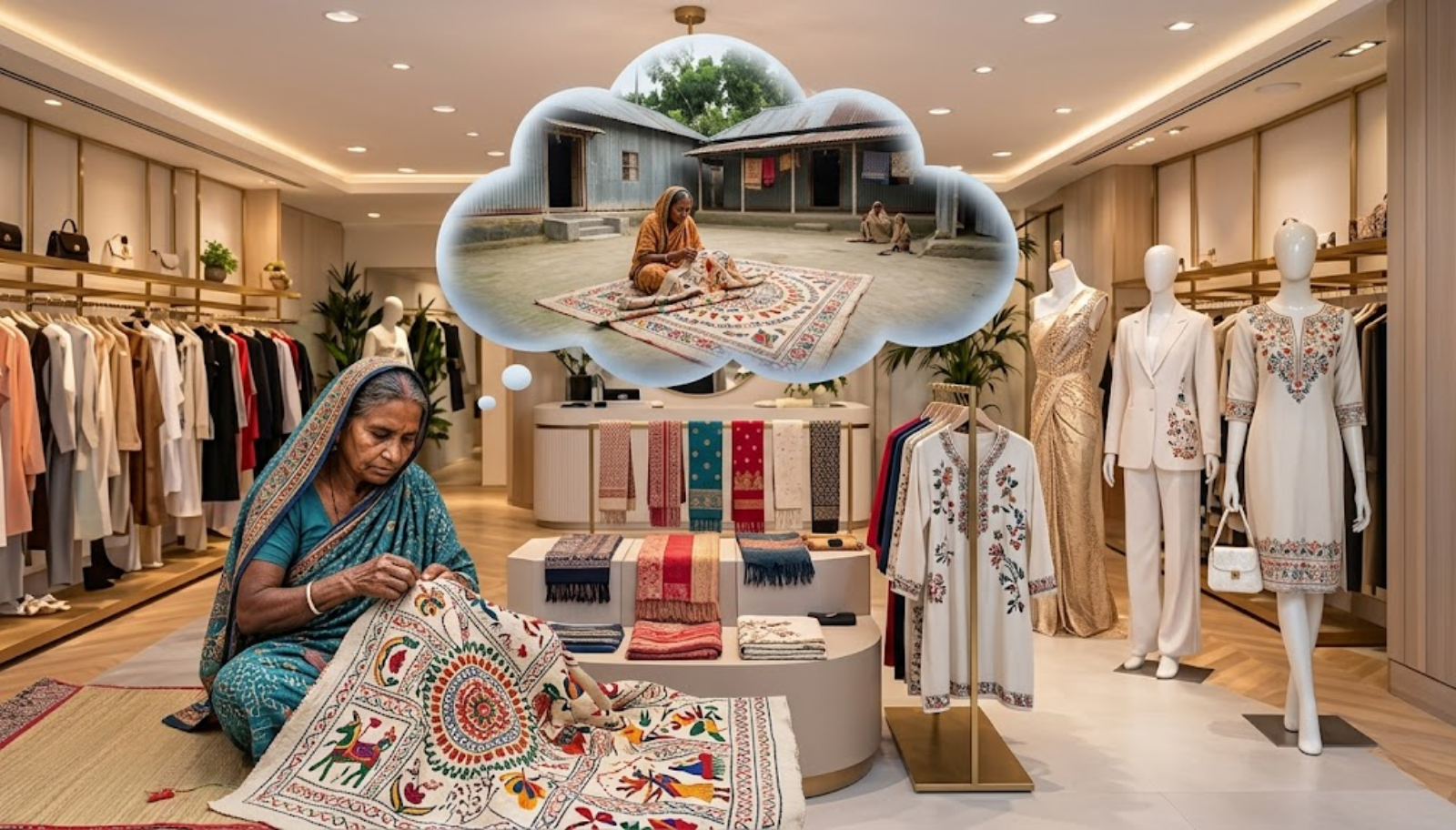
Beneath the soft gallery lighting of these high-end boutiques lies a stark and unsettling economic divide. The rural women whose masterly precision and tireless fingers create these works of art receive only a tiny fraction of the wealth they generate. Instead, the dominant share of the profit is captured by urban boutique owners who simply attach a designer tag and a brand label to the finished product.
The Evolution of Extraction: Informational Asymmetry at Work
The transformation of Bangladesh’s indigenous textile heritage began when pioneering, educated upper-class entrepreneurs in Dhaka recognized the immense market potential of traditional crafts. Centuries-old traditions passed down communally from mother to daughter across rural Bengal were cleverly reimagined. Nakshi Kantha transitioned from a humble family quilt into luxury home decor, while the UNESCO-recognized muslin weaves of Narayanganj and Rupganj were successfully rebranded as high fashion.
However, as city-based middle managers and brokers began arriving at the doorsteps of village artisans in Jamalpur, Rajshahi, or Narail with bulk orders, the supply chain developed into a system based on informational asymmetry rather than a balanced partnership. Lacking direct access to urban markets, a rural artisan has no way of knowing that the Nakshi Kantha quilt she sells to an intermediary for 1,000 to 1,500 Taka will eventually retail for 8,000 to 15,000 Taka on a boutique shelf in Dhaka. Data reveals that while urban boutiques capture a massive 48 percent of the final retail price, the indigenous artisan who poured weeks of labor into the piece receives a meager 12 percent, with brokers and middlemen swallowing another 20 percent. To fully grasp the depth of this economic gap across different product lines, consider the structural data compiled in the chart below:
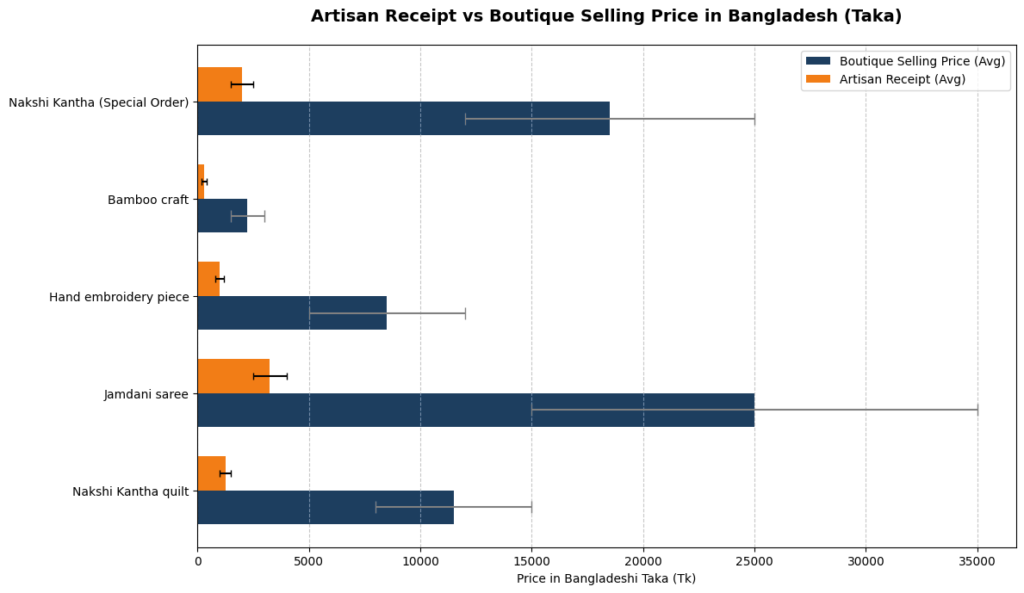
As illustrated in the graph, the pricing discrepancy reveals markups ranging from 500 to 1,000 percent. For instance:
Jamdani Saree: While the average boutique selling price reaches a staggering 25,000 Taka, the artisan’s receipt hovers near a tiny fraction of that amount, at roughly 3,200 Taka.
Nakshi Kantha (Special Order): Retail prices climb close to 18,500 Taka, yet the rural creator receives an average of only 2,000 Taka.
Nakshi Kantha Quilt & Hand Embroidery: Boutiques retail these items at averages of 11,500 Taka and 8,500 Taka respectively, while the hidden artisans are left with just 1,200 Taka and 1,000 Taka.
The Stolen Reward: Legal Void and Cultural Piracy
This exploitation is not merely financial; it is a form of cultural piracy. In slum-based workshops and remote villages, a recurring cycle plays out. Brokers deliver raw fabric and thread, promise payment upon delivery, and collect the finished embroidery after weeks of perfectionism. The broker pays the pre-determined nominal sum, disappears, and leaves the artisan completely blind to the retail value or the brand label later stitched onto her work. Consequently, needlework artisans in Bangladesh earn roughly 50 percent less than workers in comparable skill sectors. In settlements around Narail, these women lack secure marketplaces or proper storage facilities, leaving them highly vulnerable to seasonal losses when monsoon rains destroy their unsold wares.
Worse still, wealthy urban entrepreneurs systematically exploit deep loopholes in the country’s legal system. They photograph unique village motifs, digitize centuries-old patterns, and reproduce them at scale using industrial screen printing or machine power looms. When these cheap imitations are sold as “exclusive designer collections,” the indigenous artisan loses both authorship and income.
While Bangladesh’s Copyright Act 2000 protects individual artistic creations, traditional cultural expressions developed communally over generations fall into a legal black hole. Because no single author can be legally identified, these ancient heritage designs are treated as public domain, leaving them entirely unprotected from commercial exploitation.
A Policy Roadmap to End Value Chain Discrimination
To transform this extractive relationship into an ethical partnership, Bangladesh must move past voluntary corporate social responsibility and implement rigorous, legally binding policy reforms.
Enact a Traditional Cultural Expressions Protection Act
The state must introduce legislation recognizing communal custodianship over indigenous designs. This law should guarantee traditional communities the right to prior informed consent before any motif is commercially reproduced, ensure mandatory attribution on product labels, and secure collective compensation via royalty payments. Unauthorized commercial reproductions must face strict fines and legal injunctions.
Establish a National Traditional Design Register
The Ministry of Cultural Affairs should develop a comprehensive, publicly accessible digital database to document originating communities, motif histories, and customary usage rules for every traditional design. This register will serve as legal proof of communal ownership. Any brand wishing to utilize these patterns must use this platform to credit the community and negotiate fair terms under the principles of Free, Prior, and Informed Consent (FPIC).
Mandate Price Transparency via QR Codes
The government should legally require all boutiques selling handcrafted heritage items to disclose the exact artisan wage component on the product label or via a scanable QR code. This transparency mechanism will expose unfair markups and empower consumers to support ethically sourced brands.
Replicate Dedicated Artisan Marketplaces Nationwide
To eliminate exploitative middlemen, the government must scale up successful decentralized models. The UNCDF-supported Durgapur Growth Center model in Narail, which provides women artisans with permanent vending booths, climate-secure storage, and digital marketing tools, should be replicated in all 64 districts. Direct market access allows rural creators to set their own prices based on actual labor.
Implement Mandatory Royalty Sharing
When commercial fashion houses use indigenous motifs on mass-produced garments, a mandatory 5 to 10 percent of the retail price should be deposited into a community development fund managed directly by the originating artisan group. This ensures that a portion of the commercial wealth flows back to sustain the craft’s birthplace.
Redefining the Bridge
The urban boutique sector is not inherently an enemy to rural artisans; it represents their most vital link to high-value domestic and global markets. However, a commercial bridge that carries wealth exclusively in one direction and leaves poverty in the other is not a bridge at all, it operates as a toll gate. Until our national legal frameworks recognize that the hand which stitches the pattern holds the inherent right to its economic value, the luxury boutique shelves of Dhaka will remain a monument to beautiful things taken from people rendered too invisible to demand their fair share.