
Md. Sawkat Wasit
Student
Bangladesh’s poultry industry has emerged as one of the most important pillars of the country’s agricultural economy. It plays a vital role in ensuring food security, meeting the growing demand for animal protein, creating rural employment, and supporting small-scale entrepreneurship. Today, approximately eight million people are directly and indirectly employed in the sector, while nearly one million entrepreneurs depend on poultry farming for their livelihoods. With annual production of around 23 billion eggs and 1.46 million tonnes of poultry meat, the industry has become one of the country’s primary sources of animal protein.
Although the number of commercial farms and overall production continue to grow at an annual rate of nearly 15 percent, the industry’s long-term sustainability remains threatened by multiple structural challenges. Comprehensive reforms are now essential if the sector is to remain profitable, resilient, and sustainable. Against this backdrop, this article examines the current state of Bangladesh’s poultry industry, the challenges confronting the sector, and the policy measures required to secure its future.
Dependence on Imported Feed and Rising Production Costs
One of the poultry industry’s greatest vulnerabilities is its heavy dependence on imported feed ingredients. A significant proportion of maize and soybean meal, the two primary components of poultry feed, is sourced from international markets. As a result, fluctuations in global commodity prices directly increase production costs within Bangladesh. Geopolitical disruptions, including the Russia-Ukraine war, have further intensified these pressures.
At times, production costs have exceeded market prices. Broiler production costs have risen to approximately BDT 160 per kilogram, while farmers have been forced to sell their birds for around BDT 130 per kilogram, resulting in substantial financial losses.
Reducing this dependence requires greater domestic production of maize and soybeans, increased research into alternative protein sources such as insect meal and single-cell protein, and investment in locally adapted, cost-effective feed technologies.
Climate Change: A Growing Threat to Poultry Farming
Climate change has become one of the most serious emerging threats to Bangladesh’s poultry industry. In recent years, severe heatwaves have pushed broiler mortality rates to nearly 10 percent and layer mortality rates to around 5 percent in several districts. Egg production has also declined by 15 to 30 percent during extreme weather conditions. During the heatwaves of April and May 2025 alone, poultry farmers reportedly suffered losses amounting to approximately US$25 million.
Nearly 80 percent of Bangladesh’s egg and poultry meat production comes from small-scale farmers, many of whom lack access to climate-controlled housing or reliable electricity. Addressing this challenge will require subsidised cooling and ventilation systems for small farms, investment in heat-tolerant poultry breeds, uninterrupted electricity supply, and government support for climate-resilient farm infrastructure.
The industry’s competitiveness is also constrained by inadequate cold chain facilities, refrigerated transportation, and modern slaughterhouses. Expanding both public and private investment in these areas is essential to improve food safety and maintain product quality.
Disease Control, Biosecurity, and Regulatory Weaknesses
Infectious diseases such as avian influenza and Newcastle disease continue to pose significant threats to Bangladesh’s poultry industry. At the same time, the excessive and often unregulated use of antibiotics has increased the risk of antimicrobial resistance, created concerns that extended beyond livestock production and into public health. Biosecurity standards remain weak across many small-scale farms, allowing infectious diseases to spread rapidly.
Addressing these challenges requires mandatory biosecurity protocols for poultry farms of all sizes, a comprehensive national disease surveillance and rapid response system, stricter regulation of antibiotic use, and stronger regulatory institutions capable of ensuring food safety throughout the production chain.
Protecting Small Farmers and Modernising the Market
Bangladesh’s poultry supply chain is characterised by multiple intermediaries, high transportation costs, and limited pricing transparency. As a result, farmers frequently receive prices that do not reflect the true value of their production.
Contract farming has the potential to become an effective model for supporting small-scale producers. However, success will depend on regulatory safeguards that guarantee fair pricing and protect farmers from exploitative market practices.
Affordable credit, livestock insurance covering climate-related and disease-related losses, targeted emergency financial assistance, and broader financial inclusion are equally important. Without these protections, many small farmers may be forced to leave industry, threatening the country’s future supply of affordable animal protein.
Environmental Sustainability and Technological Innovation
Long-term sustainability requires more than increasing production. Environmental responsibility must become an integral part of future industry development. Improved poultry waste management, measures to reduce soil and water pollution, lower greenhouse gas emissions, and greater use of poultry waste for organic fertiliser and biogas production would contribute to a more sustainable production system.
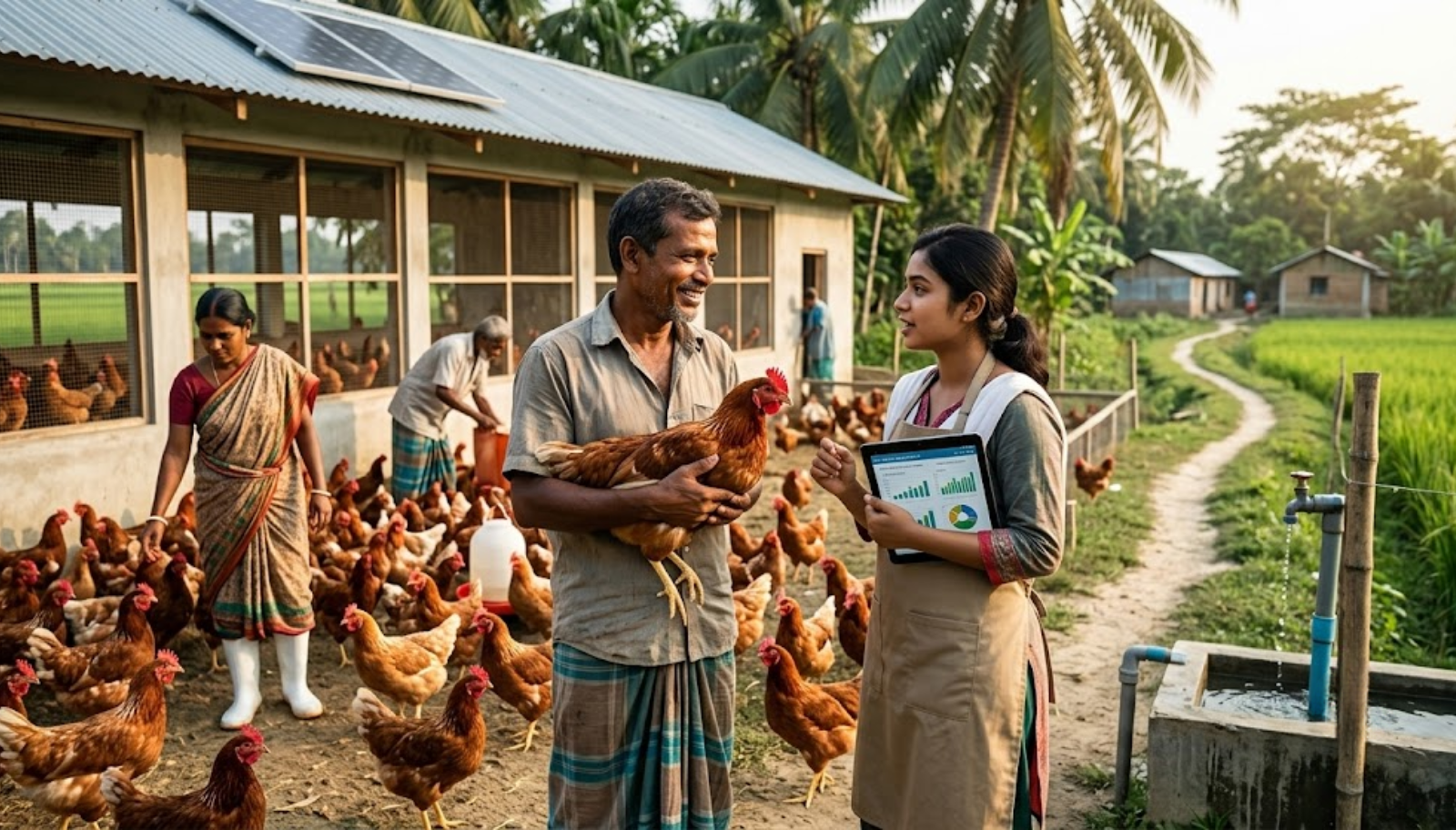
Digital technologies also offer significant opportunities. Artificial intelligence for disease detection, digital farm management systems, mobile veterinary services, online marketing platforms, and end-to-end digital traceability from production to retail could substantially improve productivity while strengthening consumer confidence in poultry products.
Export Potential and Value Addition
Global demand for halal-certified poultry products continues to expand rapidly, particularly across the Middle East, Southeast Asia, and other Muslim-majority markets. Bangladesh has significant export potential in these regions.
Realising that opportunity will require internationally recognised slaughtering practices, modern processing facilities, halal certification, and rigorous food safety compliance. The industry can also enhance its competitiveness by expanding production of value-added products such as sausages, nuggets, ready-to-cook poultry products, and other processed foods while increasing access to consumers through e-commerce platforms.
Research, Innovation, and Human Capital Development
Ensuring the long-term sustainability of Bangladesh’s poultry industry will require greater investment in research and innovation. Universities, research institutions, veterinary professionals, and private-sector stakeholders should work together to develop climate-resilient poultry breeds, improve locally sourced feed technologies, and advance modern production methods.
At the same time, regular farmer training programmes, skilled workforce development, and the modernisation of agricultural extension services will play a critical role in increasing productivity and strengthening the industry’s resilience.
Conclusion
Bangladesh’s poultry industry stands at a defining moment. On one hand, it remains one of the country’s most important drivers of food security, nutrition, rural employment, and agricultural growth. On the other, dependence on imported feed, climate change, disease outbreaks, inadequate infrastructure, and inefficient market systems continue to expose industry to significant risks.
Building a sustainable future will require a comprehensive national strategy focused on greater self-reliance in feed production, climate-resilient infrastructure, effective biosecurity measures, financial protection for small farmers, environmentally responsible technologies, expanded investment in research and innovation, and internationally competitive export capacity.
The future of Bangladesh’s poultry industry is far more than an economic issue. It is fundamentally connected to the nation’s food security, nutritional well-being, employment generation, and long-term sustainable development.




Comments on “Bangladesh’s Poultry Industry and the Path to Sustainable Growth: Opportunities, Challenges, and the Way Forward”