
Desk Report
This article examines why imported goods become substantially more expensive in Bangladesh after arrival and outlines practical reforms that can reduce these costs, improve competitiveness, strengthen trade efficiency, and lower prices for consumers and businesses. The price a Bangladeshi consumer pays for an imported product bears little resemblance to its international market value. By the time a container arrives at a warehouse in Dhaka, the original product cost has been inflated by layers of tariffs, banking fees, port charges, customs delays, corruption, and transport costs that together can add 45 percent or more to the landed price. Understanding these layers is the first step toward dismantling them.
We argue that Bangladesh’s import costs are inflated by tariffs, expensive letter-of-credit confirmations, inefficient ports, customs delays, logistics bottlenecks and manual procedures. Our main recommendations include tariff rationalisation, banking reforms, faster customs clearance, complete digitalisation, transport upgrades, market-based exchange rates and stronger international banking relationships to improve affordability and competitiveness.
The Real Cost Structure
Bangladesh imported $75 billion worth of goods in the fiscal year 2023 (WITS data). The landed cost of those imports, however, far exceeded their invoice values. Tariffs and duties alone constituted approximately 15 percent of landed cost. Port and logistics charges added another 10 percent. Customs clearance delays and associated informal payments consumed roughly 8 percent. Inland transport from Chattogram to Dhaka and other destinations contributed 7 percent. LC related banking fees accounted for 5 percent.
The base product cost represented only about 55 percent of what importers actually spent. These are not marginal markups. They represent structural inefficiencies that punish every consumer and business in the country.
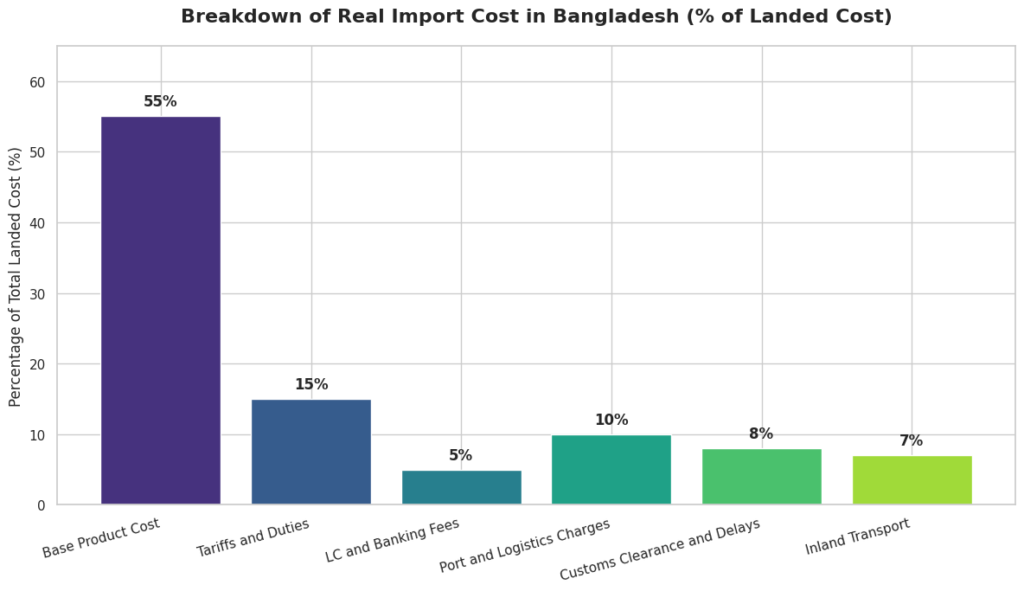
The graph (Based on WITS data) above illustrates how the real import cost in Bangladesh is distributed. The product itself accounts for barely half the total expense. The remaining half consists of costs generated entirely by domestic systems, policies, and failures, costs that are neither inevitable nor irreducible.
Letter of Credit: The Costliest Banking Fee in South Asia
The most striking inefficiency in Bangladesh’s import architecture is the cost of Letters of Credit. Previously, approximately one fourth of import LCs required third party bank confirmations. After the foreign exchange crisis of 2022, that figure surged to over 80 percent. LC confirmation fees charged by foreign banks now stand at 3.5 percent of import value per year, up from 1.7 to 2 percent previously.
In the fiscal year 2023, with $75 billion in imports and roughly 80 percent requiring LC confirmation at an average rate of 3 percent, Bangladeshi importers paid an additional $1.8 billion, or over Tk 19,000 crore, in confirmation fees alone. Had the rates not increased by 1.5 percentage points, the country would have saved $600 million, or over Tk 6,600 crore, in a single year. These costs are passed directly to consumers through higher retail prices.
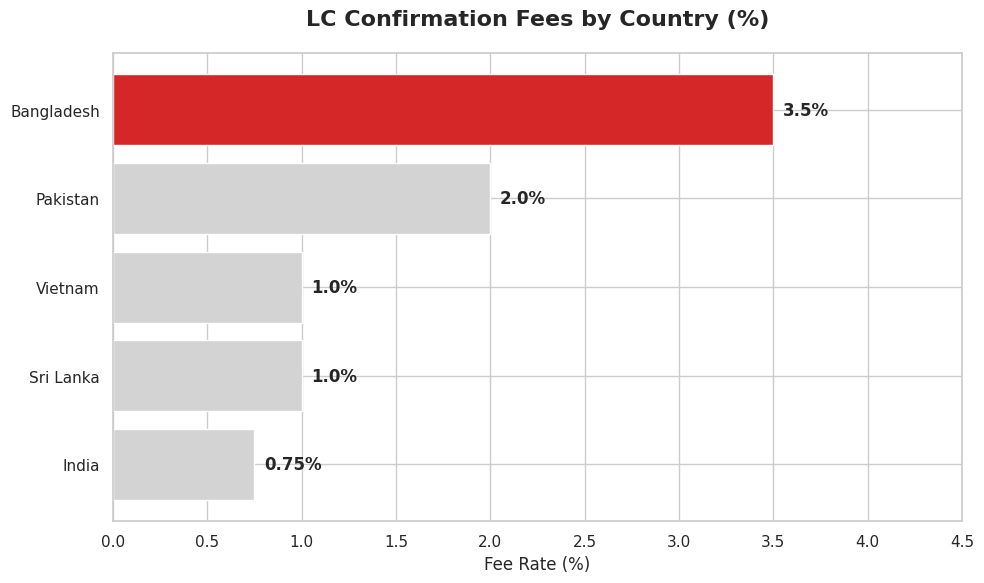
The comparison (based on WITS data) above reveals the magnitude of the disparity. India charges 0.75 percent for LC confirmation on transactions up to Rs 10 crore and 0.50 percent for larger amounts. Pakistan, despite facing comparable economic stress, charges 1.5 to 2.5 percent. Even Sri Lanka and Vietnam operate at roughly 1 percent. Bangladesh at 3.5 percent stands alone at the extreme.
The reason is not that foreign banks bear higher risk in Bangladesh per se, but that many local banks opened LCs beyond their payment capacity, defaulting on obligations and destroying the credibility of the entire banking system in international markets. Foreign banks responded by raising confirmation fees to compensate for perceived country risk and institutional fragility. A 20 percent tax on interest payments related to foreign loans has further compounded the burden.
Port, Customs, and Transport Inefficiencies
Chattogram port handles approximately 92 percent of Bangladesh’s import and export traffic, yet it has the highest dwell time in Asia. Goods spend an average of over 11 days waiting for clearance, against a global benchmark of 3 to 5 days. The World Bank listed Bangladesh as having the longest time to fulfil import processes of any region, with customs clearance alone consuming 168 hours, well above the regional average. Importers are required to submit up to 30 separate documents across permits, declarations, and banking papers, a process that remains heavily dependent on manual intervention despite years of promised digitisation.
The National Single Window system, intended to integrate all trade related agencies into a single digital platform, remains only partially functional. Each day of delay at the port generates demurrage charges that compound the cost of the goods. Informal payments to expedite clearance, widely reported by importers and documented by Transparency International, add an opaque but significant overhead. Road and rail connections from Chattogram to the rest of the country remain inadequate, adding further time and cost to inland distribution.
Essential Reforms
The tariff structure must be rationalised. Average input tariffs of 12 to 15 percent and rising output tariffs create an anti export bias that favours import substitution over diversification and keeps consumer prices artificially high. The National Tariff Policy 2023 already addresses some of these distortions but remains largely unimplemented. It must be enforced immediately, with supplementary duties and regulatory duties reviewed and reduced on intermediate goods and essential imports. The exchange rate must be governed by a market determined mechanism rather than administrative management, so that import pricing reflects genuine supply and demand rather than central bank distortion.
The banking sector’s LC confirmation fee crisis can only be resolved by addressing its root cause: the erosion of foreign bank confidence in Bangladeshi issuing banks. The central bank must enforce strict limits on LC openings relative to each bank’s verified payment capacity, precisely the approach used by Dutch Bangla Bank, which has maintained low confirmation rates by opening only those LCs it can honour. The 20 percent tax on interest payments for foreign loans should be abolished or substantially reduced. The country must also develop overseas banking relationships and explore alternative payment systems, including bilateral currency arrangements with major trading partners, to reduce dependence on dollar denominated LC confirmations.
Port operations require urgent overhaul. Chattogram’s dwell time must be brought down from 11 days to 5 days within two years through 24 hour customs operations, automated cargo handling, reduced physical inspections using risk based assessment, and completion of the National Single Window with mandatory participation from all 42 agencies involved in import clearance. Rail and road corridors from Chattogram to Dhaka and the northern industrial zones must be upgraded or constructed to cut inland transport costs by at least 30 percent. Bay Terminal, the long delayed deep sea port project at Chattogram, must be fast tracked to accommodate larger vessels and reduce transshipment dependence on regional hubs like Singapore and Colombo.
Digitisation is not optional. Every document currently processed manually, from import permits to customs declarations to bank certificates, must be migrated to an integrated digital platform within three years. Bangladesh must also pursue free trade agreements and comprehensive economic partnership agreements with major trading partners to secure tariff reductions on Bangladeshi exports while gaining access to cheaper imported inputs.
The real import cost in Bangladesh is not a fact of geography or fate. It is a product of policy choices, institutional weaknesses, and governance failures that can be reformed. Every percentage point shaved from the landed cost of imports translates directly into lower prices for consumers, lower input costs for producers, and a more competitive economy. The question is not whether these reforms are necessary but whether the institution will exist to implement them before the next crisis arrives.
Read also –