
Sheikh Selim
Oniket Research Group
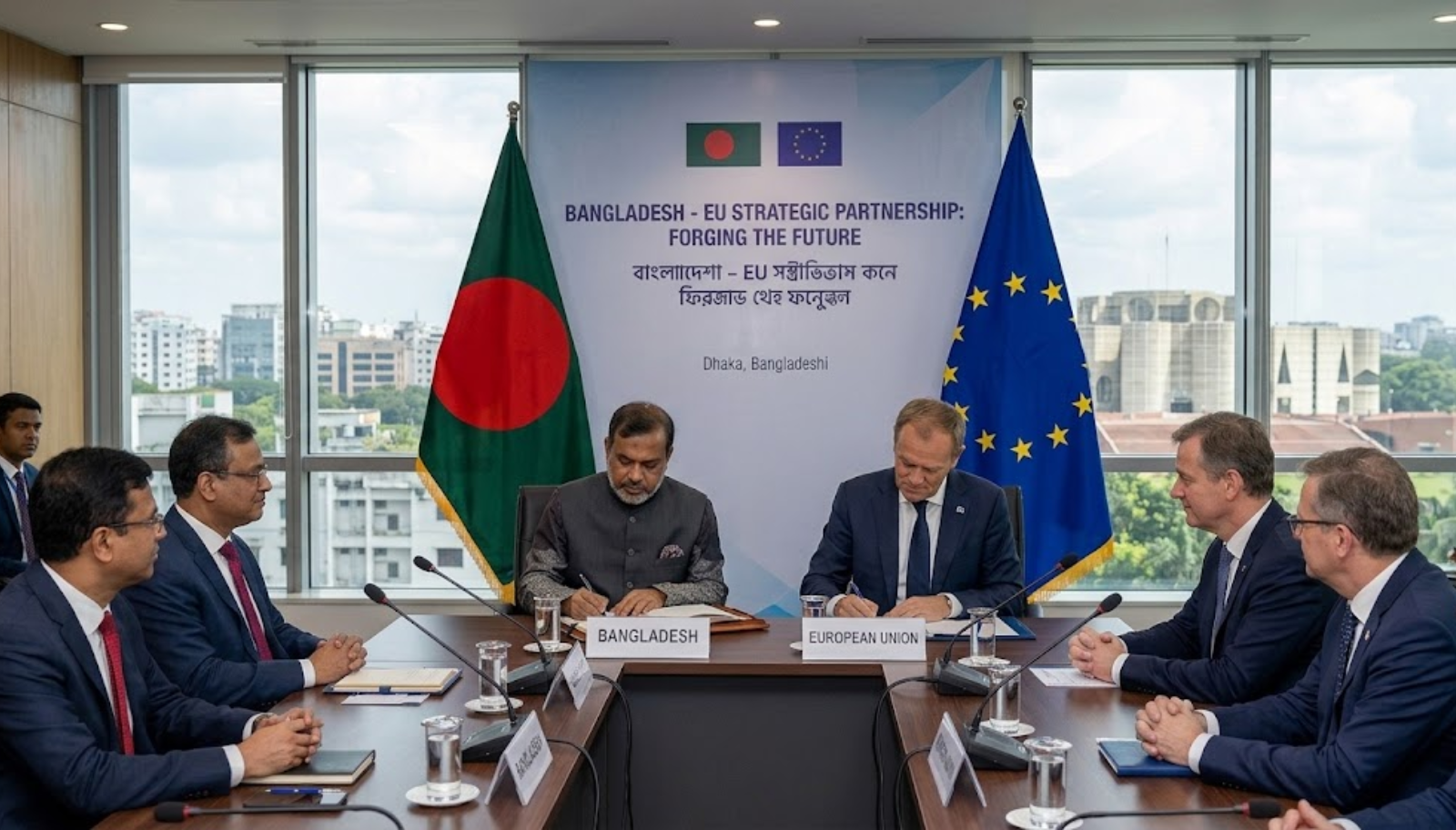
Bangladesh and the European Union stand at a decisive turning point. The initialing of the Partnership and Cooperation Agreement (PCA) in April 2026 formally launches a relationship that aspires to be more than transactional. But aspiration and achievement remain separated by a wide gap, one built from structural asymmetries, institutional deficits, and political uncertainties that no amount of diplomatic language or ceremonial signing can bridge on its own. Whether Bangladesh-EU relations mature into a genuine strategic partnership, or remain a dependency dressed up in polite phrasing, will depend on the choices Dhaka makes over the next three to five years. This article is intended to open that discussion on a larger scale, and with the urgency it deserves.
The Stakes Are Economic and Existential
The EU absorbs 44% of Bangladesh’s total exports (over $21 billion annually) of which 94% is textiles and garments. Bangladesh is the largest beneficiary of the EU’s Everything but Arms (EBA) scheme, with a 91% utilization rate. This is not a diversified trade relationship; it’s single-sector dependency on preferential access set to disappear.
Once Bangladesh graduates from LDC status in 2026, EBA continues for only three more years, until 2029. After that, the country must shift to GSP+, which carries punishing conditions: garments make up 16.5% of the EU’s total apparel imports, exceeding the 9% threshold that would disqualify the sector from duty-free GSP+ access. The resulting tariff, roughly 12%, is not a manageable adjustment in a sector where margins are routinely in the single digits … it’s an existential threat. The rules-of-origin shift compounds this danger. EBA allows single-stage origin rules, letting Bangladesh import fabric and still qualify duty-free. GSP+ requires two of three stages (spinning, weaving, manufacturing) domestically, a threshold Bangladesh’s growing but still-insufficient backward linkage cannot meet at scale. Verbal EU assurances of flexibility remain legally worthless until codified.
The FTA Gamble
Dhaka’s pursuit of a free trade agreement with the EU is a logical hedge, but logic and timetable are different things. FTA negotiations are notoriously slow: India’s talks began in 2007, stalled in 2013, and only resumed in 2022. If Bangladesh follows a similar path, any agreement will arrive years after the EBA cliff edge hits.
FTAs are also reciprocal, i.e. the EU will demand market access concessions that could expose Bangladesh’s nascent industries to fierce European competition. The feasibility study reportedly shows net benefits, but such studies routinely underestimate the political economy of reciprocal liberalization. Given the garment sector’s near-total reliance on single-stage origin rules, any FTA must resolve this explicitly, or it will end up protecting everything except the industry that matters most.
Pursuing GSP+ and an FTA simultaneously also reveals strategic incoherence: if GSP+ preserves garment access, an FTA becomes desirable but not urgent; if it does not, an FTA becomes essential but impossible to conclude in time. Dhaka needs sequencing; secure the best GSP+ outcome first, then treat an FTA as structural insurance.
The Governance Question
The PCA, however, signals that the EU’s conception of partnership extends well beyond tariffs. The agreement encompasses political dialogue, security cooperation, energy, transport, migration, counterterrorism, climate action, and critically, human rights, good governance, democracy, and labor standards. The EU insisted on clauses requiring Bangladesh to implement UN human rights conventions during PCA negotiations, and the reported exchange (EU officials asking why Dhaka was reluctant to commit to its own people’s rights) is revealing. Bangladesh’s political transition, with an interim government preparing for elections, creates a window of vulnerability: the EU will increasingly tie market access to governance performance, and any perception of democratic backsliding will have direct trade consequences.
Policy Imperatives for Bangladesh
Bangladesh must invest urgently in backward linkage development, strengthening domestic spinning and weaving capacity not merely as an industrial policy objective but as the prerequisite for surviving the shift from single-stage to double-stage rules of origin, whether under GSP+ or an FTA. Without it, no trade arrangement will preserve the garment sector’s competitiveness. This effort should be paired with a sequenced negotiation strategy: maximizing GSP+ concessions first, while treating the FTA as a complementary but slower-track process, since rushing FTA talks under time pressure would only weaken Bangladesh’s position and invite concessions it cannot afford.
Governance reform, meanwhile, must be treated as domestically legitimate rather than an externally imposed burden. Labor rights, freedom of association, and regulatory transparency are prerequisites not just for GSP+ qualification and an FTA, but also for attracting the foreign direct investment envisioned in the PCA’s investment chapter; resisting these commitments signals unreliability that penalizes Bangladesh across every negotiating forum at once. Alongside this, Bangladesh must diversify its export basket … a relationship in which 94% of one side’s exports fall into a single product category is not a strategic partnership but a supply chain, and the PCA’s provisions on energy, digital connectivity, and transport infrastructure should be leveraged to build up sectors like pharmaceuticals, IT services, and light engineering.
Finally, Dhaka should proactively propose interim safeguard mechanisms for the post-2029 transition period. If neither GSP+ nor an FTA is fully in place by 2029, Bangladesh will face tariff disruptions capable of triggering factory closures and mass unemployment. Negotiating a bridge arrangement, such as temporary preferential access conditioned on reform benchmarks, would demonstrate strategic foresight and reduce the risk of a hard landing.
The future of Bangladesh-EU relations depends less on what Brussels intends than on what Dhaka is prepared to do. The EU has signaled willingness for a closer partnership. Whether that partnership becomes one of genuine strategic depth, or remains a fragile arrangement built on preferential access that can be revoked, is now Bangladesh’s choice to make. The margin for error is narrow, and the clock is already running.
Read also –




Comment on “Bangladesh EU Strategic Relation and its Future”