
Farah Zahir
Editor, Oniket Research Group
The article aims to highlight how a technical failure at a single foreign company, Facebook, exposed Bangladesh’s overreliance on one platform for everyday communication, business, and social connection. It uses the outage as a starting point to raise a bigger policy question about digital sovereignty and infrastructure dependency.
The piece describes a Facebook outage that began around 1:40 PM local time on July 19, during which desktop users saw an “Account Temporarily Unavailable” message and mobile app users faced frozen, unresponsive pages. Bangladeshi ISPs and bandwidth providers confirmed the issue wasn’t caused by domestic network problems or a government-ordered block, it originated entirely from Facebook’s own systems, leaving local authorities and users powerless to fix or work around it.
Given how central Facebook has become to Bangladesh’s small businesses, news distribution, and even government-citizen communication, this outage should prompt policymakers to encourage platform diversification, supporting local or alternative communication tools, requiring businesses to maintain backup channels (like SMS, websites, or other apps), and investing in digital infrastructure that isn’t solely dependent on one foreign company’s uptime.
The Scale of Dependency
Bangladesh is not merely a consumer of Facebook. It is among the most Facebook dependent nations on earth. For millions of citizens, Facebook is the internet. Small businesses operate exclusively through Facebook pages and Messenger conversations. Freelancers communicate with international clients through the platform. News organisations break stories on Facebook before publishing them on their own websites. Community groups organise civic action through Facebook groups. When the platform becomes unavailable, these activities do not merely slow down; they stop entirely. There is no fallback, no alternative infrastructure, and no contingency plan at either the individual or institutional level.
The Human Cost Behind the Screen
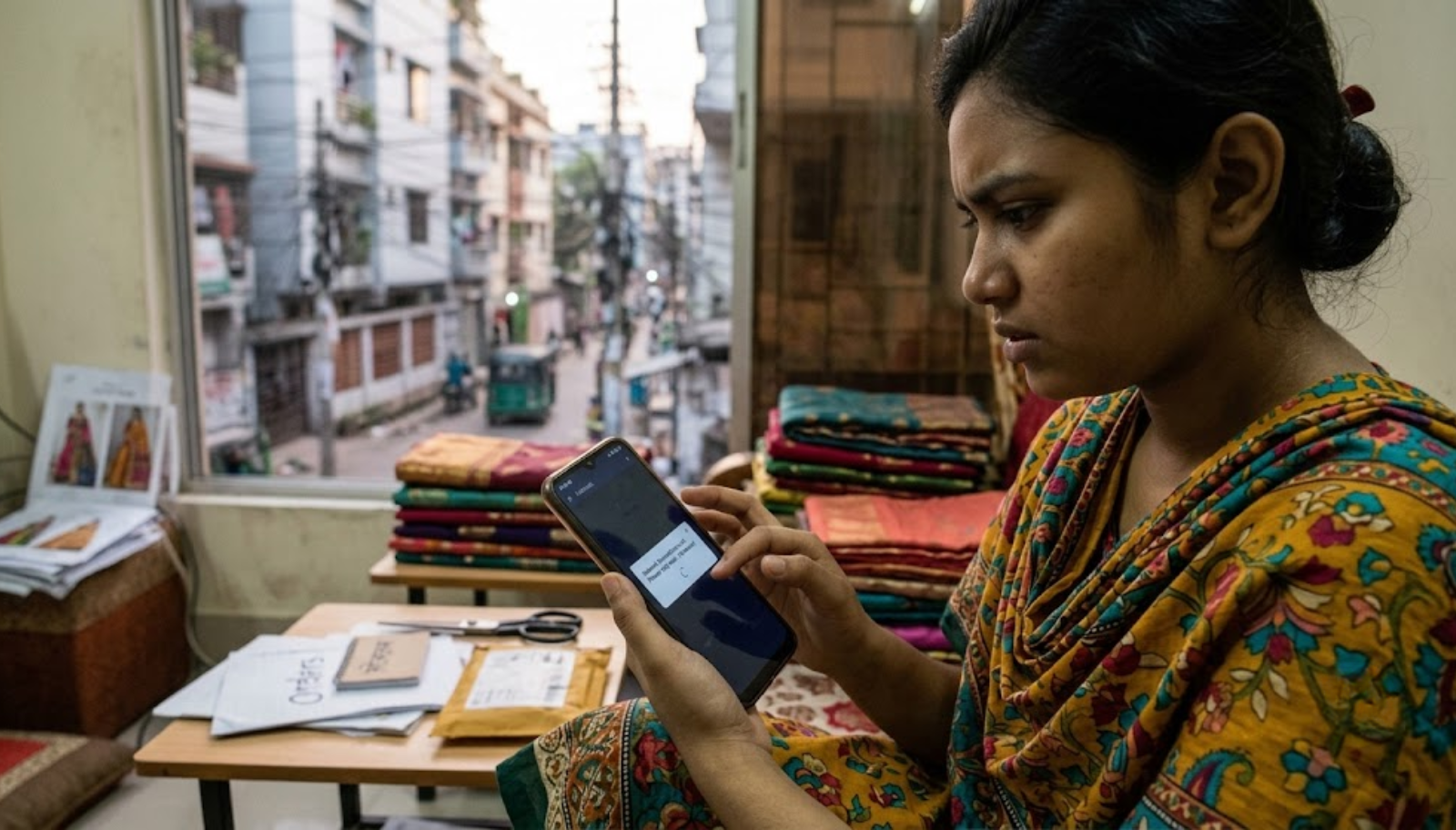
Beyond the numbers, there is a quieter, more personal toll that rarely makes it into policy discussions. For a home-based seller in Dhaka or Rangpur whose entire livelihood lives inside a Facebook page, an hour of downtime is not an inconvenience; it is a direct threat to the day’s income. Anxiety spreads quickly among small entrepreneurs who cannot confirm whether a customer’s payment went through, whether an order was received, or whether weeks of built-up trust with a buyer have simply vanished into a frozen page. Many of these sellers are women running home-based businesses, for whom Facebook is often the only accessible marketplace, free of the overhead of a physical shop or a formal website.
An outage does not just cost them money; it shakes their confidence in the very tool they depend on to be taken seriously as entrepreneurs. The same helplessness echoes among freelancers refreshing a blank screen, unsure if a client on the other side of the world thinks they have gone silent by choice. This psychological strain, of being professionally and financially tethered to a system one cannot control or even contact for support, is rarely acknowledged, yet it is one of the most corrosive effects of digital dependency on ordinary people’s peace of mind.
Money, Trust, and an Unregulated Marketplace
It is worth asking a harder question. Facebook was never built as a payment platform or a regulated marketplace, yet in Bangladesh it functions as both. Buyers transfer advance payments through mobile financial services based on nothing more than a Messenger conversation and a product photo. There is no escrow, no verified seller registration, no dispute resolution mechanism, and no institutional guarantee that money changing hands through a Facebook chat is protected in any way. When the platform goes down, these informal transactions are simply suspended in limbo, with no receipt, no customer service line, and no regulator to appeal to.
This is not a flaw that appears only during outages; it is a permanent structural gap. Bangladesh has, in effect, allowed its digital marketplace and informal payment ecosystem to run entirely on a foreign platform’s goodwill and uptime, without ever building the safeguards that a genuine ecommerce economy would require.
Has the Government Considered This?
This raises a fair and overdue question for policymakers: has the government ever seriously examined how much the national economy now depends on a platform it neither owns nor regulates? There is little public evidence of a coordinated risk assessment, a contingency framework, or even a basic advisory to small businesses about the dangers of single platform dependency. Precaution, so far, appears largely absent from official planning, even though the warning signs have been visible for years through repeated smaller outages and slowdowns.
Social and Informational Consequences
Beyond commerce, the outage struck at the information ecosystem. During the disruption, users flocked to other social media platforms to confirm the problem and seek updates, a reflex that underscores the degree to which Facebook has become the default channel for real time information in Bangladesh. When that channel fails, the public is left in an informational vacuum. Civic announcements, emergency coordination, and community safety alerts that routinely pass through Facebook groups became momentarily impossible. For a country prone to natural disasters and public safety emergencies, this vulnerability is not hypothetical. It is a present and recurrent risk.
Essential Reforms
Addressing this dependency requires action on multiple fronts. First, the government must adopt a digital platform diversification strategy, with dedicated government channels, SMS based alert systems, and nationally hosted platforms that remain under Bangladeshi control. Dependency on a foreign corporation’s infrastructure for domestic civic communication is a sovereign vulnerability no responsible government should tolerate.
Second, small businesses need real alternatives. If citizens are to generate income from home based or small enterprises, they need access to secure, user friendly, and locally supported ecommerce platforms rather than remaining tied to a single foreign app with no accountability. Government backed digital marketplaces, verified seller systems, and simple, affordable payment gateways with proper consumer protection would give entrepreneurs a safer foundation to build on. Tax incentives, technical training, and low-cost hosting for small businesses could accelerate this shift.
Third, regulatory frameworks must catch up with the reality of platform concentration. Bangladesh needs data localisation policies, mandatory redundancy requirements, and formal service level agreements with major platforms serving critical mass populations, alongside clear consumer protection rules for transactions conducted over social media.
Fourth, digital literacy programmes must teach citizens and businesses to operate across multiple platforms rather than concentrating their entire digital and financial life in one place. Using Facebook as email, messaging service, marketplace, bank, and news portal all at once creates a single point of failure that no individual should accept and no policy environment should encourage.
Facebook will experience outages again. That is not a prediction; it is an engineering certainty. The real question is whether Bangladesh, and the small businesses whose livelihoods now rest on this single platform, will still be this exposed the next time it happens. The reforms outlined above are not aspirational. They are urgent, practical, and overdue. Every outage that passes without policy response deepens the structural dependency and magnifies the eventual cost of reckoning.