
Desk Report
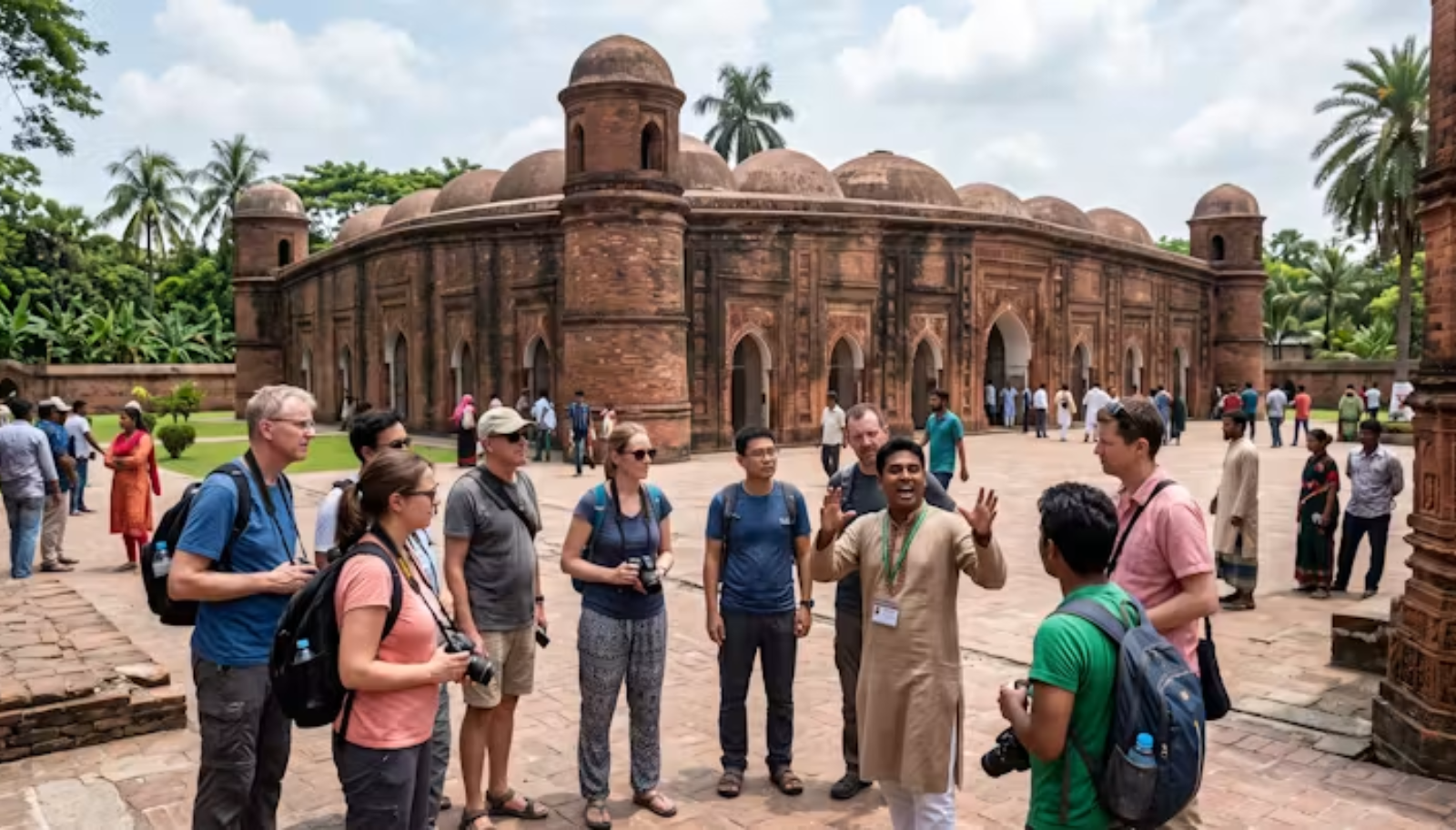
Bangladesh holds a heritage inventory that few countries in South Asia can match on paper. Three UNESCO World Heritage Sites, the Mosque City of Bagerhat, the Buddhist Vihara ruins at Paharpur, and the Sundarbans mangrove forest, sit alongside seven Intangible Cultural Heritage designations and a growing tentative list that includes the archaeological landscapes of Mahasthan and Mainamati. Yet the country registers barely a footnote in global tourism flows. The question worth asking is not whether Bangladesh has the raw material to compete internationally, but whether it can build the institutions and infrastructure to convert that material into a functioning industry, especially when its neighbours have already done so.
In this report, we build on a recent article published on this topic in the Oniket Bulletin.
The Regional Gap
India offers the starkest comparison. With the Taj Mahal, Rajasthan’s forts, Varanasi’s ghats, and a national tourism marketing apparatus built over decades, India draws millions of heritage focused travellers every year and has turned individual monuments into globally recognised symbols. Its scale advantage is enormous, but so is its investment in signage, guiding standards, hospitality infrastructure, and international promotion, areas where Bangladesh remains largely absent.
Sri Lanka, despite a much smaller landmass and years of political and economic turbulence, has built a heritage tourism product around Sigiriya, Kandy, and its ancient cities that punches well above its size. Its tourism board has marketed the island as a compact, easily navigable heritage circuit, pairing ruins with beaches and wildlife in a single itinerary, something Bangladesh’s Sundarbans, mosque cities, and archaeological sites could theoretically replicate but currently do not.
Bhutan has taken the opposite path, choosing scarcity and premium positioning through its high value, low volume tourism policy. It does not compete on visitor numbers at all, instead using controlled access and steep tourist fees to protect its cultural sites while generating meaningful per visitor revenue. Nepal, meanwhile, leans on Kathmandu’s temple complexes and its position as a gateway to the Himalayas, sustaining a trekking and heritage combination that draws sustained interest from Western and East Asian travellers even after earthquakes and political instability.
Each of these countries has found a distinct competitive lane: India through scale, Sri Lanka through compact accessibility, Bhutan through exclusivity, Nepal through adventure paired with culture. Bangladesh has not yet defined its own lane, and until it does, it will keep losing potential visitors to destinations with clearer positioning.
What Bangladesh Actually Needs
The core problem is not a shortage of heritage assets but the absence of the systems needed to present them. A dedicated, ring fenced heritage conservation fund is the starting point, drawing on tourism revenue, private capital, and international conservation partnerships, so that restoration work stops being chronically deferred. Without predictable financing, sites will keep deteriorating faster than they can be repaired.
Institutional clarity matters just as much as money. Responsibility for heritage sites is currently split between the Department of Archaeology, local administrations, and the Bangladesh Tourism Board, a fragmented arrangement that produces confusion rather than coordinated management. Each major site needs a single professionally trained authority with a clear conservation mandate, a visitor management plan, and real accountability for outcomes.
Physical infrastructure is the most visible gap. Roads leading to sites, interpretation centres, multilingual signage, a range of accommodation for different budgets, and a certified guide training programme are baseline requirements that competing destinations solved years ago. Travellers researching a heritage trip compare practical logistics as much as historical significance, and Bangladesh currently loses that comparison before a visitor even books a flight.
Legal enforcement also needs teeth. Protective laws exist but are routinely ignored, allowing urban encroachment and unregulated development to eat into protected zones. A dedicated heritage protection agency with genuine prosecutorial authority would signal that the assets are treated as strategic national resources rather than incidental features of the landscape, a shift in public and institutional attitude that has been notably absent so far.
Finally, none of this matters without visibility. Bangladesh has no coherent international brand as a heritage destination, unlike its neighbours, who have each built recognisable identities in outbound tourism markets. A sustained, professionally designed marketing campaign aimed at cultural tourism markets in Europe, East Asia, and North America is necessary to convert restored sites and improved infrastructure into actual arrivals.
Bangladesh can compete internationally on heritage tourism, but only if it treats the sector as an economic priority rather than an afterthought. The assets already exist and rival anything on offer in India, Sri Lanka, Bhutan, or Nepal. What is missing is institutional commitment, sustained investment, and the strategic ambition to act before more revenue drifts permanently toward competitors who made these decisions long ago.