
Iqra Manzoor
University of the Punjab, Lahore, Pakistan
“Information is a public good,” UNESCO affirmed in its Windhoek+30 Declaration, declared that access to reliable and independent information is highly indispensable for democracy, sustainable development, and peace. However, in this era of the digital landscape, information has increasingly become a contested political resource rather than a shared public good.
The recent political crises in Pakistan and Bangladesh also underscore the broader challenges faced by media freedom in both countries. These concerns are reflected in the 2025 World Press Freedom Index published by Reporters Without Borders (RSF), which ranks Pakistan 153rd and Bangladesh 149th out of 180 countries, indicating persistent constraints on independent journalism and the free flow of information. However, the root causes of the crises are the multiple structural factors including, propaganda, partisan media, and misinformation, that are exacerbating societal divisions, eroding public trust, and complicating democratic governance. As media becomes a battlefield for competing political narratives, safeguarding media integrity is no longer a journalistic concern but it is a democratic imperative.
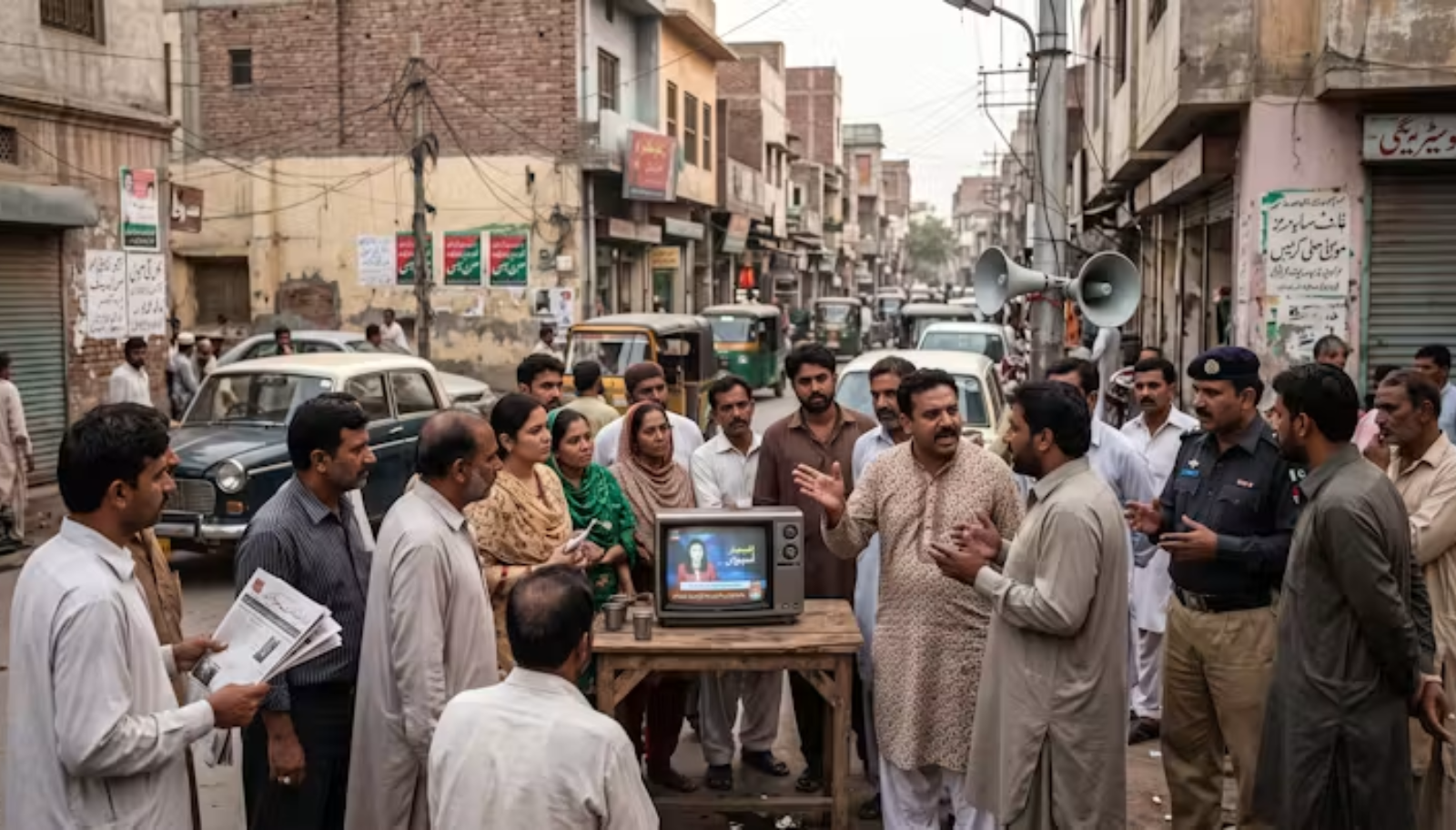
In reference to Pakistan’s political turmoil following the arrest of former Prime Minister Imran Khan in May 2023 shows how opposing political narratives rapidly shaped into national unrest across the country. Even within hours of the arrest, television channels, political commentators, and social media influencers presented highly contrasting depictions of the event. However, the supporters of Khan described the arrest as an assault on democracy and civilian supremacy. On the other hand, government-aligned outlets framed it as a lawful accountability process. These contrasting narratives led to the violent confrontations as military installations, government buildings, and public property were attacked in several cities and in return restrictions on media coverage, mass political detentions, and the deployment of tear gas and rubber bullets against protestors were taken.
In response to this, Amnesty International heavily criticized the subsequent indefinite shutdown of mobile internet and social media blocks as severe violations of the public’s right to information and free expression. This shows how polarized media information reinforces public anger and accelerate mobilization to restore social stability.
On the other hand, Bangladesh experienced the violent challenges during the 2024 quota reform protests in which a student-led peaceful movement demanding changes in the public sector recruitment policies gradually turned into a broader political confrontation. Earlier, most of the state-controlled media framed the protest as politically motivated rather than acknowledging public concerns that led to blockout and creating a critical information vacuum. Human rights watchdogs and the United Nations Human Rights Office noted that the media restrictions and a lethal, “shoot-on-sight” curfew were used to obscure a massive crackdown by security forces that ultimately resulted in an estimated 1,400 deaths.
Although the political outcomes in Pakistan and Bangladesh varry but both cases reveal similar structural weaknesses. Both cases emerged because of long-standing political polarization, institutional distrust, governance challenges, and public frustration rather than just because of propaganda and misinformation. Propaganda did not create these deep societal divisions but these are heavily amplified by emotional narratives. Once the media outlets get weaponized by the political actors, it leads to the destruction of space for constructive public dialogue.
This deliberate polarization is reflected in V-Dem Institute’s classification of both Pakistan and Bangladesh as electoral autocracies, where the systematic spread of disinformation directly undermines democratic discourse. Moreover, several media watchdogs and Reporters Without Borders (RSF) heavily documented the suppression on independent media channels that represent the voice of the public.
The rapid expansion of digital media has intensified South Asia’s information crisis where algorithmic rewards for emotional engagement consistently outpace verified journalism. However, to address these systematic vulnerabilities in Pakistan and Bangladesh, long-term institutional reforms must replace reactive censorship and internet blackouts to strengthen media independence, transparency, and public trust. First, media regulatory bodies should operate independently of undue political influence to ensure licensing, oversight, and enforcement are guided by transparent legal standards rather than partisan interests.
As concerns regarding the implementation of digital governance laws including Pakistan’s Prevention of Electronic Crimes Act (PECA) and Bangladesh’s Cyber Security Act are raised by journalists, civil society organizations, and international observers that highlight the need to ensure that efforts to combat online harms remain proportionate and consistent with international standards on freedom of expression. Second, governments should strengthen legal protections for journalists and support independent public-interest journalism and fact-checking initiativesto enable accurate reporting during periods of political uncertainity. Last, reactive measures such as internet shutdowns should be replaced by accountable digital governance to ensure timely public communication, targeted responses to misinformation, and nationwide digital literacy programs. As evidence from both countries suggests that internet blockage leads to undermining public trust, encouraging the spread of unverified information, and imposing significant economic and social costs.
Ultimately, resilient democracies depend on independent media institutions that prioritize accuracy, accountability, and public trust to reduce polarization an strengthen democratic resilience.
References




True & informative.