
Rishabh Bhatnagar
University of Birmingham Dubai
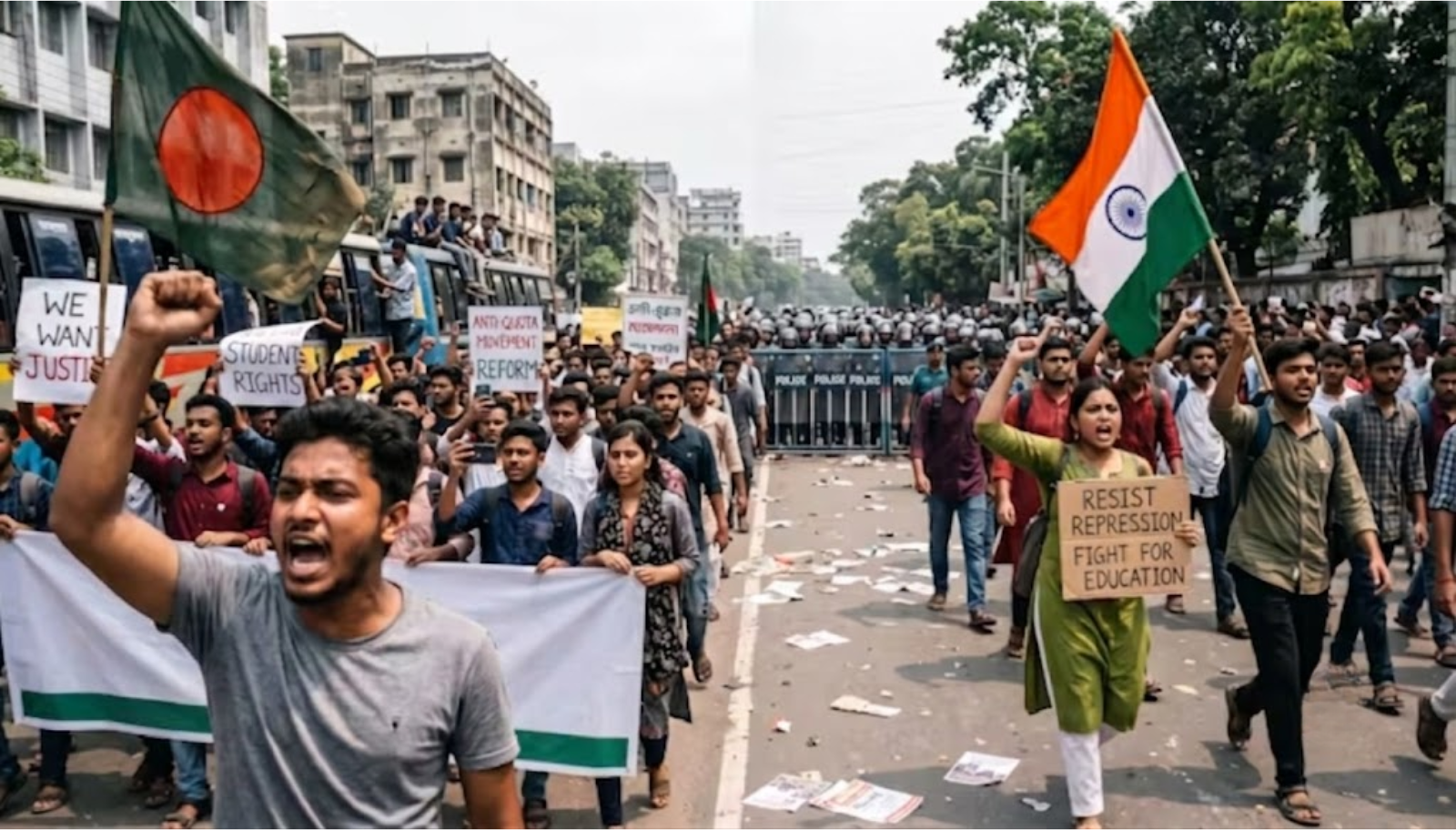
August 2024, a quota dispute over Bangladeshi civil service jobs ended a fifteen-year premiership. July 2026, an exam integrity scandal forced the largest confrontation with the Modi government since the 2021 farmers protests. Just two years apart, both were Gen-Z, youth unemployment driven movements. A single institutional failure speaking broader anger at governance corruption and blocked economic mobility.
Two Triggers, One Grievance
On 15th May 2026, Chief Justice of India Surya Kant remarked during a supreme court hearing that unemployed youth turned social media or RTI activists were like “cockroaches” and had no place in the work force. Within a day the Cockroach Janta Party (CJP) was launched, satire that blew up past 10 million followers in 5 days. It found something to attach to, the leaked 2026 NEET-UG exam forcing ~2 million retakes, and CBSE marking irregularities leaving thousands in what was deemed ‘limbo’ leading to at least a dozen suicides. On 20th July, the youth’s frustration erupted into a CJP march on Parliament, ending in violent police confrontation leading to ~180 injured.
Bangladesh’s uprising began differently but from the same root. On 5th June 2024, the high court reinstated a civil service job quota, by declaring the 2018 overturn illegal. Students pushed back by calling this discriminatory and began demonstrating in Dhaka on 1st July. The PM Shekh Hasina’s dismissal of the protests as a waste of time, made escalation inevitable; and the unrest snowballed into violence that killed ~1500 people, of which at least 32 were children.
The common cause? Dismissive governments, economic frustration, and educated youth denied opportunity befitting their qualifications. But the two diverged sharply from there. Bangladesh’s fuse to extreme violence was short, its demand singular, and its resolution swift. India remains for now, non-lethal, diffuse, and without a unifying call for regime change from mainstream opposition.
Two Systems, One Flaw
Both events exposed one major weakness in their political systems. They have not been built to handle mass movements of an educated and digitally connected youth population who are ready to confront an economy and a political regime that is unable too facilitate their aspirations and goals. Rapid GDP growth over the last decade has seen expansions in both countries with high levels of youth unemployment, ~10.5% in Bangladesh and ~16.03% in India with expectations to keep rising.
Analysts who have been tracking the CJP protests have explicitly noted that India is currently facing its most educated generation ever and with too few avenues to use that education which is making it strikingly like the underlying reasons behind the Bangladesh uprising. Not only in the way events are similarly unfolding, but also in the reactions of the governments to the rising civil unrests. In both cases however, economic instability and insecurity have harmonised with a perception that the system itself is rigged in favour of connections and money instead of qualifications and hard work.
Two Economies, One Disruption
Both movements have resulted in quantifiable economic disruption. Bangladesh’s uprisings caused the shutdown of garment factories which make up ~80% of Bangladesh’s export earnings with an estimated loss of ~US$150million per day. A direct loss of ~US$530million-550million in the first round of protests alone while indirect costs were even larger. The blackout caused a loss of ~US$8million per day across e-commerce and call centres and over five days the estimated economy wide losses reached more than US$1.2billion per Bangladesh’s business community with additional costs incurred from vandalism and arson.
For investors, the S&P downgraded the nations sovereign credit rating from BB- to B+ leading to a decline in FDI, while their GDP growth fell to 3.3% from 5.1% during the first half of 2025, due to the lingering effects of the protests, tighter policy, continued political uncertainty compounded by political instability, floods, and LNG shortages hitting their textile sector.
While the situation in India is still unfolding, investor sentiment has already been rattled with some market analysts flagging the movement as a risk factor even before the violent parliament march, and prolonged instability in the capital carries very clear costs for business confidence, tourism, and daily commercial activity in the political home of the country.
Two States, Two Standards of Force
Delhi’s rights concerns, to date, involve nothing beyond injuries, detentions, and one high profile forced hospitalisation with no reported deaths as of right now. Bangladesh’s involved an internationally documented pattern of extrajudicial killing alleged at the level of state policy, now the subject of active criminal prosecution and a former head of government convicted in absentia.
The two cases should not be flattened into equivalence. What they share is narrower but still instructive. Both draw the same international human-rights standard, invoked by the same organisation, over the same underlying claim, that the state’s obligation in the face of protest is restraint, not suppression. Bangladesh’s experience since 2024 suggests that meeting that obligation after the fact through commissions, prosecutions, and UN-mandated inquiry is possible, but incomplete. Accountability for past violations has not, on the evidence to date, ended new ones.
Bangladesh faced a complete government reformation, with the resignation of Hasina as well as receiving the death sentence, while the events in India still unfold with their demands for justice still unmet.




The article succeeds in stimulating discussion on governance, youth aspirations, institutional trust, and economic opportunity. Its comparative structure is engaging and highlights several important themes that merit debate. At the same time, readers should approach it as an analytical opinion piece rather than a fully referenced academic study, since many factual claims are presented without citations and some interpretations are expressed in normative language.