
Jamil Shahed
Freelance Journalist
Bangladesh has emerged as one of the most passionate cricketing nations on the planet, and the economic dimensions of that passion are becoming impossible to ignore. From a modest cricketing outpost that only gained test status in 2000, the country now commands a sports market estimated at roughly 40 to 43.5 million dollars annually, with cricket overwhelmingly dominating that figure.
Yet for all its fervor and commercial promise, the sports economy in Bangladesh remains structurally fragile, heavily dependent on international revenue shares, and constrained by deficits in infrastructure and strategic contract negotiation. The path forward demands both concrete investment and far smarter engagement with the global cricketing apparatus.
The Current Socio-economic Footprint
Cricket is not merely a sport in Bangladesh. It is a symbol of national unity and a significant money-making mechanism. The Bangladesh Cricket Board receives 4.46 percent of the total annual revenue distributed by the International Cricket Council, which amounts to approximately 26.74 million dollars, or roughly 290 crore taka. The ICC distributes from a total estimated annual income of 600 million dollars.
To put this in perspective, the Board of Control for Cricket in India receives 38.5 percent of that same pool, approximately 231 million dollars, nearly nine times what Bangladesh earns. England and Wales receive 41.33 million dollars, Australia 37.53 million, Pakistan 34.51 million, and even Sri Lanka edges ahead at 27.12 million. Bangladesh sits eighth among full members, a ranking that reflects both its relatively smaller contribution to the global commercial pie and the structural inequity baked into ICC revenue sharing formulas.
The Infrastructure Deficit
Revenue alone cannot build a sustainable sports economy if the physical and institutional foundations remain weak. Bangladesh currently operates with a limited number of international standard venues. Most grounds lack modern training facilities, fitness centers, high-performance analytical units, and adequate spectator amenities. The domestic cricket structure remains heavily concentrated in Dhaka and a handful of divisional cities, leaving vast parts of the country without access to competitive cricket environments. Grassroots talent identification programs suffer from the absence of proper coaching infrastructure at district and upazila levels. Women’s cricket facilities remain critically underserved, with limited access to dedicated grounds, specialized coaching, and competitive league structures.
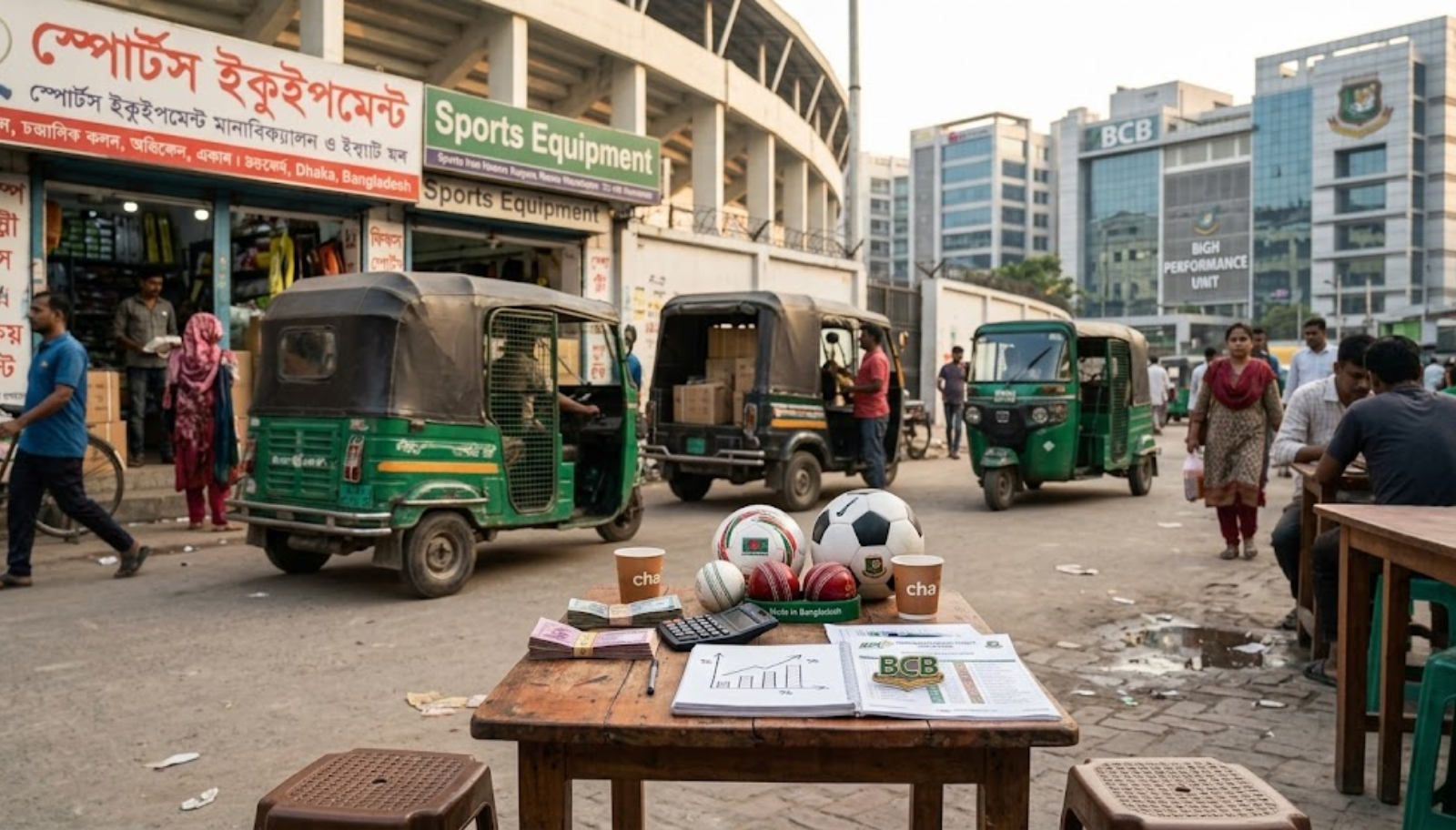
The sports equipment market, while growing, relies heavily on imports, and domestic manufacturing capacity for quality cricket gear is minimal. Floodlight systems, drainage technology, and pitch maintenance standards at most venues fall well below the benchmarks set by top cricketing nations. Without addressing these infrastructure gaps, Bangladesh cannot expand its hosting capacity, develop deeper talent pools, or generate the domestic commercial revenue needed to reduce dependence on ICC distributions.
Contract Design With the ICC
The revenue sharing model that governs ICC distributions is built on four criteria: cricket history, performance in ICC events over the preceding 16 years, contribution to ICC commercial revenue, and equal weightage for full member status. Bangladesh’s low share is largely a function of its modest historical contribution and its smaller broadcast market, but the model itself deserves scrutiny. India alone contributes an estimated 85.3 percent of ICC annual earnings, which gives the BCCI enormous leverage over revenue allocation.
Bangladesh must negotiate more strategically within this framework. The recent standoff involving Bangladesh and Pakistan during the T20 World Cup demonstrated that collective bargaining pressure can extract concessions from the ICC. Bangladesh secured hosting rights for an additional ICC tournament in the 2028 to 2031 cycle, alongside its cohosting role for the 2031 ODI World Cup with India. The economic impact of hosting an ICC event is substantial.
The 2024 men’s T20 World Cup, held across nine host cities, generated a combined economic impact of 1.66 billion dollars. Hosting brings direct revenue from ticketing, broadcast rights, and sponsorship, plus indirect gains through tourism, hospitality, and urban infrastructure development. Bangladesh must optimize future ICC member participation agreements to secure more hosting allocations, performance linked revenue escalators, and penalty protections that prevent the ICC from using financial threats as leverage during disputes.
Bilateral and Regional Contracts
The greatest untapped commercial opportunity for Bangladesh lies in bilateral cricket, particularly with India. A single India versus Pakistan ICC match generates between 2,200 and 4,500 crore rupees across broadcast, sponsorship, ticketing, merchandise, and corporate hospitality.
While Bangladesh does not command that scale, bilateral series involving India touring Bangladesh attract enormous broadcast and sponsorship interest. The BCCI’s scheduled tour of Bangladesh in 2026, now uncertain due to political tensions, illustrates the vulnerability of these arrangements to noncricketing factors. Bangladesh must design contract frameworks with neighboring boards, especially India, Pakistan, and Sri Lanka, which include enforceable commitments, minimum tour frequency guarantees, financial penalties for unilateral cancellation, and revenue sharing formulas for broadcast and digital rights.
The Bangladesh Premier League offers another lever for economic growth. Franchise based tournaments generate sponsorship, media rights, and employment, but the league requires stronger governance, anti-corruption mechanisms, and scheduling coordination with the ICC Future Tours Programme to maximize player availability and commercial returns. Regional cooperation through the Asian Cricket Council also presents opportunities for tri nation series and cross border talent exchange, provided contractual terms ensure equitable revenue distribution among participating boards.
Building the Future
Bangladesh’s cricket economy stands at an inflection point. The fan base is massive and growing. The commercial potential of hosting global events has been demonstrated. But without modernized infrastructure, equitable ICC contract terms, and robust bilateral agreements with neighboring nations, the country will remain confined to the lower tiers of cricket’s economic hierarchy. The challenge is not merely to play the game but to negotiate the terms on which it is played, and to build the facilities that transform passion into sustainable prosperity.