
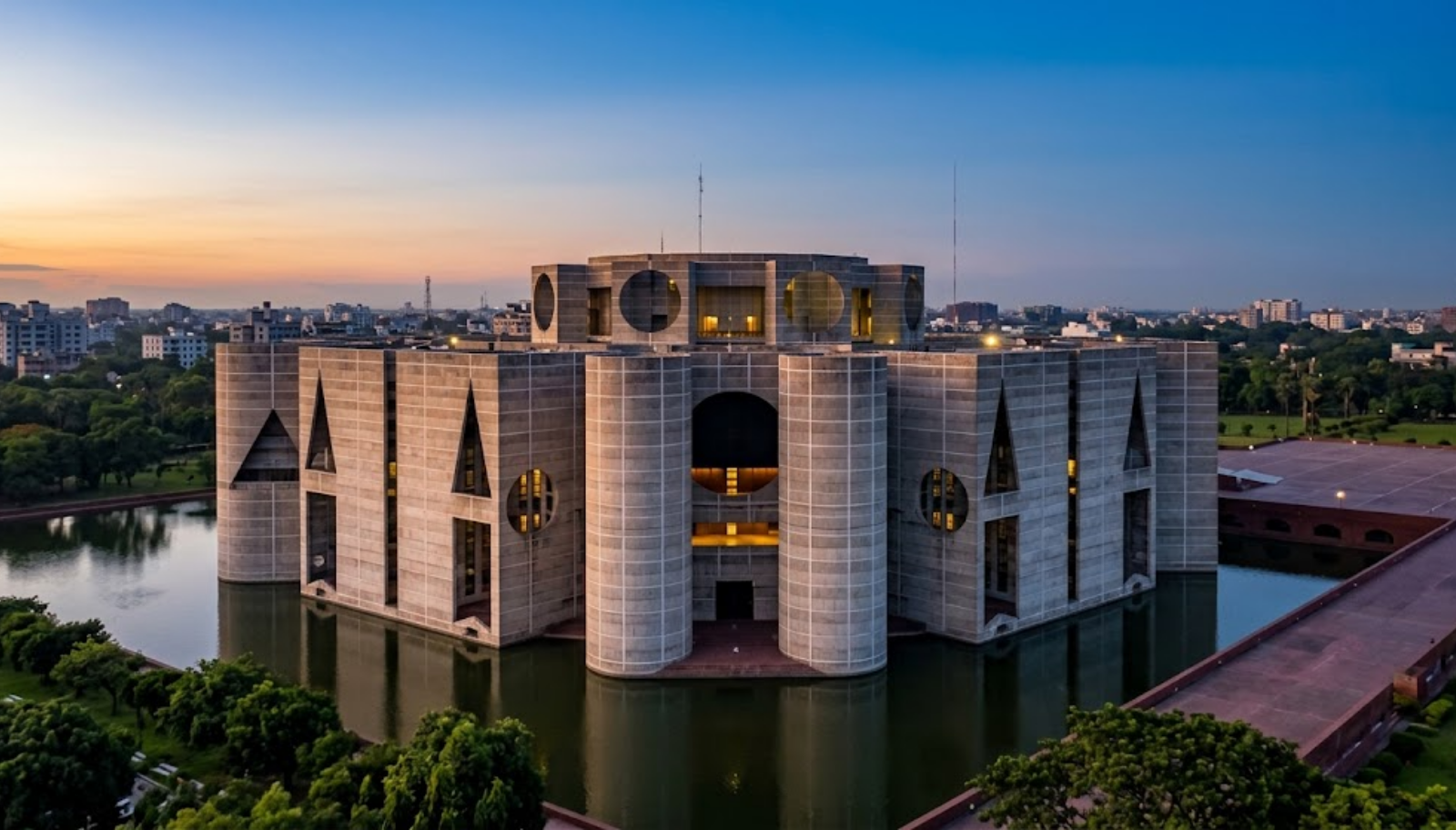
Desk Report
The presidential election scheduled for 20 August 2026, prompted by the resignation of President Mohammed Shahabuddin before his term expired, presents a familiar spectacle. The Election Commission has published dates, nomination deadlines have been set, and voting will occur inside the Jatiya Sangsad session hall. Everything looks constitutional. Yet the real question goes unasked: is this a democratic act at all, or merely a ritual performed in constitutional costume?
The Constitutional Framework: Legitimate but Inadequate
Article 48 of the Constitution assigns the presidential election to Members of Parliament rather than to the general electorate, an indirect model that is not itself unusual; several parliamentary democracies use similar arrangements for largely ceremonial heads of state. The provision was adopted in 1991, when Bangladesh transitioned from a presidential to a parliamentary system, on the reasoning that Parliament, as the directly elected body, should select the ceremonial president.
This logic held internal coherence at the time. The deeper problem, however, lies not in the constitutional text itself but in what three decades of political practice under it have revealed: an electoral design premised on a competitive, multi-party Parliament functions very differently when one party commands a durable legislative majority, a condition the framers of 1991 did not fully anticipate.
The Uncontested Pattern: Democracy by Absence of Choice
Since the return to parliamentary democracy in 1991, Bangladesh has held multiple presidential elections. Only once has more than one candidate appeared on the ballot, forcing an actual vote in Parliament. Every other instance ended the same way: the ruling party’s nominee was elected unopposed, without a ballot, without debate, without any meaningful expression of parliamentary will.
What the constitution calls an election is, in practice, an appointment. When the people’s representatives never exercise choice, the thread connecting popular sovereignty to presidential legitimacy snaps entirely.
The upcoming election appears likely to follow a familiar pattern, though this also reflects a period of clear political stability. The ruling Bangladesh Nationalist Party and its allies hold over two thirds of parliamentary seats following the February 2026 general election, giving the government a strong mandate to govern decisively. The opposition, led by Jamaat e Islami, holds a substantial minority presence, ensuring continued representation within Parliament. While no opposition party has yet signaled it will field a presidential candidate, and precedent suggests the ruling alliance’s nominee may go uncontested, this points to an opportunity: strengthening the presidential process going forward could make it more genuinely competitive and reflective of Bangladesh’s pluralistic political landscape, further deepening the country’s democratic maturity over time.
The Political Environment: A Legislature Shaped by Exclusion
The presidential vote’s democratic legitimacy depends not just on how the election is conducted, but on how democratically constituted the electing body itself is. The current Parliament, elected in February 2026 with around 59 percent turnout and genuine multi-party competition, was widely regarded as the most competitive vote in nearly two decades. Yet this election also excluded the Awami League, which had governed Bangladesh for fifteen years before the 2024 uprising ended its rule.
Barring a major party from participation, regardless of justification, means the resulting Parliament cannot represent the full range of political opinion. A legislature missing major political currents cannot confer full democratic legitimacy on its decisions, least of all one as significant as choosing the head of state.
Formality Versus Democratic Practice
The distinction between formality and democratic practice turns on whether the process permits genuine deliberation and choice. A formal process obeys prescribed rules: nominations are filed, scrutiny occurs, a result is declared. A democratic process demands more: the outcome must not be predetermined, opposing views must be voiced and voted upon, and the result must reflect collective judgment rather than ratification of a prior decision. By this measure, Bangladesh’s presidential election system has operated as a formality for nearly all of its existence. The constitutional mechanism is observed, but democratic substance is absent. The head of state is chosen not through parliamentary deliberation but through the ruling party leadership’s prior decision, which Parliament then rubber stamps without genuine contest.
What Democratic Integrity Would Require
For the presidential election to become genuinely democratic, structural change is essential. The practice of suppressing opposition candidacies must end, with the ruling party no longer using its parliamentary majority to guarantee an unopposed outcome. Parliamentary parties should be required to field candidates, so the election involves real voting rather than acclamation. The broader political environment must also allow full participation by all legitimate political forces in parliamentary elections, since the presidency’s democratic legitimacy ultimately rests on that of the Parliament electing it.
A national conversation about direct presidential elections is also overdue, as the current indirect system reflects an earlier era and warrants fresh constitutional scrutiny. Though ceremonial, the presidency’s selection process mirrors the political system itself, and at present, that mirror reflects formality rather than democracy.