
Mio Okalinde
Universiti Malaya
Bangladesh stands at a pivotal intersection. The country is preparing to exit the UN’s Least Developed Country category, currently expected by November 2029 after the UN Committee for Development Policy recommended a three-year extension, while simultaneously pursuing the UN Sustainable Development Goals with a 2030 deadline.
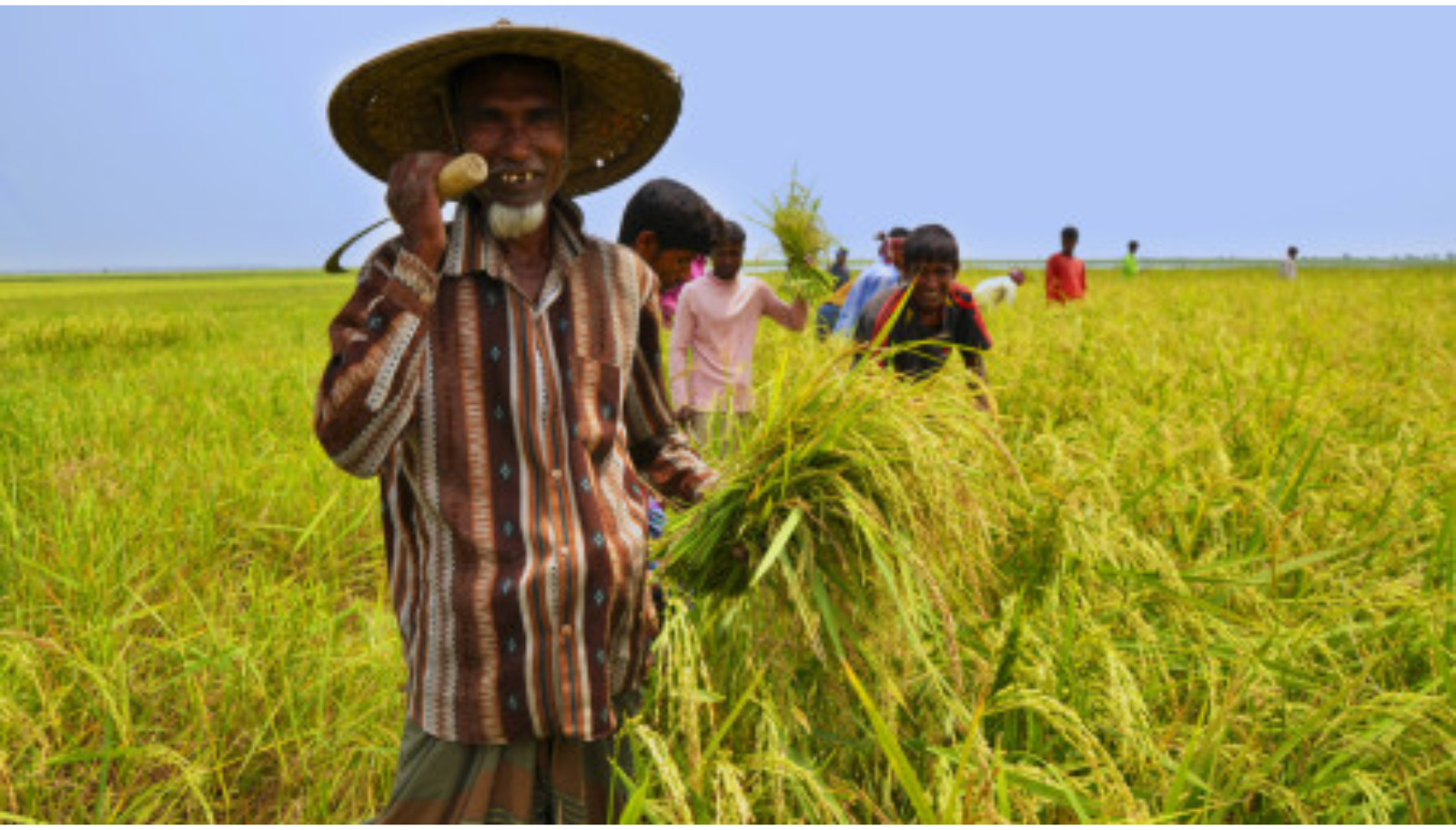
Agriculture, which still employs over 44 percent of the workforce according to 2025 World Bank modeled ILO estimates, yet contributes only 11.16 percent to GDP as of 2024, remains the sector where these two ambitions most visibly converge and most riskily diverge. This article investigates this challenge.
Bangladesh’s Current Agricultural Standing
Bangladesh’s food production gains over three decades merit scrutiny as much as celebration. Rice self-sufficiency, the longstanding centerpiece of national policy, has been nominally achieved at the aggregate level, yet aggregate sufficiency is a poor proxy for lived food security. The undernourishment rate fell from 32.8 percent in 1990 to 11.4 percent in 2023, per the Global Hunger Index, and the 2025 Index scores Bangladesh at 19.2, ranking 85th out of 123 countries, an improvement from its score of 34.6 in 2000, but still squarely in the “moderate” hunger category, not the “low” one. Child stunting declined from 51 percent in 2004 to roughly 31 percent by 2018; this means nearly one in three children remain stunted two decades on. Framing these trajectories as evidence that Bangladesh is “among the better performing LDCs” says less about Bangladeshi success than about how low the bar remains among least developed countries.
The headline improvements, however, conceal structural fragilities that the aggregate numbers cannot capture. The Bangladesh Bureau of Statistics reports that approximately 21.91 percent of households experience moderate food insecurity and 0.83 percent face severe insecurity, meaning roughly one in five households cannot reliably access adequate food. When food security is measured by access and utilization rather than mere availability, around 35 percent of the population falls below the threshold, a figure that exposes the inadequacy of production volume metrics as proxies for nutritional wellbeing. Agricultural growth has decelerated in recent years, and the sector’s share of GDP continues to shrink, yet employment in agriculture has paradoxically risen from 40.6 percent in fiscal year 2016 to nearly 44.7 percent in 2024. This is not a sign of rural dynamism; it signals that workers are retreating into agriculture because the nonfarm economy has failed to absorb them, a distress driven reverse migration that deepens the sector’s labor congestion while masking it as employment growth.
Alignment with UNSDG Goal 2
SDG 2 calls for ending hunger, achieving food security and improved nutrition, and promoting sustainable agriculture. Bangladesh has integrated the SDGs into its national development planning frameworks, including Vision 2040 and successive Five-Year Plans. The Government’s PARTNER project, launched to promote diversification, food safety, entrepreneurship, and resilience in agri food value chains, represents the most ambitious institutional response to SDG 2 to date.
Yet the evidence reveals that progress on several SDG 2 targets remains uneven. Dietary diversity is constrained by the dominance of rice, which accounts for roughly 80 percent of cropped area and two thirds of caloric intake. Soil organic matter has fallen below 1 percent in many regions, and over 95 percent of pesticides applied damage beneficial soil microorganisms, according to recent agronomic reviews. Crop diversification, identified by the World Bank as the biggest challenge facing the sector, has advanced far more slowly than needed.
LDC Graduation and Agricultural Vulnerability
LDC graduation will gradually remove Bangladesh’s international support measures, such as preferential market access and concessional financing. The World Bank’s $1.1 billion approval for food security, fertilizer imports, and crisis response in April 2026 illustrates exactly the kind of support that will grow harder to obtain afterward.
Agricultural exports like leather, jute, and processed goods will lose cash incentives, facing tariff increases near 6.7 percent and export earnings drops of about 8.7 percent. Already climate vulnerable, agriculture must now fund resilience against flooding, salinity, and cyclones affecting 8.9 percent of coastal residents.
Essential Reforms for Achieving UNSDG
Bangladesh’s path forward begins with rethinking how subsidies are allocated, moving away from a rice centric model that has long incentivized paddy monoculture at the expense of pulses, oilseeds, fruits, and vegetables. Redirecting these resources toward quality seed systems for non-paddy crops and Good Agricultural Practices certification could accelerate nutrition outcomes and soil regeneration alike. Alongside this, formalizing land markets is essential: informal rentals and progressive land fragmentation remain among the most binding constraints on productivity, and a transparent, digitally registered leasing system could unlock economies of scale without requiring ownership transfer.
Infrastructure gaps compound these structural issues. The absence of adequate cold storage, logistics, and food safety enforcement destroys post-harvest value and blocks commercialization, making diversification away from rice economically irrational for most smallholders. Extension services face similar limitations, with weak adoption of good practices and few farmer aggregation models constraining access to advisory support, finance, and markets. Scaling cooperative structures and digital platforms, such as the Krishak Smart Card system under PARTNER, would help close this gap.
Underlying all of this is the need for climate resilience and nutrition sensitivity to be woven into every agricultural investment. With soil organic matter below 1 percent and climate vulnerability intensifying, programmes must incorporate climate adaptive varieties, efficient irrigation, and disaster responsive insurance. Ultimately, Bangladesh must move beyond calorie sufficiency toward genuine dietary adequacy, which demands cross sectoral coordination between agriculture, health, and social protection ministries, backed by real time food consumption surveillance rather than periodic surveys alone.
Without these reforms, LDC graduation risks becoming a statistical milestone rather than a structural transformation, leaving agriculture, and the 44 percent of workers it employs, to bear the cost of a transition they were never equipped to complete.
Reference: