
Soumili Chatterjee
University of Birmingham Dubai
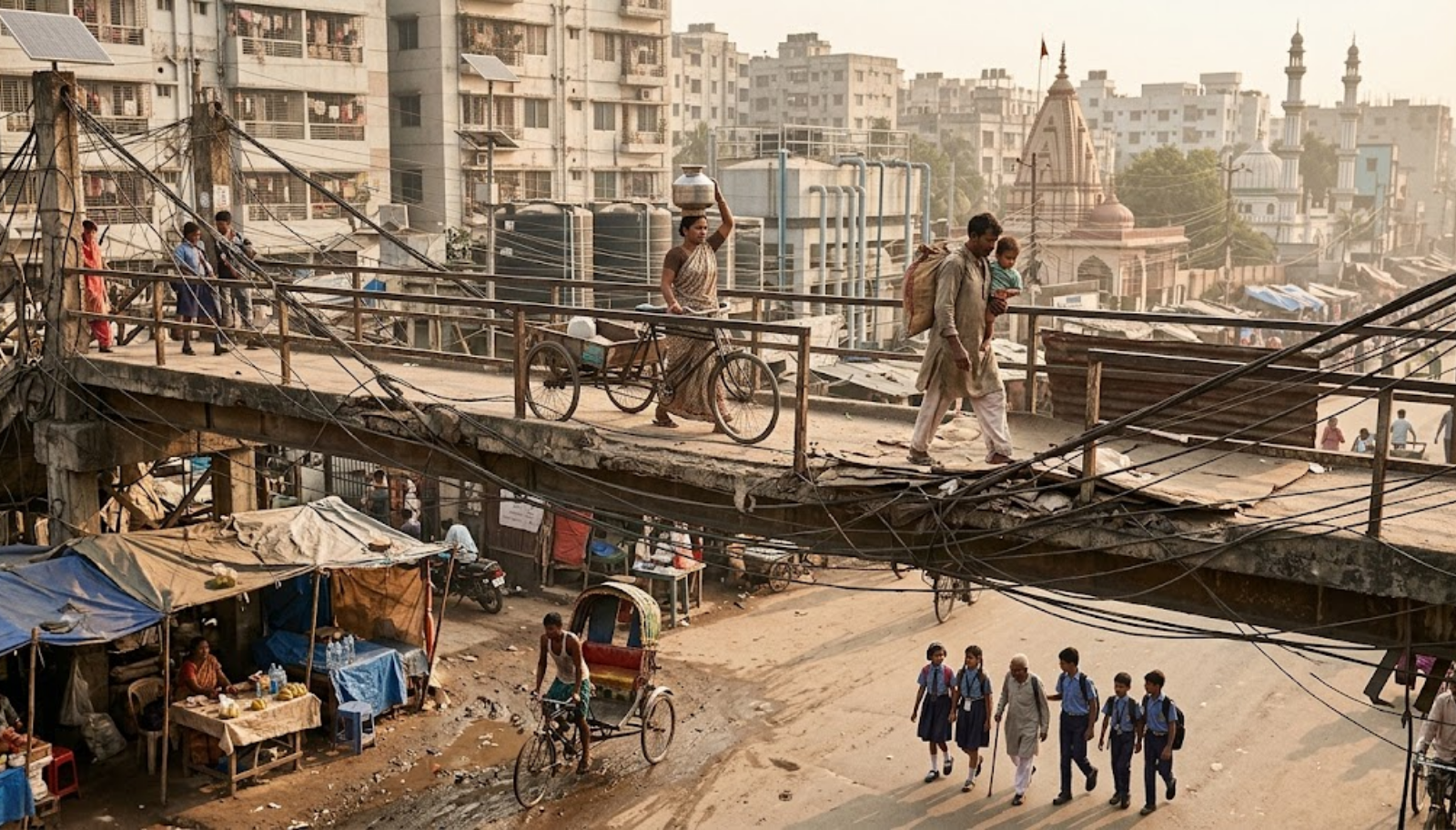
For millions of residents, Dhaka and New Delhi promise economic mobility. These massive urban centers have transformed themselves into primary drivers of regional growth, thus attracting families seeking careers, higher education for their children as well as financial security. In Dhaka alone, the population has surged past 25 million people (Onamika, 2026), while Delhi has swelled to over 35.5 million (Macrotrends, n.d.), reflecting a large-scale regional migration towards better opportunities.
Yet, beneath the cities’ booming success story, a quiet, structural crisis is underway. The very density that fuels these cities is also making them unlivable for the people who keep them running.
This is the dilemma of middle-class workers who form the backbone of the urban economy. Because they earn too much to qualify for public welfare programs, yet far too little to withstand the costs of unregulated housing and private services, they are caught in a structural trap. As these capital cities allow the cost of basic survival to skyrocket, they risk exiling the very workforce they depend on. This article analyzes the key pressures that the middle class in Dhaka and Delhi face and discusses policy measures that can help make these cities livable again.
The Housing Trap
At the core of the urban crisis in both capitals is housing, a sector with highly inelastic demand. When this meets a severely restricted supply of formal, regulated housing, it allows landlords to hold near-monopoly pricing power.
Dhaka serves as the ideal case study, where middle-class households spend up to 69% of their monthly income on rent, which is more than double the internationally accepted housing affordability benchmark of 30%. Owning a house has also become near impossible, with a standard 1,200 square-foot apartment now costing up to 6 million BGT. To make matters worse, Dhaka’s Premises Rent Control Act of 1991 is being widely ignored in practice. Tenants are forced to pay extra payments and higher rent demanded by landlords, not opposing the legalities due to the fear of getting evicted.
On the other hand, middle and working classes in New Delhi are priced out of formal housing and pushed into crowded, unregulated “unauthorized colonies,” informal urban villages, or distant satellite towns like Ghaziabad, Faridabad, and Gurugram.
Additionally, housing geography in both cities directly reflects income inequality. While elites retreat into highly secured enclaves like Delhi’s Lutyens’ or Dhaka’s Gulshan , strategically positioned near core economic, political, and cultural opportunities, the rest of the population is pushed to the margins, forcing them to pay the price in lengthy commutes, informal and drained savings.
The Privatization of Public Goods
In a functioning economy, physical safety and a clean environment are public goods that should be universally guaranteed by the state. Yet, in Dhaka and New Delhi, these basic rights have been turned into luxury commodities.
In both cities, public safety has been privatized and acts as major concerns mainly for women and children. Dhaka’s poorly lit and weakly policed neighborhoods allow less people on the streets after dark, and Delhi’s street crime intensifies in its sprawling unauthorized colonies and resettlement clusters. Wealthy residents are able to avoid these issues by hiring security guards and living in gated communities, leaving middle-class and informal renters vulnerable to unsafe conditions.
This inequality also exists in the justice system of both cities, where wealth buys opportunities to escape the law. Delhi’s elites use political influence to walk free after fatal hit-and-runs and high-profile murders. The city’s low chargesheeting rates for major offenses provide wealthy people with an adequate timeframe to seize bail and influence legal proceedings (Gahlawat, 2026). Similarly, Dhaka’s affluent commit financial fraud. In Bangladesh, over 87% of the richest evade income taxes, and corporate elites have siphoned BDT 92,000 crore through bank scams (Akter, 2025).
In addition, both capitals rank among two of the world’s most polluted. While well-off families are able purchase air purifiers and water filters, the middle class faces the dire consequences of pollution, spending most of their limited savings on expensive healthcare. When safety and a clean environment become private luxuries, they cease to be universal rights and instead, act as powerful drivers of permanent structural inequality.
Policy Solutions
To change things for the millions of residents in these cities, basic needs like clean air and safe housing must be protected as human rights rather than being viewed as luxury items.
First, both cities require enforceable rental and housing regulations. Both cities should practice inclusionary zoning to make housing more affordable. This is where developers set aside a percentage of housing units for middle and low-income households (California YIMBY, 2024). Digital tenant registration, transparent rent setting, as well as partnerships between the government and private sector to build more affordable housing options would benefit residents of both cities.
Second, investment in metro and train lines, which both capitals have already begun, must be extended to satellite cities and isolated villages where displaced populations live. Furthermore, both cities should invest in cheap buses that pick people up near their homes and drop them off directly at the main stations.
Finally, environmental issues should be prioritized rather than treated as a secondary problem. Both cities could build neighborhood depots where families trade toxic, burnable household waste for vouchers that buy free school supplies or food, keeping hazardous materials away from children while also supporting a better lifestyle. The collected waste could then be safely disposed of or recycled by officials, instead of being dumped in public places. These are incentives that can allow the populations of both cities to build themselves a cleaner future.
Dhaka and New Delhi should also work towards providing a clean and reliable water supply for its residents by turning street-food and tea vendors into decentralized water hubs. By subsidizing simple, zero-electricity gravity filters for local stalls, the city instantly creates clean water access points on every corner, while vendors get a cleaner setup in exchange for letting passersby fill up a bottle for free.
Conclusion
Ultimately, the future of both cities lies greatly in the hands of the working class. By providing them with the benefits discussed above and allowing them to reclaim their basic human rights, these cities can turn their rapid economic growth into true, shared dignity.
References
- Akter, S. (2025). White-collar crime and its legal implications in Bangladesh. [online] Lilac Education Press (LEP). Available at: https://press.lilaceducation.com/white-collar-crime/ [Accessed 22 Aug. 2026].
- Angan properties (2026). Flat price in Gulshan 2026: Updated price guide. [online] Angan.com.bd. Available at: https://angan.com.bd/flat-price-in-gulshan/ [Accessed 22 Aug. 2026].
- California YIMBY (2024). What is “inclusionary zoning”? The California YIMBY explainer – California YIMBY. [online] California YIMBY. Available at: https://cayimby.org/blog/what-is-inclusionary-zoning-the-california-yimby-explainer/ [Accessed 22 Aug. 2026].
- Gahlawat, R. (2026). Delhi tops 19 Metro cities in cognizable offences: NCRB data – the Tribune. [online] The Tribune. Available at: https://www.tribuneindia.com/news/delhi/delhi-tops-19-metro-cities-in-cognisable-offences-ncrb-data/ [Accessed 22 Aug. 2026].
- Macrotrends (n.d.). Delhi, India metro area population (1950-2026). [online] Macrotrends.net. Available at: https://www.macrotrends.net/global-metrics/cities/21228/delhi/population [Accessed 22 Aug. 2026].
- Onamika, N. (2026). Living at risk in Dhaka. [online] The Oniket Bulletin. Available at: https://bulletin.oniket.org/humanity-social-welfare-human-rights-happiness/living-at-risk-in-dhaka/editor/ [Accessed 22 Aug. 2026].
- Realty Applications (2026). 6 Indian billionaires who own crores in Lutyens’ Delhi. [online] Realtyapplications.in. Available at: https://www.realtyapplications.in/blog/6-indian-billionaires-who-own-crores-in-lutyens-delhi-109 [Accessed 22 Aug. 2026].

